

On this page
A newborn leaves the warm womb for a cooler room. An adult would shiver. A baby mostly cannot, so it switches on brown fat instead. To see why that works, compare it with ordinary white fat.
What is the difference between white fat and brown fat?
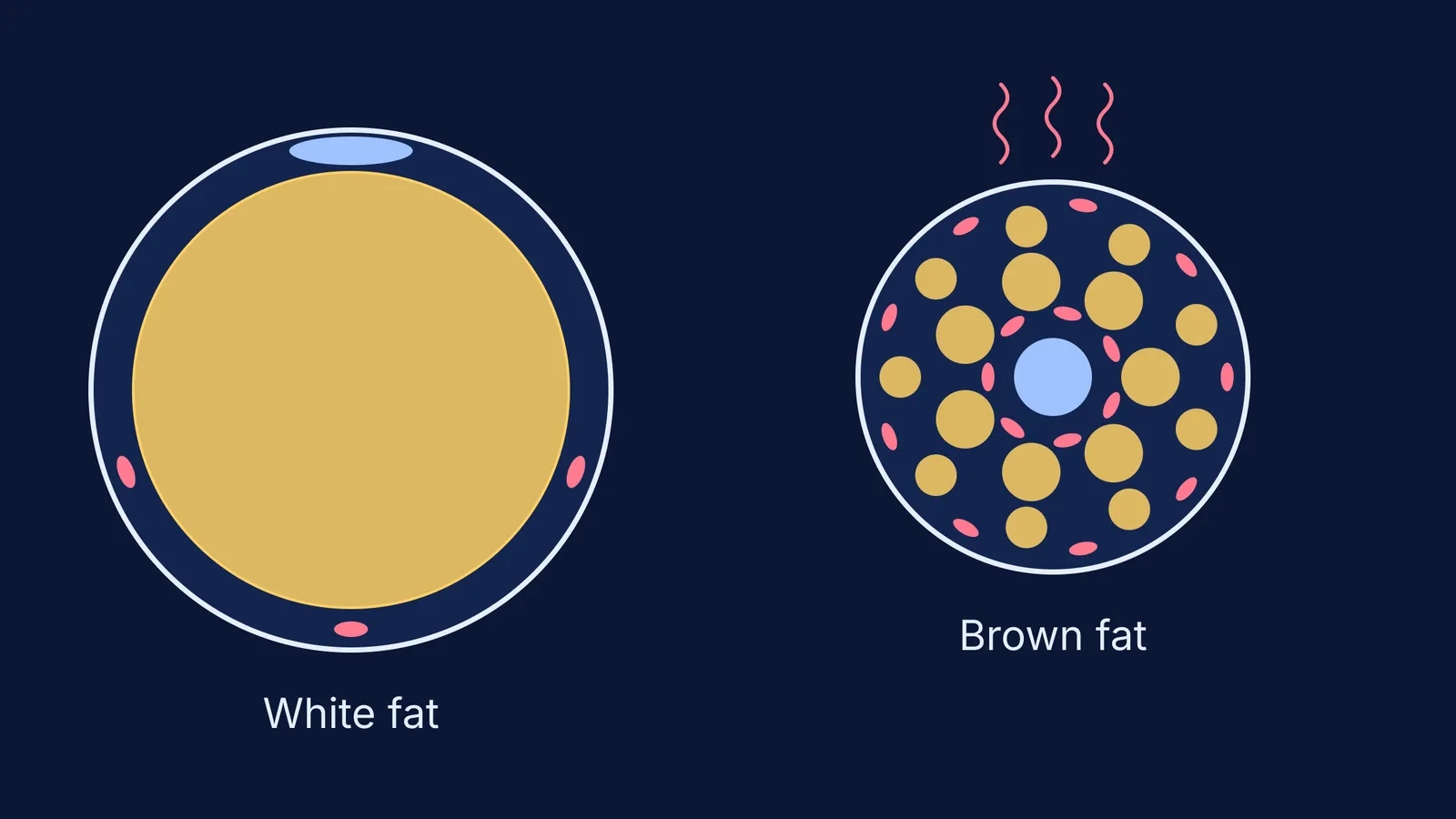
A review in Pediatric Research by Gilsanz, Hu and Kajimura puts the difference in one line: white fat cells are spherical and unilocular, while brown fat cells are usually smaller, with many lipid droplets and an abundance of mitochondria carrying uncoupling protein-1 (UCP1). The same review says white fat is the body's main site of energy storage, while brown fat stores little fat and burns it to produce heat.
Feature by feature:
Droplets: white fat has one large droplet that fills most of the cell (unilocular); brown fat has many small droplets (multilocular).
Mitochondria: white fat has relatively few; brown fat has many, densely packed with cristae.
Colour: brown fat gets its colour from those many mitochondria, and it is richly supplied with blood vessels and sympathetic nerves, according to this OpenAnesthesia review of temperature regulation in children.
Job: white fat stores fuel for later; brown fat burns fuel on the spot to make heat.
How does brown fat make heat without shivering?
Normally, the electron transport chain pumps protons across the inner mitochondrial membrane, and they flow back through ATP synthase to make ATP. For a refresher, see our post on the electron transport chain, complexes I to IV.
Brown fat adds a shortcut. The Pediatric Research review explains that UCP1 increases proton leakage across the inner membrane, releasing the energy as heat rather than ATP. Follow the chain of events:
Cold triggers sympathetic nerves to release norepinephrine onto brown fat.
Norepinephrine acts on beta-adrenergic receptors, and stored triglycerides break into free fatty acids.
Mitochondria burn the fatty acids, and the electron transport chain pumps protons.
Protons leak back through UCP1 instead of ATP synthase, so the energy comes out as heat.
A major review by Cannon and Nedergaard in Physiological Reviews describes brown fat's function as converting food energy into heat, controlled by norepinephrine from sympathetic nerves. No muscle contracts, which is why this is called nonshivering thermogenesis.
Why do newborn babies need brown fat?
A nursing textbook from OpenStax notes that the neonate is unable to shiver, and its decreased subcutaneous fat and large body surface-to-weight ratio increase heat transfer to the skin, so newborns rely on nonshivering thermogenesis from brown fat. The OpenAnesthesia review adds that the ability to shiver is limited in infants younger than 3 months, while nonshivering thermogenesis is possible within a few hours of birth.
The same review says brown fat develops in the fetus between roughly 20 and 30 weeks of gestation and makes up only 2-6% of an infant's body weight. It sits between the shoulder blades, around blood vessels in the neck, in the armpits, in the chest, and around the kidneys and adrenal glands. The Pediatric Research review notes that brown fat abundance peaks at birth and declines over the next 9 months.
Worked example: a 3 kg full-term baby with brown fat at 2-6% of body weight carries 0.02 x 3000 g = 60 g to 0.06 x 3000 g = 180 g of it.
Timing explains why premature babies struggle. A technical brief from USAID's Every Preemie–SCALE project, hosted on WHO's website, notes that low birth weight and premature babies lack an adequate supply of brown fat, which develops in the last weeks of pregnancy. Our explainer on why a premature baby in a warm incubator can still lose heat covers the physics side.
What do hospitals do to keep newborns warm?
The same brief defines the safe range: newborn thermal stability means a body temperature of 36.5-37.4°C, and neonatal hypothermia is a temperature below 36.5°C. For care in health facilities, it describes a 10-step "warm chain" that includes:
A warm delivery room of at least 25°C.
Drying the baby immediately after delivery.
Skin-to-skin contact on the mother's chest, covered by a dry, warmed cloth.
Starting breastfeeding within an hour of birth.
Waiting at least 24 hours before the first bath.
A cap, because as much as 25% of a newborn's heat loss can occur from an uncovered head.
Keeping mother and baby together.
If you are ever worried about a baby's temperature, ask a doctor or nurse.
How can you remember brown fat vs white fat for exams?
Use three words: one, few, store for white fat; many, many, burn for brown fat (droplets, mitochondria, job). Then contrast it with shivering, where muscle makes the heat, as our post on why we shiver and how the body's thermostat works explains.
If proton gradients still feel shaky, the Fermi Concept Library has a lesson for every concept in biology and chemistry. If a thermogenin question trips you up, Fermi's AI tutor can work out what you already know and build a plan for the session.


