

On this page
Once a virus lands on a door handle, a phone or a steel tiffin box, it cannot multiply; it can only slowly fall apart. How fast depends on the virus and the surface, and a half-life turns that into a number you can calculate with.
What is fomite spread?
A fomite is a contaminated surface or object that passes a virus between people, as the US CDC's science brief on surface transmission describes: an ill person coughs or sneezes onto a surface, someone touches it, then touches their mouth, nose or eyes.
Every link loses virus, so survival time is not the same as risk. For SARS-CoV-2, studies summarised in the CDC brief found that each contact with a contaminated surface generally has less than a 1 in 10,000 chance of causing an infection, and the brief lists consistent hand hygiene among the ways to lower the risk further.
How long do viruses survive on surfaces?
A widely cited measurement is a 2020 letter in the New England Journal of Medicine by Neeltje van Doremalen and colleagues, who put SARS-CoV-2 onto different materials and tracked how much stayed infectious (NEJM, 2020; full text). Their results:
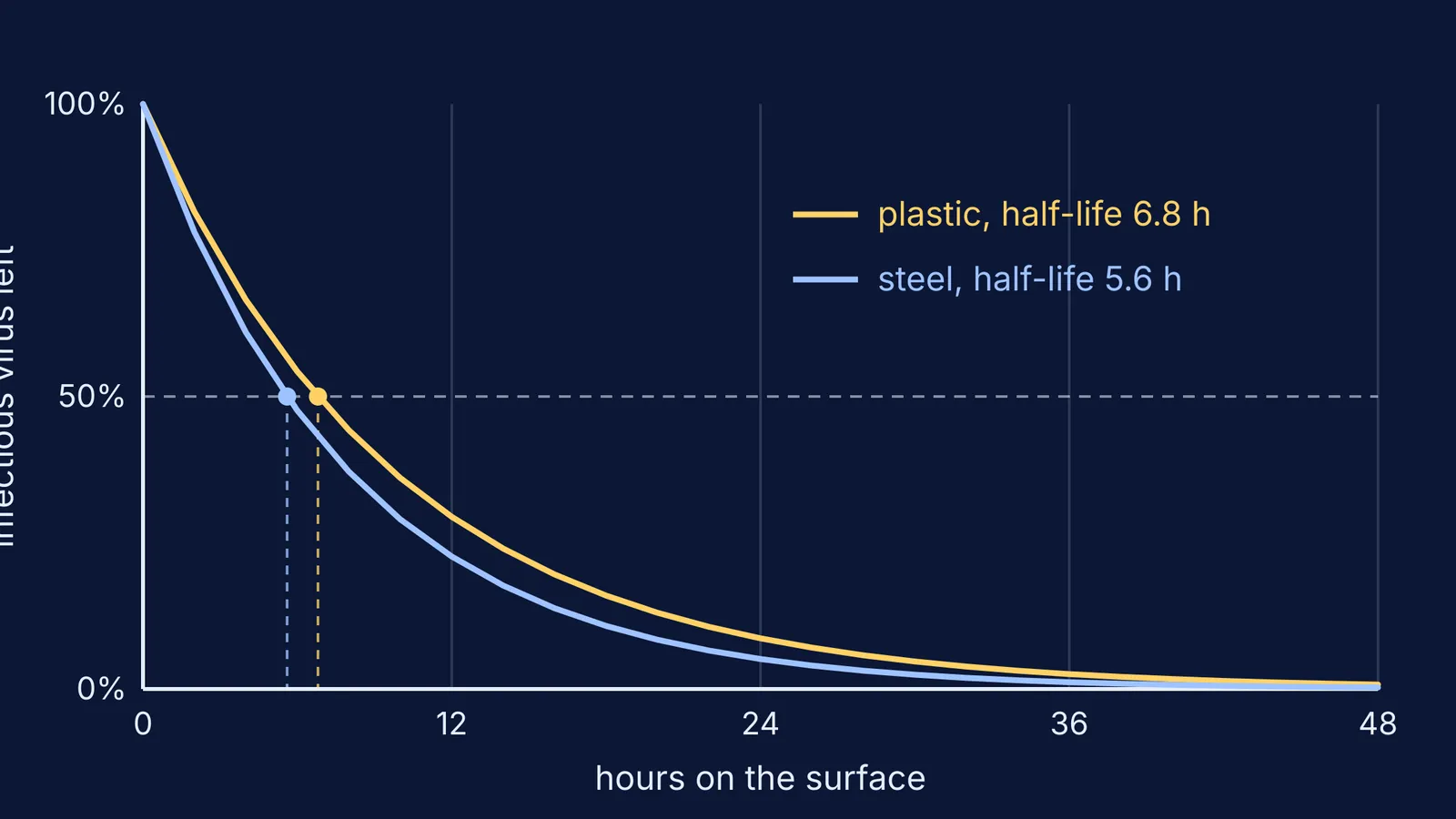
Plastic: median half-life about 6.8 hours, with viable virus detected up to 72 hours.
Stainless steel: median half-life about 5.6 hours, also with viable virus detected up to 72 hours.
Copper: no viable virus after 4 hours.
Cardboard: no viable virus after 24 hours.
A 2006 systematic review by Axel Kramer, Ingeborg Schwebke and Günter Kampf pooled surface-survival studies for many viruses (BMC Infectious Diseases, 2006). Most respiratory viruses persisted for a few days. In their table, influenza lasted 1 to 2 days, while rotavirus lasted 6 to 60 days and adenovirus 7 days to 3 months. The ranges are wide because labs use different surfaces, temperatures and starting amounts of virus.
Why do enveloped viruses die faster than non-enveloped ones?
An enveloped virus keeps its genetic material inside an outer layer of proteins and lipids, as the CDC brief explains for SARS-CoV-2. The brief says this envelope can degrade quickly on contact with surfactants in cleaning agents and under environmental conditions such as heat and evaporation. A non-enveloped virus has no such layer to lose.
A 2015 study by Swan Firquet and colleagues dried both kinds on the same plastic at room temperature (Microbes and Environments, 2015). Influenza A (H1N1) and herpes simplex virus type 1, both enveloped, were inactivated within 5 and 3 days. The non-enveloped coxsackievirus B4 lasted 6 weeks, and minute virus of mice was still infectious when the experiment ended (full text).
How do you turn a half-life into a decay curve?
A half-life assumes exponential decay, as in a radioactive sample. If N0 is the starting amount and T is the half-life, the amount left after t hours is N(t) = N0 × (1/2)^(t/T).
Worked example, using the plastic half-life of 6.8 hours from the NEJM study:
After 6.8 hours, half is left: 50%.
After 24 hours: 24 ÷ 6.8 ≈ 3.53 half-lives, and (1/2)^3.53 ≈ 0.087, so about 9% is left.
After 48 hours: 7.06 half-lives, so about 0.75% is left.
Time for a 99% drop: set (1/2)^(t/6.8) = 0.01, so t = 6.8 × log2(100) ≈ 6.8 × 6.64 ≈ 45 hours. For steel, 5.6 × 6.64 ≈ 37 hours.
That fits the CDC brief, which expects a 99% reduction in infectious SARS-CoV-2 within 3 days on common non-porous surfaces such as stainless steel, plastic and glass. It also fits the raw data: on plastic, the study's titre fell from 10^3.7 to 10^0.6 over 72 hours, about 1/1,260 left, while the formula predicts about 1/1,540.
To draw it yourself:
Tabulate t = 0, 6.8, 13.6 and 20.4 hours, halving the amount each step.
On ordinary axes, the curve drops steeply, then flattens towards zero without touching it.
Plot ln N against t and you get a straight line with slope −ln2 ÷ T, about −0.10 per hour for plastic; our guide to reading an ln A vs t graph uses the same method for radioactive samples.
Add steel on the same axes and compare where each line crosses 50%.
Exponential change is easier to see than to read, which is what the interactive simulations in the Fermi Simulation Lab are for.
What should you do with this at home or school?
Wash your hands before eating and after touching shared surfaces; that breaks the last link. Our explainer on how long to wash hands to remove germs covers the timing.
For SARS-CoV-2 in community settings, the CDC brief says cleaning with soap or detergent, not disinfecting, is enough in most situations.
That advice is specific to SARS-CoV-2; tougher non-enveloped germs can need different cleaning, so follow local health guidance if someone at home is ill.
Viruses and bacteria behave differently; our bacteria vs virus difference table sets out how.
If envelope, half-life or decay constant still feel fuzzy, the Fermi Concept Library has a lesson for every concept in physics, chemistry, biology, mathematics and computing.
Next time you read a survival claim, ask for the half-life and the surface, then work out the 99% time yourself.


