

On this page
Washing your hands is the simplest and most effective way to stay healthy, especially during exam season when a single sick day can disrupt your carefully planned study routine. We all know we should do it, but the specific details matter. Exactly how long do you need to scrub, and does skipping the soap really make a big difference? Let's look at what the research says about the physics and biology of handwashing, so you can build a reliable daily habit.
How long to wash hands to remove germs?
The standard advice from health authorities is often to wash for at least 20 seconds. However, empirical research shows that a significant drop in bacteria actually happens much sooner than that. A 2017 study by researchers at Rutgers University found that lathering hands for 10 seconds is highly effective at removing *Escherichia coli* bacteria source.
In the study, increasing the lather time from 10 seconds to 20 seconds did not remove significantly more bacteria in most of the test conditions. This means the initial friction does the heavy lifting. However, the Centres for Disease Control and Prevention (CDC) continues to recommend a full 20 seconds source. This extra time acts as a safety margin for the general public, ensuring you scrub all parts of your hands, including the backs of your fingers and under your nails, where germs often hide. The extra 10 seconds compensates for imperfect washing techniques.
If you are curious about how other common methods compare in the fight against pathogens, we have previously covered how alcohol-based hand sanitiser kills germs and when it is best used as a backup.
Does water temperature matter for handwashing?
Many people intuitively believe that hot water is necessary to kill or remove germs effectively. However, the same Rutgers University study concluded that water temperature does not matter for removing bacteria during handwashing source.
The researchers tested handwashing with water at 15 °C (60 °F), 26 °C (79 °F), and 38 °C (100 °F), finding no significant difference in how effectively the bacteria were washed away across the different temperatures source. The mechanical friction of rubbing your hands together and the chemical action of the soap are what remove the pathogens, not the heat. Using comfortable, lukewarm or cool water is just as effective, is kinder to your skin, and saves significant energy over time.
Soap versus water alone: what the data shows
What happens if you are in a rush and only use water without lathering up? A 2011 study published in the *International Journal of Environmental Research and Public Health* tested this exact scenario by having volunteers deliberately touch public surfaces and then washing their hands in different ways source.
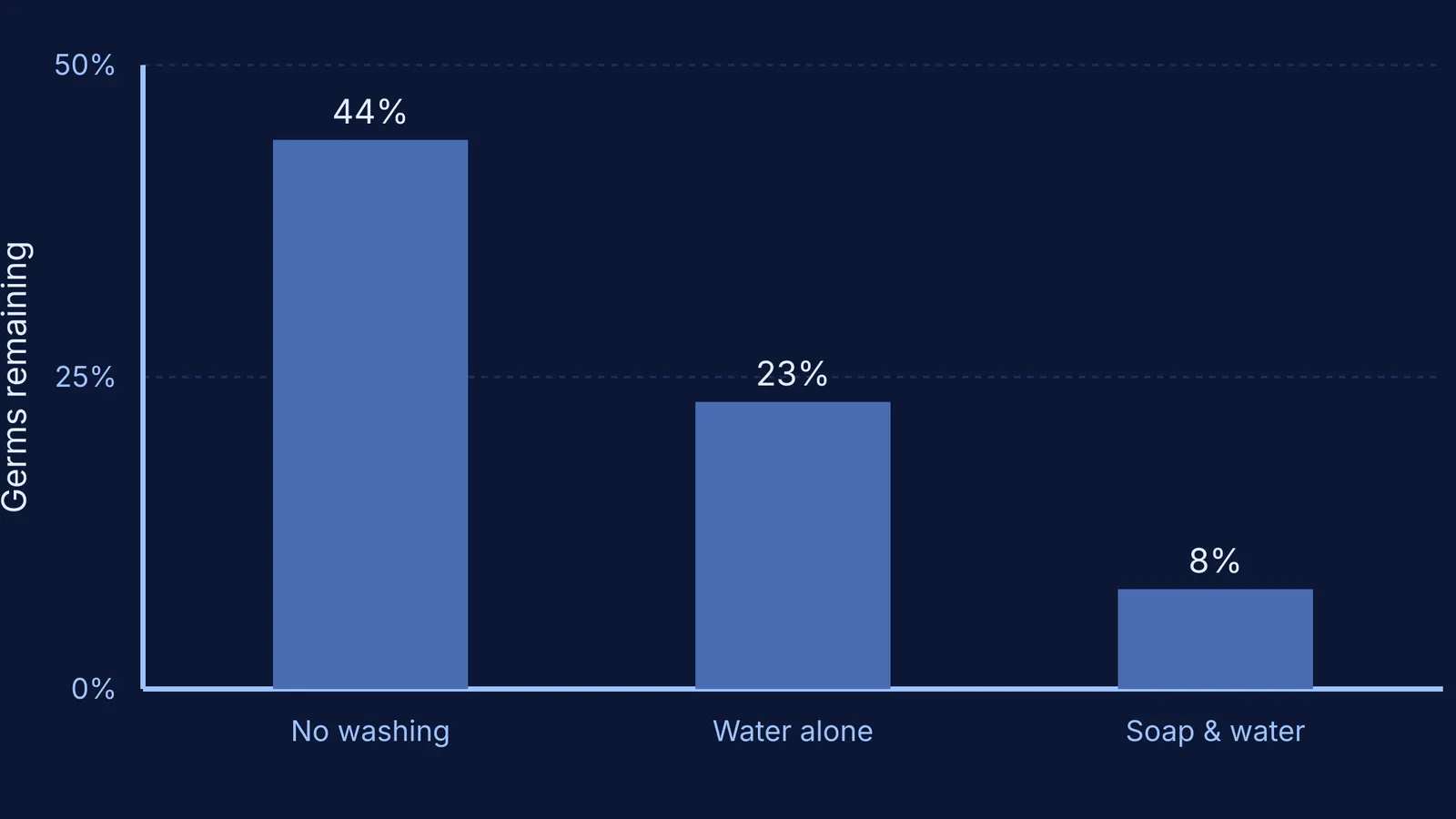
The results were clear. Handwashing with plain soap and water reduced the presence of bacteria to 8% source. Washing with water alone reduced the presence of bacteria to 23% source. By comparison, when the volunteers did not wash their hands at all, bacteria were found in 44% of the samples source.
Soap is highly effective because it contains surfactants, which are molecules engineered with a water-loving (hydrophilic) head and an oil-loving (lipophilic) tail. These unique molecules attach to dirt, natural skin oils, and the lipid membranes of bacteria and viruses, pulling them off the skin so they can be easily rinsed away down the drain. If you find it hard to picture how molecules and forces interact in a dynamic system, you can test different physics and chemistry scenarios in the Fermi Simulation Lab. Seeing a concept in action often helps it stick in your memory much better than simply reading it in a textbook.
A practical handwashing experiment
While you cannot easily count microscopic bacteria at home, you can observe the mechanics of soap and water in action through a simple physics and chemistry experiment.
Rub a small amount of ordinary cooking oil on your hands.
Try washing it off with cold water alone for 10 seconds. You will notice that your hands still feel greasy, and the water simply runs off the oil.
Now add a pump of regular hand soap and lather for 10 seconds. The grease will quickly break down and wash away easily.
This happens because the oil and water naturally do not mix, but the soap acts as a chemical bridge between them. If you are learning about the complex mechanisms of surfactants for a chemistry exam and feel stuck, Fermi's AI tutor can explain the underlying concepts step by step. Understanding the reasoning behind the reaction is always a better strategy than just memorising the rule.
Building good, evidence-based hygiene habits keeps you healthy and ready to focus on your learning. It is an active part of protecting yourself, working alongside your body's natural defences like why we sneeze when dust enters the nose. For any severe skin issues or persistent illnesses, always consult a healthcare professional.


