

On this page
Outside it is −30 °C. Inside a snow house, the air around the people can sit a little above 0 °C. Inuit have long built these shelters for travel and winter living; the study we use spells them iglus. Two pieces of physics make them work: snow is a poor conductor of heat, and something inside keeps adding heat. This post puts numbers on both, and shows a limit most textbook explanations leave out.
Why is snow a good insulator?
Snow is mostly air. Snow blocks in a field study at Resolute, in the Canadian High Arctic, had a mean density of about 400 kg/m³ (Kershaw, Scott and Welch, Arctic, 1996). Solid ice is about 917 kg/m³, so about 1 − 400/917 = 56% of a block's volume is air.
Still air conducts heat very poorly, about 0.023 W m⁻¹ K⁻¹. Ice conducts about a hundred times better, roughly 2.2 W m⁻¹ K⁻¹. Heat has to cross a tangled path of thin ice links with air pockets in between, so snow ends up much closer to air than to ice. Measured values vary a lot. A review of 27 studies found roughly a tenfold spread at any one density, depending on grain type and bonding (Sturm and others, Journal of Glaciology, 1997). Refrozen-grain snow at 314 to 496 kg/m³ measured 0.095 to 0.250 W m⁻¹ K⁻¹ (summary in Smith and Jamieson, ISSW 2014). In this post we take k ≈ 0.2 W m⁻¹ K⁻¹ as a round illustrative value inside that range.
The same air-filled structure is why snow looks white while ice is clear, a different effect covered in why snow looks white when ice is clear.
How much heat leaks through an igloo wall? A worked example
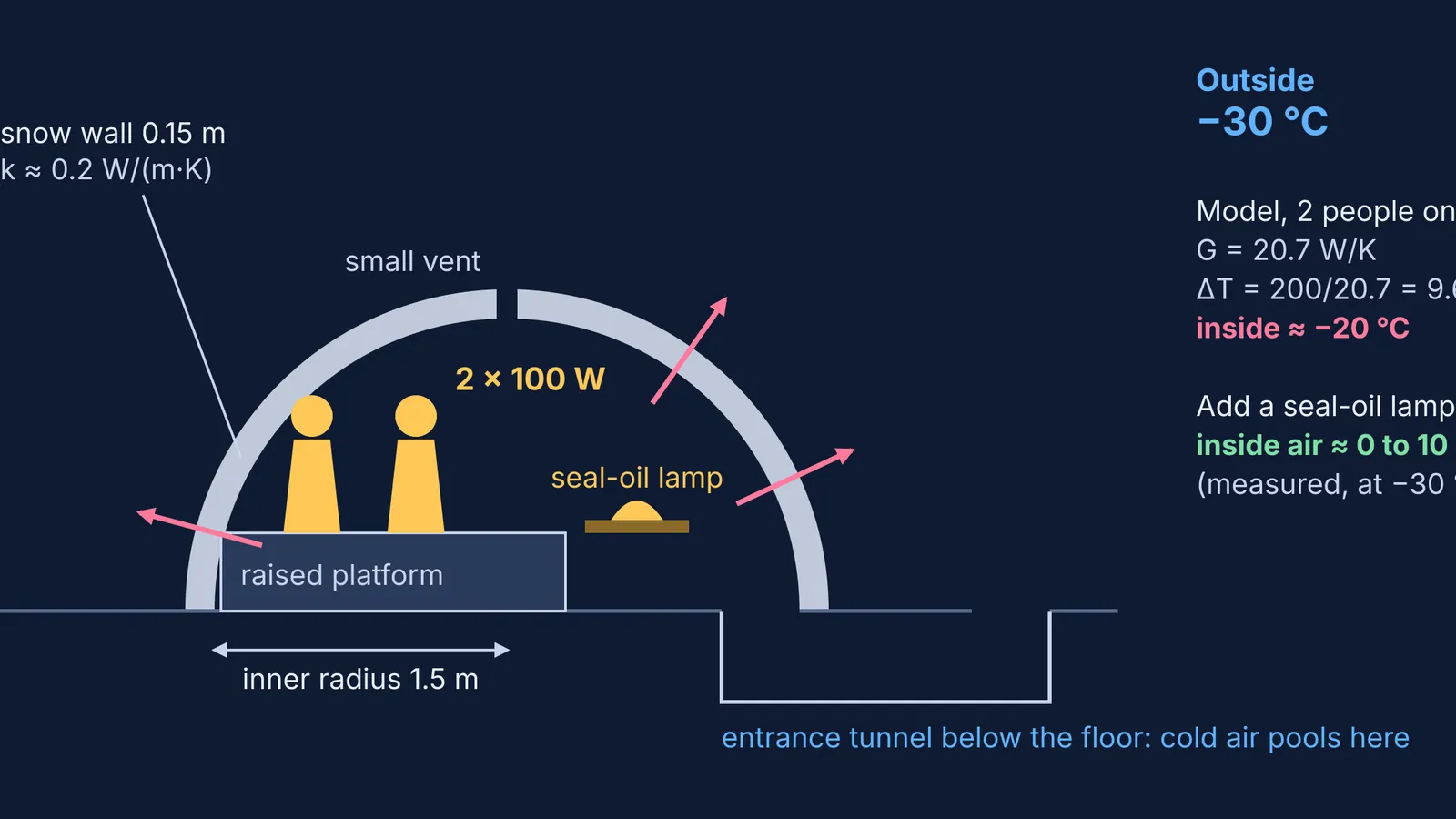
Model the snow house as a hemispherical shell. The inner radius is r₁ = 1.5 m, close to the 3.05 m diameter of the smaller Resolute iglu. The blocks there averaged 14.7 cm thick, so take a wall of 0.15 m, which gives r₂ = 1.65 m. Two adults sit inside. A resting adult gives off roughly 100 W, a round illustrative value. (Kershaw and colleagues take an active person's daily food energy as about 12,560 kJ, which averages 12,560,000 / 86,400 = 145 W, so 100 W at rest is reasonable.)
Conductance of a hemispherical shell. Add thin shells in series: each has resistance dr / (k × 2πr²). Integrating from r₁ to r₂ gives G = 2πk·r₁r₂ / (r₂ − r₁).
Substitute. G = 2π × 0.2 × 1.5 × 1.65 / 0.15 = 20.7 W/K.
Check with a flat wall. G ≈ kA/L with A = 2πr₁r₂ = 15.6 m² gives 0.2 × 15.6 / 0.15 = 20.7 W/K. For a thin wall the two agree.
Steady state. Heat in = heat out, so P = G·ΔT, and ΔT = 200 / 20.7 = 9.6 K.
Result. With −30 °C outside, two people alone hold the inside at about −20 °C.
Add air leakage. The inside volume is (2/3)π(1.5)³ = 7.1 m³. One air change per hour carries away ρcV / 3600 = 1.39 × 1005 × 7.1 / 3600 = 2.7 W/K more, so ΔT drops to 200 / (20.7 + 2.7) = 8.5 K.
Units. W m⁻¹ K⁻¹ × m² / m = W/K, and W ÷ (W/K) = K.
Body heat alone does not get you to 0 °C. That matches the field study: body heat supplied only 8% to 14% of the heat the Resolute iglus needed. The rest came from the kudlik, a seal-oil lamp. The small iglu burned about 2.3 kg of seal fat a day. At the paper's 39.56 kJ per gram, that is 2,300 × 39,560 / 86,400 ≈ 1,050 W on average, five times what two people give.
Thicker walls help a lot. With 0.40 m walls (r₂ = 1.9 m), the same k gives G = 9.0 W/K, and two people alone would hold a 22 K rise. Real blocks are thinner because they must be cut and lifted by hand; the larger Resolute iglu used 72 blocks averaging about 24 kg each.
Why can't an igloo get much warmer than 0 °C inside?
Because the inner surface of the wall is snow, and snow melts at 0 °C. Run the model with the lamp lit: 1,250 W ÷ 20.7 W/K gives ΔT = 60 K, which would put the inside at +30 °C. That cannot happen. Once the inner wall reaches 0 °C, the most heat that can conduct out through the wall is G × 30 K = 20.7 × 30 ≈ 620 W. Any extra heat that reaches the wall melts it. The meltwater soaks in and refreezes into a glaze of ice, which conducts better than snow. The Resolute study found that block density increased with use, and noted that the insulating value may decline the longer an iglu is used.
The air in the middle can still be warmer than the wall, because a layer of still air clings to the surface. The study quotes Mathiassen's 1928 record of a small, skin-lined iglu with two lamps at −30 °C outside: about 5 °C on the sleeping platform and about 10 °C in the middle of the chamber. Hanging caribou skins inside kept warm air off the snow; in the Resolute test the chamber averaged about 3 °C warmer than the air behind the skins.
Why is the entrance lower than the floor?
Cold air is denser, so it sinks. A tunnel entrance that dips below the floor acts as a cold trap: cold air collects in the tunnel and does not flow up into the living space, while warm air stays high. That is why people sleep on a raised platform. In the same 1928 record, the door well was about 0.5 °C while the platform was about 5 °C. A small vent near the top lets stale, moist air out, at the cost of the extra heat loss worked out above.
Two other details matter. Real iglus are not hemispheres. The study points out that a hemisphere would tend to spread outward and fail, and that the real shape is closer to an inverted paraboloid or catenoid, with forces getting more compressive towards the base. The walls also shelter the people from wind chill.
Keeping heat in with poor conductors is the same physics as why ice is packed in sawdust to keep it from melting, run in reverse. Sharing body heat to cut losses, without a shelter, is covered in why penguins huddle in the cold.
If heat flow is easier to picture than to read about, the Simulation Lab has interactive simulations for ideas easier to see than read.
Quick checklist
Snow at about 400 kg/m³ is over half air, so its k is low: about 0.1 to 0.25 W m⁻¹ K⁻¹.
Hemispherical shell: G = 2πk·r₁r₂ / (r₂ − r₁); steady state ΔT = P / G.
15 cm walls, k = 0.2, two people (200 W): ΔT ≈ 9.6 K. Body heat alone is not enough.
A seal-oil lamp supplies most of the heat in a lived-in iglu.
The inner wall cannot stay above 0 °C; extra heat melts it into an ice glaze.
The low entrance traps cold air; people sleep on a raised platform.


