On this page
In the middle of the Antarctic winter, male emperor penguins stand on the sea ice for weeks, each balancing an egg on his feet, without eating. The Australian Antarctic Division says only the males incubate, colonies face blizzards of up to 200 km/h, and huddling cuts heat loss by as much as 50%. Their answer is geometry.
Why do penguins huddle together in the cold?
A warm body loses heat through its surface. A lone penguin has every side facing the wind; in a crowd, most of that surface touches another warm penguin instead.
A 2008 review by Caroline Gilbert and colleagues in the Journal of Experimental Biology worked out where the savings come from. Birds held in small groups of 5 to 10, where they could not huddle effectively, had a metabolic rate 39% lower than birds kept alone. Birds free to move and huddle used on average 21% less energy again. About two thirds of the saving from huddling came from less cold-exposed body surface, and one third from the mild air inside the group.
That air really is mild. Data loggers on eight emperors in a 2006 study in Physiology & Behavior showed that males huddled for 38% of their time on average across the breeding season. Huddling raised the air temperature around them above 0 °C when the average outside was −17 °C, and at times up to 37.5 °C, close to their own body temperature. Each huddling bout was short, about 1.6 hours on average.
What does surface area to volume have to do with it?
A body makes heat throughout its volume but loses it through its surface, so the surface-to-volume ratio decides how fast it cools.
For a sphere of radius r, the surface area is 4πr² and the volume is (4/3)πr³, so the surface-to-volume ratio is 3/r. Double the radius and each unit of body has half as much surface to lose heat through. That is why a small sphere cools faster than a big one and why cells stay small.
Penguins cannot grow bigger, but a huddle lets them act like one much larger body, with far less outside per bird.
Worked example: how many penguins are on the edge?
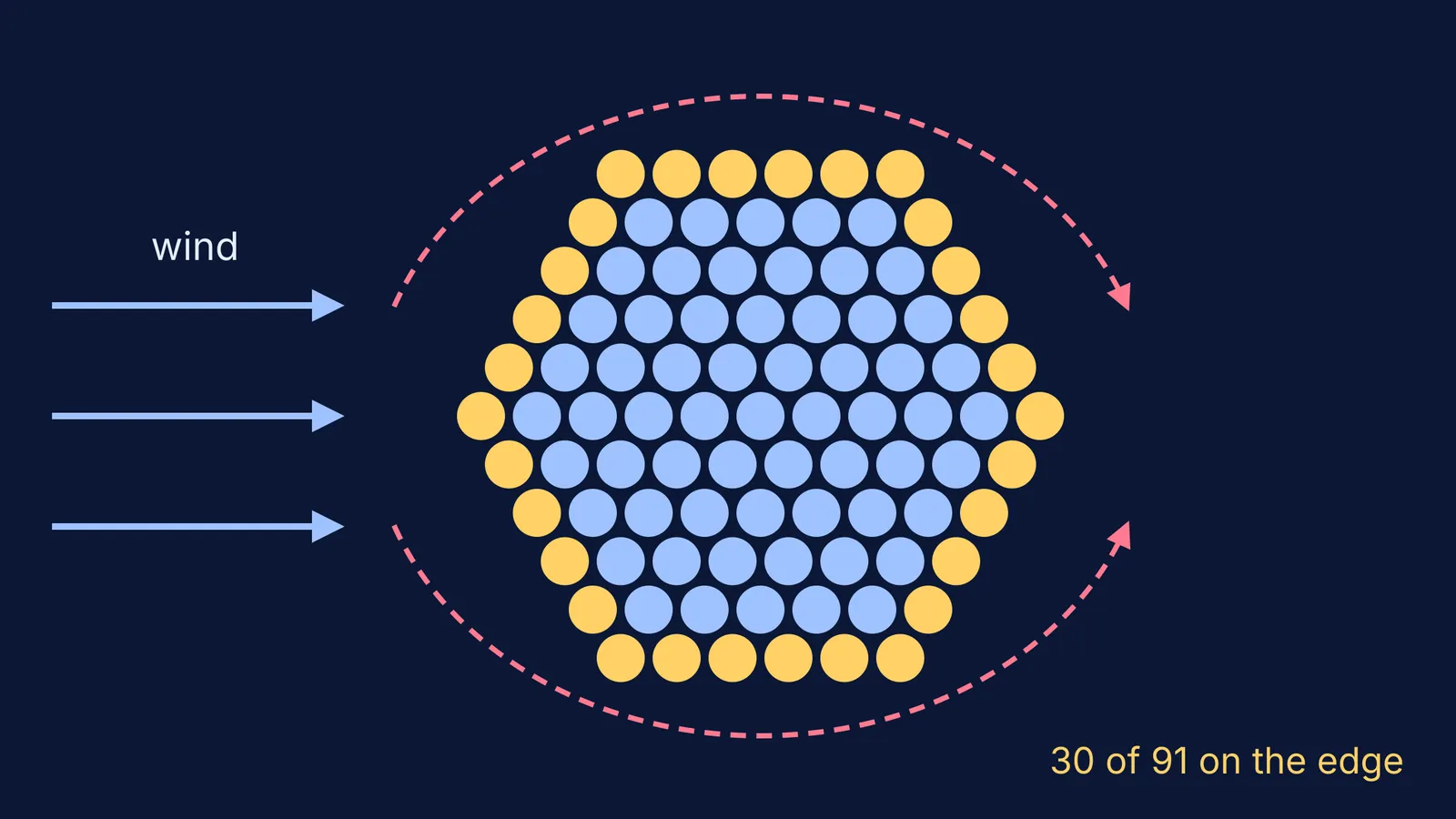
Seen from above, treat each penguin as a coin on a hexagonal grid, the tightest packing. Real huddles are packed very tightly: Zitterbart and colleagues measured about 21 penguins per square metre. Build a hexagonal huddle with one penguin in the centre and k rings around it. It holds N = 3k(k + 1) + 1 penguins, and only the outer ring of 6k birds faces the wind.
k = 1: 7 penguins, 6 on the edge (86%)
k = 3: 37 penguins, 18 on the edge (49%)
k = 5: 91 penguins, 30 on the edge (33%)
k = 10: 331 penguins, 60 on the edge (18%)
k = 20: 1,261 penguins, 120 on the edge (under 10%)
The edge grows like k while the crowd grows like k², so the fraction outside falls roughly as 2/k. This is the surface-to-volume rule in two dimensions: perimeter over area.
How do penguins take turns at the cold edge?
Zitterbart's team filmed huddles as the air cooled from −33 to −43 °C (PLOS ONE, 2011). Every 30 to 60 seconds, the penguins took small steps of 5 to 10 cm that passed through the huddle as a wave at about 12 cm/s. Over time these small steps reorganised the whole group, giving each penguin a chance to spend time inside rather than only on the edge.
A mathematical model by Waters, Blanchette and Kim gave each simulated penguin one rule: reduce your own heat loss. Birds on the windward edge walked round to sheltered spots downwind, while birds in the middle stayed put. The huddle slowly crept downwind, and every penguin ended up with roughly equal access to the warmth. Nobody had to organise it.
How can you use this idea in exams?
Surface area to volume comes up in physics cooling, biology (cells, lungs, adaptations) and maths scaling questions. Use this check:
Ask where heat or material is made or stored (the volume) and where it is exchanged (the surface).
Write the scaling: area grows as L², volume as L³, so area divided by volume goes as 1/L.
Decide which way the living thing or object needs to go: compact to keep heat, like a huddle, or spread out to lose it, like an elephant's large ears.
If the ratio still feels slippery, the Fermi Concept Library gives each concept in physics, chemistry, biology, mathematics and computing its own lesson and its place in the map. For practice, the Fermi Problem Library has worked problems with a step-by-step solver that explains the reasoning rather than printing an answer.
Next time people at a cold Delhi bus stop drift closer together, you are watching the same geometry.