On this page
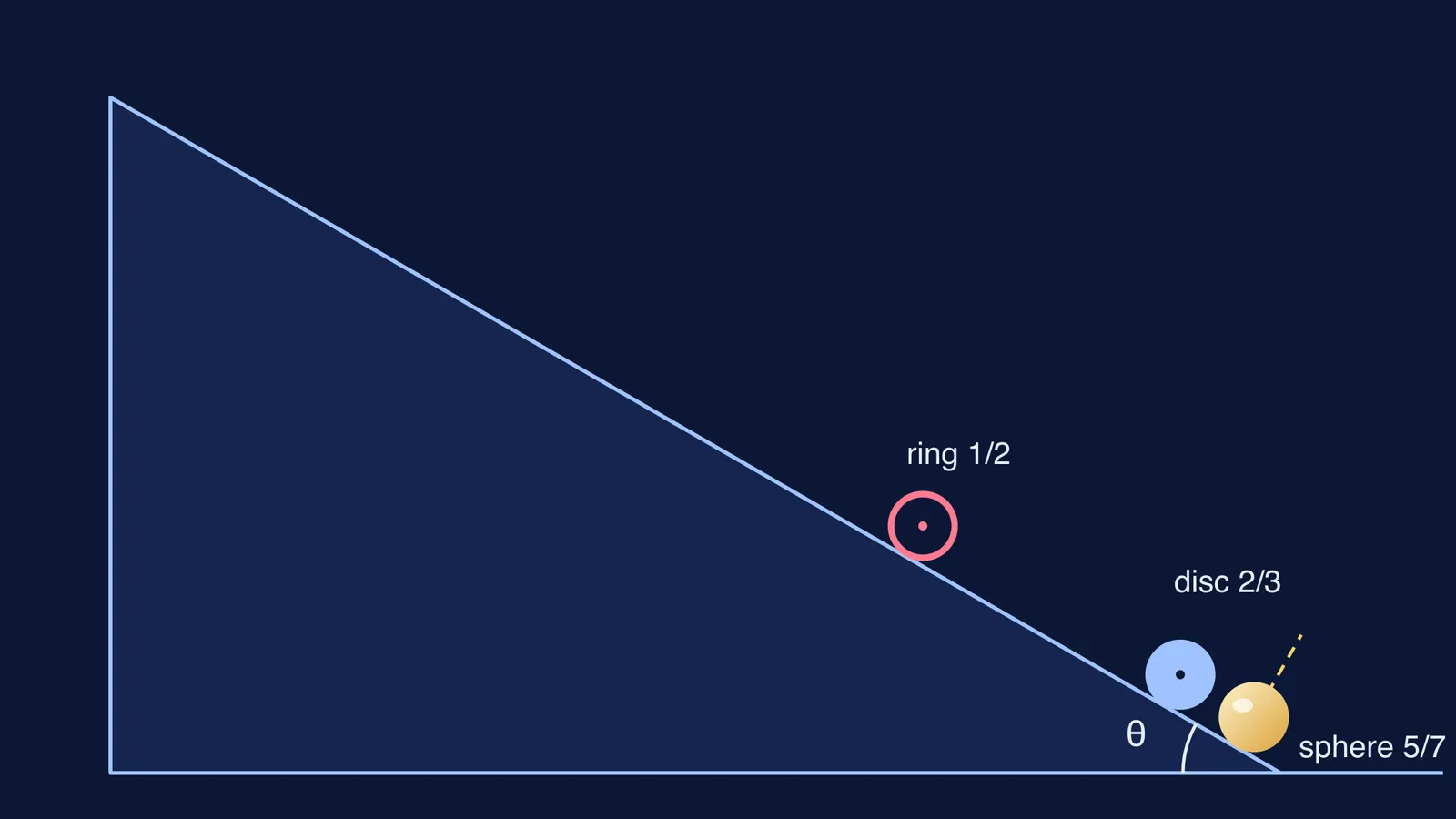
Put a ring, a disc and a solid sphere at the top of the same slope and let them go together, all rolling without slipping. The order at the bottom never changes: solid sphere first, disc second, ring last. The physics department at UC Santa Barbara runs this race as a lecture demonstration with a sphere, disc and hoop set, and explains the result as independent of mass but dependent on how the mass is spread out (UCSB lecture demonstration 28.27).
Why does the solid sphere reach the bottom first?
A rolling body has to use the same gravity for two jobs: moving forward and spinning. Whatever goes into spin is not available for forward speed.
Applying Newton's second law to translation and rotation together, the acceleration of a body rolling without slipping down an incline of angle θ is a = g sin θ / (1 + I/mR²) (OpenStax University Physics, section 11.1). Writing the moment of inertia as I = mk², where k is the radius of gyration, gives a = g sin θ / (1 + k²/R²).
So the whole race comes down to k²/R²: how far the mass sits from the axis, compared with the radius. Using the standard moments of inertia (OpenStax University Physics, Figure 10.20):
Ring (hoop) about its own axis: I = MR², so k²/R² = 1 and a = (1/2) g sin θ.
Disc (solid cylinder) about its axis: I = MR²/2, so k²/R² = 1/2 and a = (2/3) g sin θ.
Thin hollow sphere: I = 2MR²/3, so k²/R² = 2/3 and a = (3/5) g sin θ.
Solid sphere about a diameter: I = 2MR²/5, so k²/R² = 2/5 and a = (5/7) g sin θ.
The ring keeps all its mass at the rim, so it has the largest k²/R² and the smallest acceleration. The solid sphere keeps most of its mass near the centre, so it wins.
The same story in energy terms: at the bottom, Mgh = (1/2)Mv² + (1/2)Iω² (UCSB lecture demonstration 28.27). The share of kinetic energy locked up in spin works out to (k²/R²)/(1 + k²/R²): 2/7 for the solid sphere, 1/3 for the disc and 1/2 for the ring.
Does mass or radius change which one wins?
No. Mass does not appear in a = g sin θ / (1 + k²/R²), and k²/R² is a pure number set by shape alone. A heavy iron ring still loses to a light glass marble, and a large disc ties with a small disc. The larger UCSB demonstration races three cylinders of equal mass and diameter (one with a copper core, a uniform disc and a hoop), so that only the mass distribution differs; its sphere, disc and hoop set uses bodies of the same radius (UCSB lecture demonstration 28.27).
Two conditions matter. First, static friction must be enough to prevent slipping, since it supplies the torque that spins the body (OpenStax University Physics, section 11.1); our post on minimum friction for pure rolling on an incline, shape by shape works out how much. Second, if the question says the incline is smooth, nothing can start spinning: every body slides with a = g sin θ and they all tie.
How far apart do they finish? A worked example
Take a 2.0 m incline at θ = 30° with g = 9.8 m/s², so g sin θ = 4.9 m/s². Each body starts from rest, so the time is t = √(2L/a) and the speed at the bottom is v = √(2aL).
Solid sphere: a = (5/7)(4.9) = 3.5 m/s², so t ≈ 1.07 s and v ≈ 3.74 m/s.
Disc: a = (2/3)(4.9) ≈ 3.27 m/s², so t ≈ 1.11 s and v ≈ 3.61 m/s.
Ring: a = (1/2)(4.9) = 2.45 m/s², so t ≈ 1.28 s and v ≈ 3.13 m/s.
The sphere beats the disc by about 0.04 s but the ring by about 0.21 s. Since time scales as √(1 + k²/R²), t(ring)/t(sphere) = √(2/1.4) ≈ 1.20. At the moment the sphere crosses the line, the disc has covered 14/15 of the slope and the ring only 7/10, which is what the diagram at the top shows.
Where do students lose marks on rolling-race questions?
Right axis. A rolling ring spins about its own axis, so use MR², not MR²/2 (that is the ring about a diameter).
Solid or hollow? A solid sphere is 2/5; a hollow sphere is 2/3 and finishes behind the disc.
Mass is a distractor. Different masses in the question are there to test whether you know they cancel.
Rough or smooth? Rolling needs friction. On a smooth incline the bodies slide and tie.
Speed ranking matches time ranking. v = √(2gh / (1 + k²/R²)), so the sphere is also fastest at the bottom.
If you get the order right but the numbers wrong, the Fermi Problem Library has worked problems with a step-by-step solver that explains the reasoning rather than printing an answer, so you can see which line slipped.
Next, try the same body from a different angle: angular momentum of a rolling disc about the contact point, or when a sliding ball starts pure rolling.