

On this page
Elephants are defined by their unique anatomy. The trunk is a fusion of the nose and upper lip, acting as a powerful and precise tool. Meanwhile, their massive ears act as a vital cooling system, relying on the physics of heat transfer to keep the animal alive in extreme environments.
What is the function of the elephant trunk?
The elephant's trunk is a muscular hydrostat—a boneless structure that moves through coordinated muscle contractions, much like the human tongue or an octopus tentacle. Because it is a fused nose and upper lip, the trunk serves multiple roles: it is used for breathing, smelling, drinking, and grasping.
According to a 2023 anatomical study published in *Current Biology*, the trunk contains approximately 90,000 muscle fascicles (elementary muscle units). This far exceeds the musculature found in the entire human body. The tip of the trunk alone contains about 8,000 microscopic radial fascicles, allowing the elephant to pick up a delicate berry or grip a heavy branch with equal ease. The radial muscles provide the necessary fine motor control to pinch and pull, while longitudinal muscles allow the trunk to shorten and curl.
When you are studying complex muscular anatomy, picturing how tens of thousands of muscle units coordinate without bones can be difficult. The Fermi Concept Library contains every concept in physics, chemistry, biology, mathematics and computing, each with its own lesson and its place in the map. This makes it easier to visualise how structures like muscular hydrostats function. To read more about how muscles move, you can also review Locomotion and movement: sliding filaments and band-length sums.
How do large ears release heat?
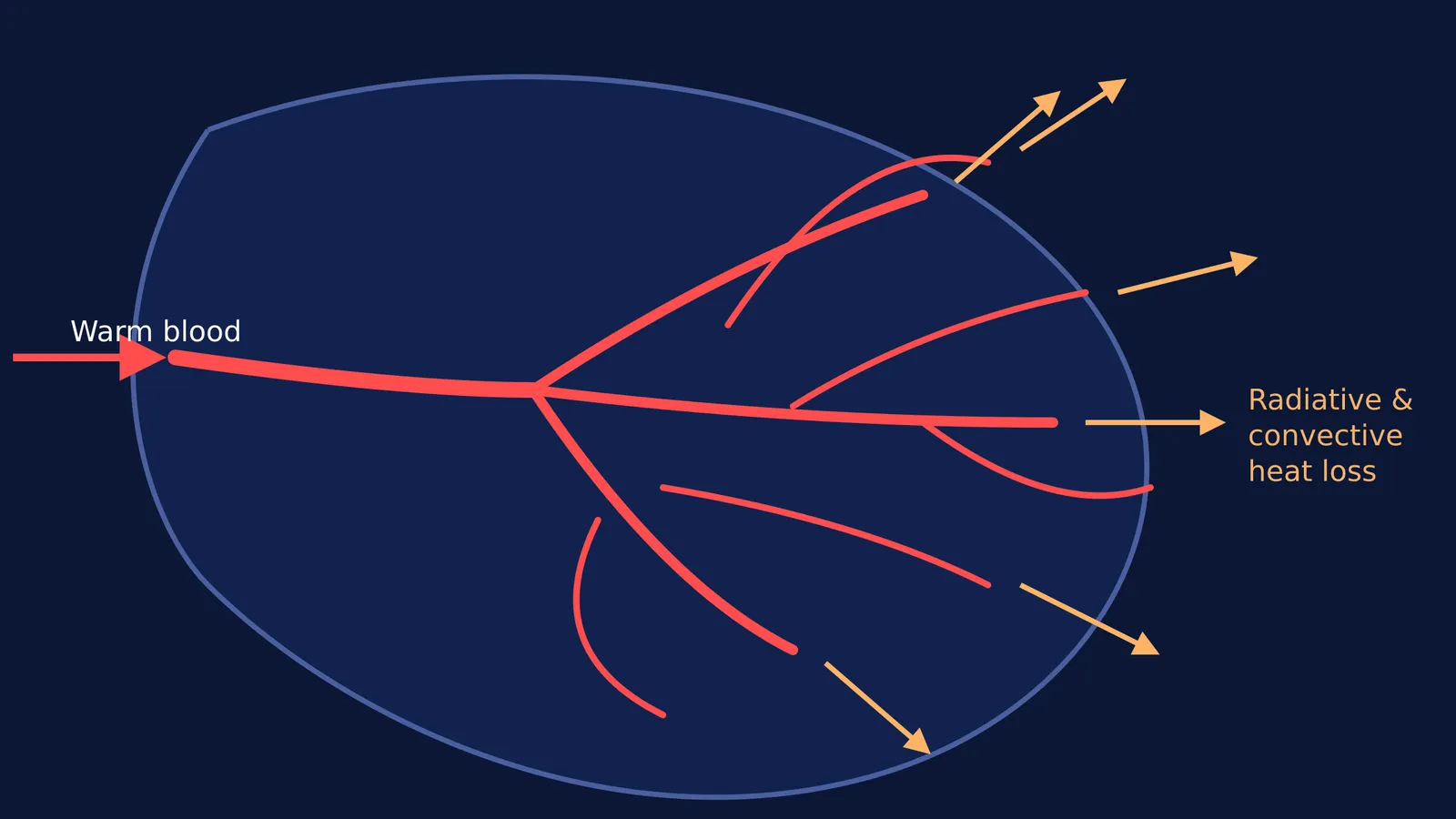
Because elephants lack sweat glands (except between their toes) and have a very low surface-area-to-volume ratio, they face a severe risk of overheating. Their large ears, or pinnae, have evolved to solve this problem by acting as highly efficient thermal windows.
The back of an African elephant's ear is covered with a dense network of blood vessels. When the elephant gets too hot, these vessels dilate to bring warm blood close to the skin's surface. According to a seminal 1992 study in *Comparative Biochemistry and Physiology*, the ears of an African elephant account for about 20% of its total surface area and can dissipate up to 100% of the animal's standard metabolic heat90345-q). By flapping its ears, the elephant creates a breeze that releases this metabolic heat into the environment through forced convection and radiation. Convection relies on moving air to strip heat away from the skin faster than still air would, while radiation allows the heat to escape directly as infrared energy. Together, these processes turn the ear into an active radiator.
This remarkable vascular adaptation is a perfect example of vasodilation in action. If you are learning about how blood flow regulates body processes, you might recall August Krogh and how capillaries open when muscles work—the same biological principle applies here on a massive scale.
What makes the elephant's ears so efficient?
African elephants have significantly larger ears than their Asian counterparts, which live in cooler, shaded forest environments. Their massive surface area is their primary cooling mechanism, but they have other surprising adaptations.
Recent research shows that the sparse hair on an elephant's skin actually aids in cooling rather than keeping them warm. A 2012 study published in *PLOS One* found that in a light breeze, these hairs increase heat loss by up to 23% by conducting thermal energy away from the skin.
How can you study physiological adaptations?
When revising animal anatomy and physiology for exams, it helps to break down complex organs using a simple "Form and Function" checklist. Here is a framework you can use for any biological system:
Identify the structure: What is the organ or tissue? (e.g., the elephant's pinna).
Note the key physical traits: Does it have a high surface area, specific muscle types, or extensive blood vessels?
Connect to physics or chemistry: How do physical laws apply? (e.g., convection, heat transfer, or vasodilation).
Determine the ultimate function: How does this keep the organism alive? (e.g., releasing metabolic heat to prevent overheating).
Understanding these biological systems requires keeping track of fluid dynamics, surface area, and muscle mechanics all at once. If you do not know where to start when revising complex animal physiology for an exam, Fermi's AI tutor works out what you already know and builds a plan for the session, so you sit down to a clear next step.


