

On this page
Release a block and a ball together from the top of the same slope. The block slides on a frictionless surface; the ball rolls without slipping. Which one gets to the bottom first? The block, whatever the ball is made of. Here is why, with numbers, and the setups where the answer changes.
Does a rolling ball or a sliding block reach the bottom first?
The sliding block wins. On a frictionless incline at angle θ, the block accelerates at g sin θ, since only gravity's component along the slope acts along it.
A body rolling without slipping accelerates at a = g sin θ / (1 + I/mR²), where I is its moment of inertia about its centre, m its mass and R its radius, as derived in OpenStax University Physics, section 11.1. Since I/mR² is always positive for a real rolling body, the denominator exceeds 1 and the roller always loses.
Why does rolling make a body slower?
Both bodies lose the same potential energy, mgh. The block turns all of it into forward motion, ½mv². The rolling ball must split it between ½mv² and spin, ½Iω².
For rolling without slipping, v = ωR, so the total kinetic energy is ½mv²(1 + I/mR²). Setting that equal to mgh gives a speed at the bottom of v = √(2gh / (1 + I/mR²)), compared with √(2gh) for the block.
Friction does not waste the ball's energy: OpenStax explains that the contact point is at rest relative to the surface, so static friction does zero work. It only redirects energy into rotation.
The University of Illinois Physics Van makes the same point and ranks a solid sphere ahead of a solid cylinder, with a hollow cylinder last. If heavier bodies still feel like they should win, read whether a heavier block slides down an incline faster.
How much longer does each shape take?
From a = g sin θ / (1 + I/mR²) and t = √(2L/a), the time ratio is t(rolling) / t(block) = √(1 + I/mR²). Using standard moments of inertia from this list of moments of inertia (solid sphere 2/5 mR², solid cylinder ½mR², thin hollow sphere 2/3 mR², thin ring mR²):
Sliding block (no rotation): ratio 0, all energy translational, time × 1.00
Solid sphere: ratio 2/5, 71% of energy translational, time × 1.18
Solid cylinder or disc: ratio 1/2, 67% translational, time × 1.22
Thin hollow sphere: ratio 2/3, 60% translational, time × 1.29
Thin ring or thin-walled hollow cylinder: ratio 1, 50% translational, time × 1.41
Worked example: a 2 m slope at 30°
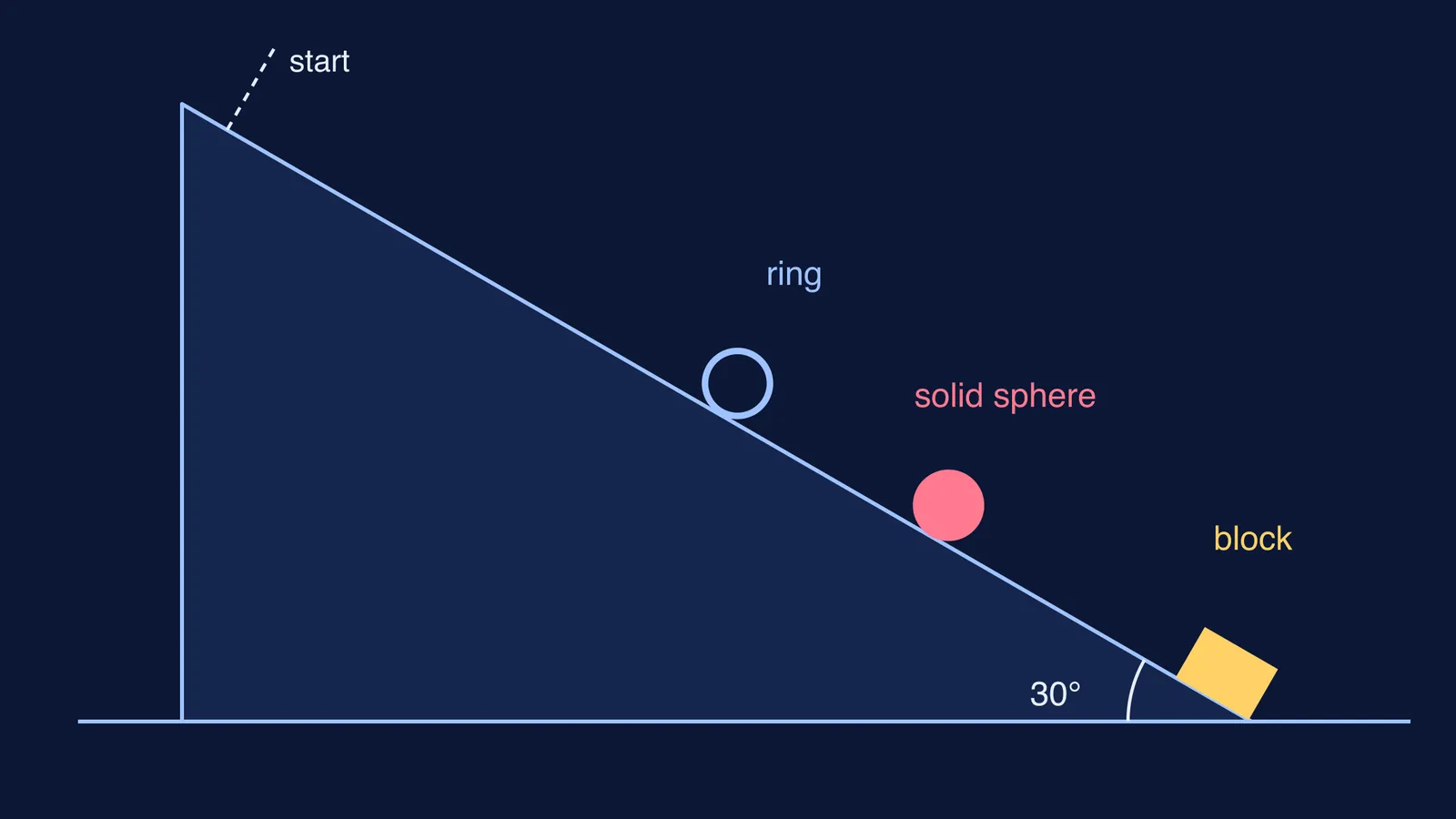
Take g = 9.8 m/s², slope length L = 2 m, θ = 30°, so the drop h = 1 m, using the OpenStax formula.
Block: a = 9.8 × 0.5 = 4.9 m/s². Time t = √(2 × 2 / 4.9) ≈ 0.90 s. Speed at bottom √(2 × 9.8 × 1) ≈ 4.43 m/s.
Solid sphere: a = 4.9 / 1.4 = 3.5 m/s², t ≈ 1.07 s, speed ≈ 3.74 m/s.
Disc: a = 4.9 / 1.5 ≈ 3.27 m/s², t ≈ 1.11 s, speed ≈ 3.61 m/s.
Ring: a = 4.9 / 2 = 2.45 m/s², t ≈ 1.28 s, speed ≈ 3.13 m/s.
At the instant the block reaches the bottom, each roller has covered L / (1 + I/mR²): the sphere is 1.43 m down, the disc 1.33 m and the ring exactly halfway, at 1 m. That is the scene in the diagram above.
When does the sliding block not win?
The block has friction. With enough kinetic friction it loses: g(sin θ − μ cos θ) falls below a solid sphere's (5/7) g sin θ once μ > (2/7) tan θ.
The whole incline is frictionless. A ball placed on a truly frictionless slope cannot start spinning, because nothing supplies a torque. It simply slides, and it ties with the block.
The roller slips. If friction is too small for pure rolling, the ball skids and the formula above no longer applies. Our post on minimum friction for pure rolling on an incline works out the threshold shape by shape.
A 30-second check for exam questions
Circle the words smooth, rough and without slipping for each body.
Sliding on smooth: a = g sin θ. Rolling without slipping: a = g sin θ / (1 + I/mR²).
Ignore mass and radius; compare only I/mR². Smaller ratio, earlier finish.
For speeds at the bottom, use energy, not forces.
For more on the energy side, read rolling without slipping: energy and friction on inclines. To practise, the Fermi Problem Library has worked problems with a step-by-step solver that explains the reasoning rather than printing an answer. If the race is easier to see than to read, try the interactive simulations in the Fermi Simulation Lab.


