On this page
When you buy a large block of ice or observe street vendors in India storing slabs for kulfi, the ice rarely sits in an open metal container. Instead, it is buried beneath coarse wood shavings and dry sawdust. While wrapping cold ice in what looks like a blanket seems counter-intuitive, this practice is rooted directly in the physics of thermal insulation.
In thermal physics, heat spontaneously flows from warmer surroundings to colder bodies until thermodynamic equilibrium is achieved. In a 30 °C room, an unprotected block of ice at 0 °C experiences rapid heat transfer via convection and conduction. According to Wikipedia's physical data, solid ice has a thermal conductivity of 2.18 W/(m·K) at 0 °C, meaning heat propagates inward swiftly unless blocked by an insulating barrier.
Why is ice packed in sawdust instead of bare containers?
Solid wood transfers heat primarily through lattice vibrations known as phonons. As documented by the Engineering ToolBox, softwoods like pine exhibit a low thermal conductivity of roughly 0.12 W/(m·K) at 25 °C. This slow heat conduction explains why metal feels colder than wood at the same temperature. However, loose sawdust insulates even better than timber because its jagged shavings trap pockets of stationary air.
According to HyperPhysics, still air has a thermal conductivity of just 0.026 W/(m·K) at room temperature. In open space, air circulates via convection, transferring heat rapidly. Inside sawdust, sub-millimetre pore spaces suppress convection loops, forcing heat to travel via molecular conduction through an air-wood matrix with an effective conductivity of just 0.08 W/(m·K).
Dry sawdust also prevents liquid water pooling. According to the Engineering ToolBox, water has a thermal conductivity of 0.606 W/(m·K) at 25 °C—over seven times higher than dry sawdust. When surface ice melts, sawdust wicks away moisture, preventing a conductive water jacket from accelerating the thaw.
How does trapped air slow down thermal conduction?
Thermal conduction depends on collisions between neighboring atoms. In solids, tightly packed atoms pass vibrational energy rapidly. In gases, widely separated molecules collide much less frequently, producing the low baseline conductivity of 0.026 W/(m·K) verified by HyperPhysics. By compartmentalising air into tiny pockets, sawdust eliminates convective fluid motion, ensuring heat only moves through slow molecular diffusion.
What does the heat conduction equation reveal about melting rates?
Under standard thermal physics curricula, as presented in OpenStax University Physics, heat flow through a uniform barrier is governed by Fourier's law of thermal conduction. The steady-state heat flow rate Q/t across thickness L and area A under temperature difference ΔT is:
Q/t = (k × A × ΔT) / L
Thermal heat flow Q/t equals temperature difference ΔT divided by thermal resistance R = L / (k × A), analogous to electrical circuits described in our guide on Thermal Resistance of Rods in Series and Parallel.
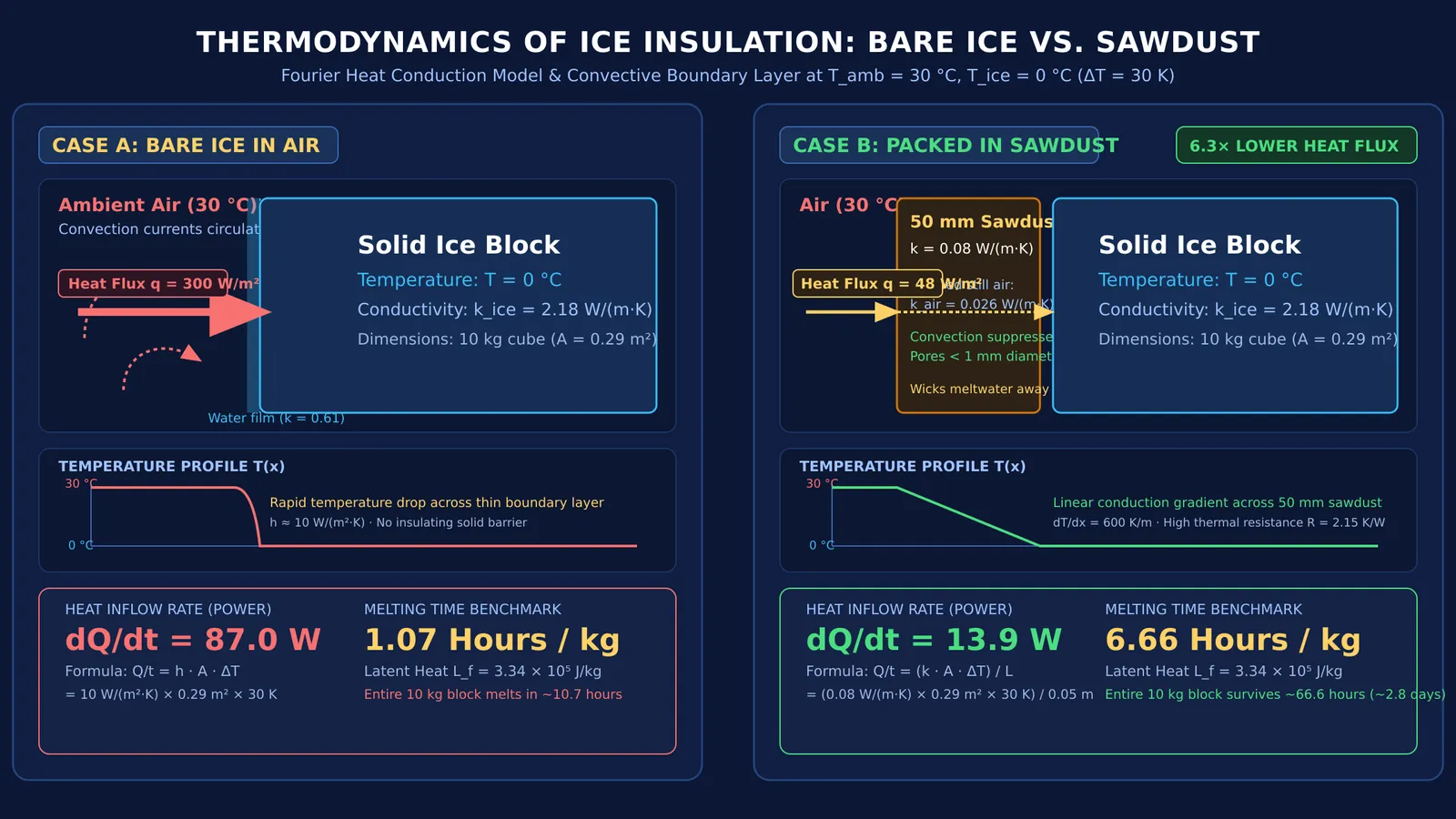
Consider a 10 kg ice cube with surface area A = 0.29 m² at 0 °C in 30 °C air (ΔT = 30 K). Melting 1 kg requires absorbing latent heat of fusion L_f = 3.34 × 10⁵ J/kg, as explored in Why temperature stays constant during melting and boiling.
Bare ice in air (convective coefficient h ≈ 10 W/(m²·K)): heat rate is Q/t = h × A × ΔT = 87 W, melting 1 kg in 1.07 hours.
Packed in 5 cm (0.05 m) sawdust (k = 0.08 W/(m·K)): heat rate drops to Q/t = (k × A × ΔT) / L = 13.92 W, stretching melting time for 1 kg to 6.66 hours.
When students find heat conduction through composite boundaries difficult to visualise, interactive models help make the concepts intuitive. The Fermi Simulation Lab provides interactive simulations for the ideas that are easier to see than to read. For numerical practice on heat transfer formulas, the Fermi Problem Library offers worked problems with a step-by-step solver that explains the reasoning rather than printing an answer.
How did sawdust power the 19th-century ice trade to India?
Before electric freezers existed, sawdust insulation supported global commerce. According to maritime history documented in Wikipedia's history of the ice trade, merchant Frederic Tudor shipped 180 tons of New England lake ice packed in pine sawdust aboard the brig Tuscany to Calcutta on May 12, 1833. After a four-month, 16,000-mile voyage across the equator, over 100 tons of ice arrived frozen. This proved that low-conductivity sawdust could preserve ice across months of tropical heat, leading to permanent ice houses in Calcutta, Bombay, and Madras.
Today, modern coolers use polystyrene foam, but the core thermodynamic mechanism remains unchanged. Trapping stagnant air inside a low-conductivity solid matrix suppresses convection and slashes conduction, keeping heat outside so ice survives in the heat.