

On this page
Every menstrual cycle, a group of ovarian follicles starts to grow, yet usually only one ovulates. A 2012 review of more than 200 studies by Baerwald, Adams and Pierson says that generally a single dominant follicle is selected in the mid-follicular phase and ovulates at mid-cycle. The rest stop growing and regress, a process called atresia. Two ideas explain how: the FSH threshold and the FSH window.
How is one dominant follicle selected each cycle?
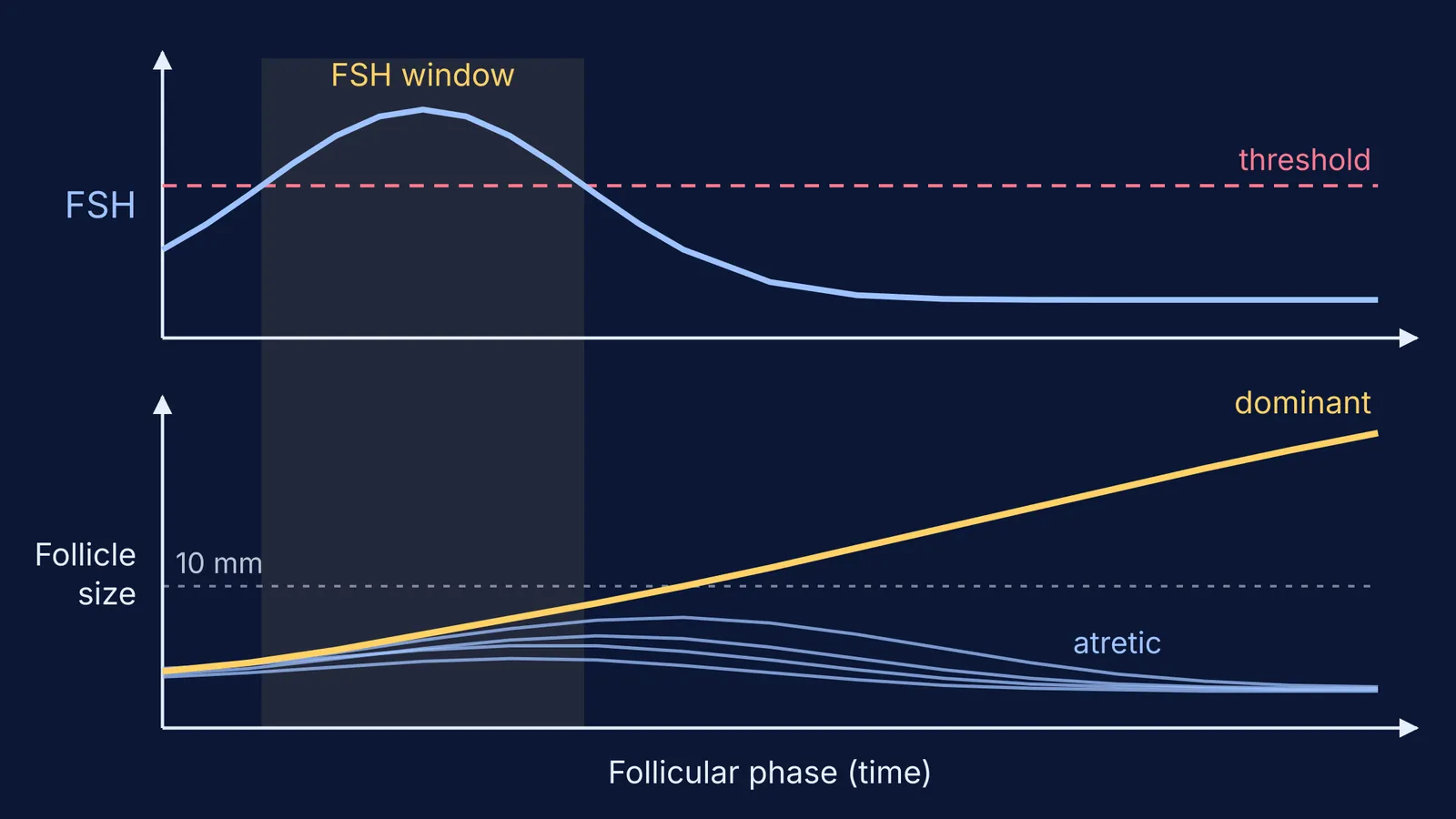
Here is the sequence, matched to the diagram above.
FSH rises. Early in the cycle, FSH from the anterior pituitary climbs above the level follicles need to keep growing.
A group responds. While FSH stays above that level, several small antral follicles grow together.
The most sensitive one pulls ahead. Hillier's 2001 review00469-5) says the most responsive follicle is the first to make oestrogen and the first whose granulosa cells carry LH receptors.
Oestradiol pulls FSH down. Rising oestradiol feeds back on the pituitary, so FSH falls in the mid-follicular phase.
The window closes. FSH drops below what the smaller follicles need, and they become atretic. The leader, now also driven by LH, grows on until the LH surge triggers ovulation.
In a 2003 ultrasound study of 50 women, Baerwald's team called a wave "major", meaning dominance showed, when one follicle reached at least 10 mm and was at least 2 mm larger than every other follicle.
What are the FSH threshold and the FSH window?
The FSH threshold is the FSH level a follicle needs before it keeps developing. Each follicle has its own, and a lower threshold means more sensitivity to FSH. A 2004 study in Fertility and Sterility, which gave slowly rising doses of FSH, estimated an average threshold of 4.65 IU/L in 13 control women.
The FSH window is how long FSH stays above threshold. A short window gives only one follicle time to break away; a long one lets several through.
A 1998 study by Schipper, Hop and Fauser tested this in 23 young women. A single high dose of FSH early in the follicular phase did not change dominant follicle development. Moderate daily doses through the mid to late follicular phase did: single selection was disrupted and several follicles kept growing. The duration of the FSH rise mattered more than its height.
Why do the other follicles become atretic?
The leader removes the fuel. It makes the most oestradiol, which lowers FSH for every follicle. The followers still depend on FSH, so they regress; the leader, now using LH as well, copes with less. A 2026 mathematical model by Lyu and Kolomeisky of Rice University proposes a similar feedback: once one follicle is selected, its oestradiol suppresses FSH below the threshold and limits the time window for a second selection. In their model, which follicle is selected first is random.
Real ovaries are messier. Baerwald's team found that 68% of women had two waves of follicle growth between one ovulation and the next, and 32% had three (Fertility and Sterility, 200300544-2)). For Class 12 biology, the single-cohort picture is what you need.
How do you read this on the hormone graph?
Use this checklist on any menstrual-cycle graph, including the one in your Class 12 human reproduction chapter.
Early FSH bump: the window opens and a group of follicles is recruited.
Oestrogen starts climbing: the leader is emerging.
FSH dips as oestrogen rises: feedback closes the window and the others turn atretic.
LH spike: the dominant (Graafian) follicle ovulates.
Worked example. "A woman gets FSH injections every day through the mid to late follicular phase. What happens in the ovary?" Step 1: FSH stays above threshold. Step 2: the window does not close. Step 3: smaller follicles keep their FSH support and escape atresia. Answer: several follicles keep growing, which matches what Schipper's team reported.
Next, read about the stages from primary to Graafian follicle, what the corpus luteum does after ovulation and the menstrual cycle hormone graph, day by day.
If the feedback loops still feel tangled, the Fermi Concept Library gives each concept its own lesson and its place in the map. For questions like the worked example, the Fermi Problem Library has a step-by-step solver that explains the reasoning rather than printing an answer.


