

On this page
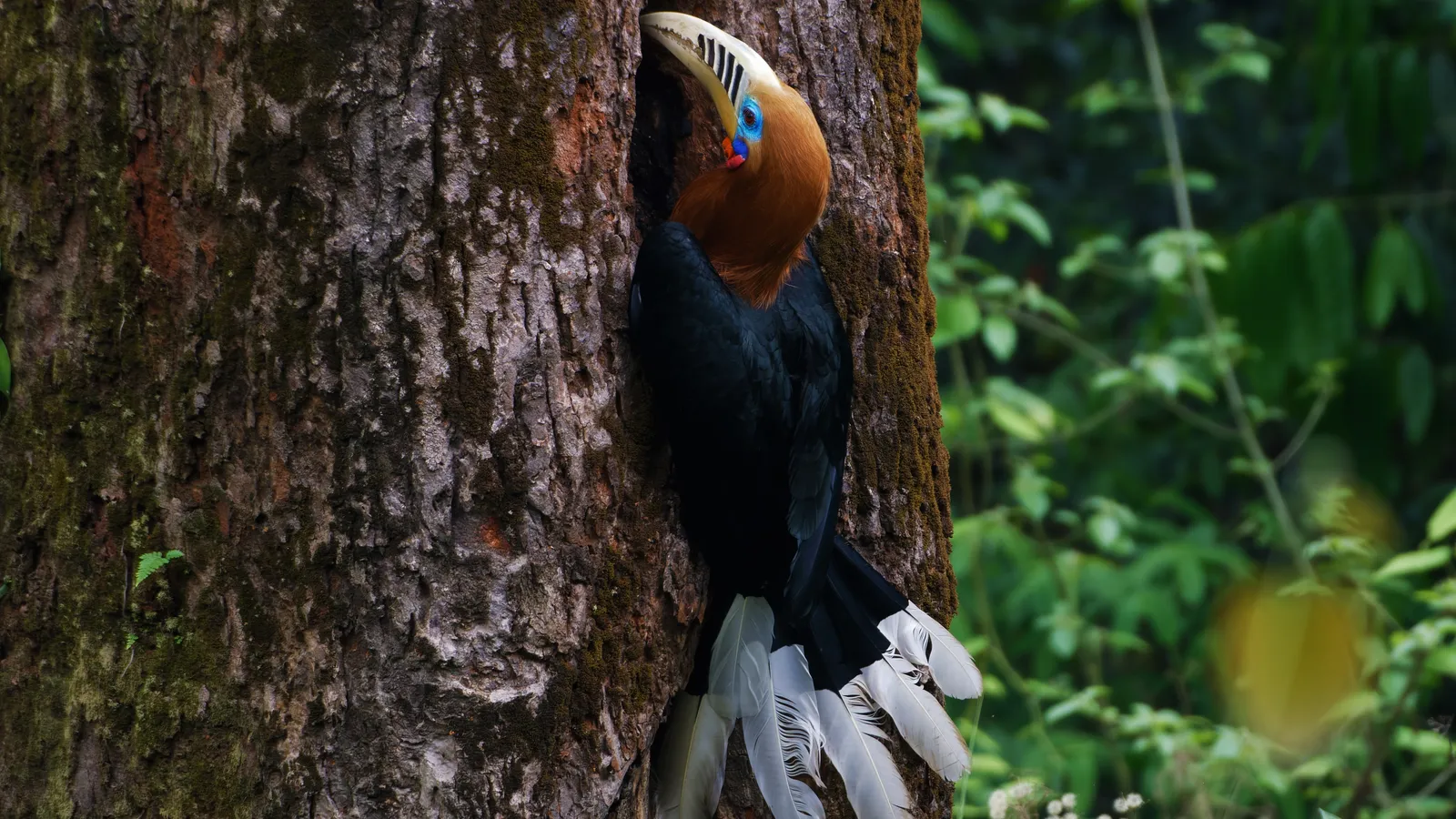
Each breeding season, a female hornbill climbs into a hole high in a tree and walls herself in, leaving only a thin slit. She stays inside for months while her mate brings every meal to that slit.
Why does the female hornbill seal herself in the nest?
The main reason is safety. Hugh Chittenden, writing in the IUCN Hornbill Specialist Group's bulletin, describes the plaster as a cast the female makes "to narrow the entrance hole as security from predators" (Chittenden, Hornbill Natural History and Conservation, 2021). In the South African Crowned Hornbill nest he followed, the chicks hatched featherless and blind, and the female kept adding to the seal to protect herself and the nest.
In and around Pakke Tiger Reserve in Arunachal Pradesh, researchers saw a yellow-throated marten below an active Wreathed Hornbill nest, monitor lizards occupying a nest-site, and Hill Mynas inspecting cavities of nesting hornbills (Datta and Rawat, Bird Conservation International, 2004). A narrowed entrance makes it harder for visitors like these to get in.
The female also moults her flight and tail feathers inside the nest, so she cannot fly again until they regrow (Chittenden, 2021).
Is the hornbill nest sealed with mud or droppings?
It depends on the species. Some older accounts said the Great Hornbill used mud. Douglas James and Ragupathy Kannan watched a nest in the Anaimalai Hills of the Western Ghats for 183 hours and saw no mud delivered or used (James and Kannan, Wilson Journal of Ornithology, 2007). Chemical analysis of fallen plaster matched droppings, not soil. The female sealed the hole with her own droppings, and after she left, the chick resealed it with its own. The tiny fig seeds in the droppings seem to hold the plaster together "much like gravel in a concrete mix," as the authors put it.
Other hornbills do use mud. The Hornbill Nest Adoption Program's 2024 mid-term report shows a male Oriental Pied Hornbill "bringing a clod of mud for the female to seal the nest" (HNAP mid-term report, 2024). Crowned Hornbill females smear a mix of their own droppings and nest debris onto the seal, and millipedes delivered by the male are probably crushed for secretions that help strengthen it (Chittenden, 2021).
How does the male hornbill feed the family?
Through the slit, on his own. Chittenden records Trumpeter Hornbill males returning with a crop full of ripe fruit and regurgitating up to 30 to 40 items in a single delivery (Chittenden, 2021). In Crowned Hornbills, the female breaks out about halfway through the chick-rearing period, by his account, once her flight feathers have regrown, and then helps him.
The risk is stark. If the male is killed or injured before her feathers regrow, "she and her chicks will die of starvation," Chittenden writes.
At Pakke, hornbills enter nests in mid- to late March, and chicks emerge from mid-July to early August (Datta and Rawat, 2004), roughly four months in which the family relies largely on the male for food.
Why do big old trees matter for hornbill survival?
Hornbills do not dig their own nest holes, so they rely on cavities that already exist (Datta and Rawat, 2004). At Pakke, holes formed where a branch broke off and the wood rotted, or where woodpeckers and barbets started a hole that later grew.
Nest-trees were bigger and taller than the trees around them, and almost all rose above the canopy. In that study, 30 of 36 nest-trees were one species, *Tetrameles nudiflora*, a tall softwood, and only 2 of 25 candidate tree species in the study area were used. Over four seasons, 19 of the 36 nest-trees were lost to felling, disturbance, flooding, shrinking holes and other causes.
The Hornbill Nest Adoption Program, begun in 2012, works with local people as "nest protectors". Its 2024 report says that since 2012 the team had located over 37 nest trees in Papum Reserved Forest, from which about 206 chicks had fledged (HNAP report, 2024).
How do you write this up in a biology answer?
Use four steps:
Behaviour: what the animal does (female seals the cavity, leaving a slit).
Mechanism: how (droppings, in some species mud; male feeds through the slit).
Advantage: why it helps survival (keeps out predators; safe moult; protects helpless chicks).
Cost or threat: what can go wrong (the family depends on one male; nest-trees are scarce).
Worked example, three marks: "The female hornbill seals herself inside a tree hole with droppings or mud, leaving a narrow slit. The seal keeps out predators while she incubates and moults her flight feathers. The male feeds her and the chicks through the slit, so the family depends on him and on large old trees with cavities."
Compare the cuckoo's habit of laying eggs in other birds' nests and how the baya weaver builds its hanging nest. For conservation, see forest and wildlife resources for Class 10.
If adaptation and parental care still feel loose, the Fermi Concept Library gives each biology concept its own lesson and its place in the map.


