

On this page
What is brood parasitism?
Brood parasitism is a reproductive strategy where a parasite manipulates a host species to raise its offspring. A classic example studied in ecology is the Asian koel (*Eudynamys scolopaceus*), which lays its eggs in the nest of the house crow (*Corvus splendens*).
Because building nests, incubating eggs, and feeding chicks takes immense energy, the parasite skips this work entirely. This allows the female cuckoo or koel to spend her energy laying more eggs instead of rearing a single clutch.
However, leaving an egg in a stranger's nest is risky. If the host bird notices that an egg is the wrong size, shape or colour, it will either throw the imposter out, puncture it, or abandon the nest entirely. In some regions of India, researchers have found that about 5% of house crow nests are parasitised by koels.
How does the evolutionary arms race work?
This interaction sets up a relentless cycle of co-evolution, which occurs when two or more species reciprocally affect each other's evolution. As hosts get better at spotting fakes, parasites must get better at forging them. This constant push-and-pull is known as an evolutionary arms race.
To win this race, parasitic eggs have evolved to look almost identical to their host's eggs. For instance, koel eggs closely match the crow's bluish-green background and brown speckles. This precise egg mimicry prevents the host from recognising the imposter. In response, some parasites have also evolved thicker eggshells to prevent the host from puncturing them, while parasite chicks often grow faster than host chicks.
When scientists study the host's response, they also find instances of the "mafia hypothesis." This theory suggests that if a host bird rejects a parasitic egg, the adult parasite might return to retaliate by destroying the host's entire nest. For example, in studies of brown-headed cowbirds, 56% of nests where the host ejected the parasitic egg were subsequently predated upon by the cowbirds, compared to only 6% of non-ejected nests. This forces the host into a corner: accept the fake egg, or risk losing everything. The development of these complex interactions is a prime example of directional selection at work in nature.
How does the W chromosome control maternal inheritance?
A fascinating genetic puzzle arises with the common cuckoo, which is known to parasitise multiple different host species. If a female cuckoo mates with a male whose mother parasitised a completely different bird (like a meadow pipit instead of a reed warbler), why don't the genes mix and ruin the disguise? The secret lies in avian sex determination.
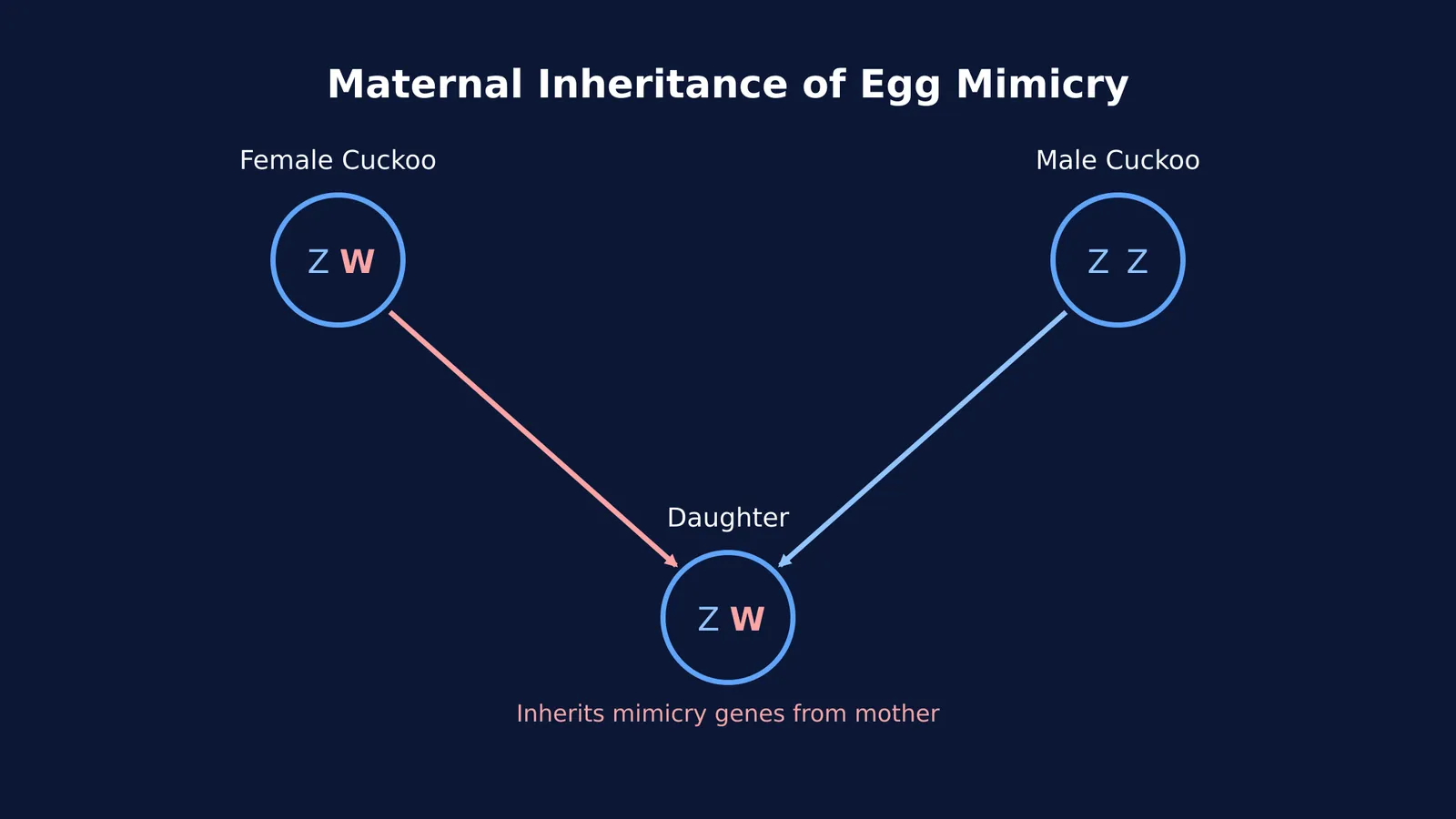
In birds, sex chromosomes are the reverse of humans: males are ZZ and females are ZW. The W chromosome is passed strictly from mother to daughter.
By keeping the genes for egg colour and pattern on the W chromosome, a female cuckoo ensures her daughters inherit the exact same disguise. The male's DNA, carried on the Z chromosome, cannot scramble the mimicry. This maternal inheritance allows a single cuckoo species to split into distinct host-specific lineages, called gentes, without losing their perfect disguise even when breeding with males from different lineages. You can see a similar evolutionary adaptation in the way mimicry in butterflies helps them avoid predators.
How can we categorise population interactions?
Brood parasitism is a frequently tested concept in the ecology and evolution syllabus. When you see a question about koels and crows, it is testing your understanding of population interactions.
To master this topic, use a simple plus-minus framework for interactions:
Mutualism (+/+): Both species benefit (e.g., lichens).
Competition (-/-): Both species are harmed as they fight for the same resources.
Predation and Parasitism (+/-): One benefits, one is harmed. Brood parasitism falls clearly into this category.
Commensalism (+/0): One benefits, the other is unaffected.
When you categorise interactions this way, the questions become much easier to answer quickly.
If you have concept gaps when revising genetics, sex determination, or ecological interactions, you can read about them in the Fermi Concept Library. Instead of just memorising that koels parasitise crows, learning the genetic "why" behind the W chromosome gives you a deeper understanding of the science, making it much harder to forget on exam day.


