

On this page
Every spring someone in a housing-society WhatsApp group posts the same video: a cloud of bees pours out of a wall, swirls, then settles as a humming brown beard on a branch. It looks like an attack. It is closer to a birth.
Why do honeybees swarm and leave the hive?
Swarming is the honeybee's method of colony reproduction, says the University of California guide to honey bee swarms.
In late spring or early summer, a strong colony divides: the queen and approximately half the workers leave to start a new colony, while a daughter queen and the remaining workers stay to carry on the old one, write Thomas Seeley, Kirk Visscher and Kevin Passino in American Scientist (2006). For a refresher on the roles, see honeybee castes: queen, worker and drone.
A departing swarm holds 5,000 to 20,000 bees, according to the UC guide, and soon settles as a cluster nearby.
How do scout bees vote on a new home?
In a swarm of some 10,000 bees, only a few hundred scouts search for a home while the rest stay still and save energy, Seeley and colleagues report. Scouts inspect cavities, return, and advertise a site with the waggle dance foragers use for flowers: its angle gives direction, the length of the waggle run gives distance.
Three rules in that same article turn many opinions into one choice:
Dance harder for better sites. On her first return from a first-rate site a scout tends to perform 100 or more dance circuits; from a so-so site, only a dozen or so.
Let support fade. On each later return a scout dances about 15 fewer circuits, so a site keeps support only if new scouts take it up.
Count heads at the site. Once 15 or more scouts are at one site together, they return and start piping, a signal that makes the cluster warm its flight muscles to 33-35 degrees Celsius for takeoff.
Better sites recruit faster, so support snowballs. Offered four 15-litre nest boxes and one 40-litre box on an island off Maine, swarms chose the 40-litre box in four of five trials, the article reports. A later study in Science (Seeley and others, 2012) found that scouts also give stop signals to bees signalling for rival sites, which helps keep the swarm from reaching an impasse.
Worked example: how did one swarm vote, hour by hour?
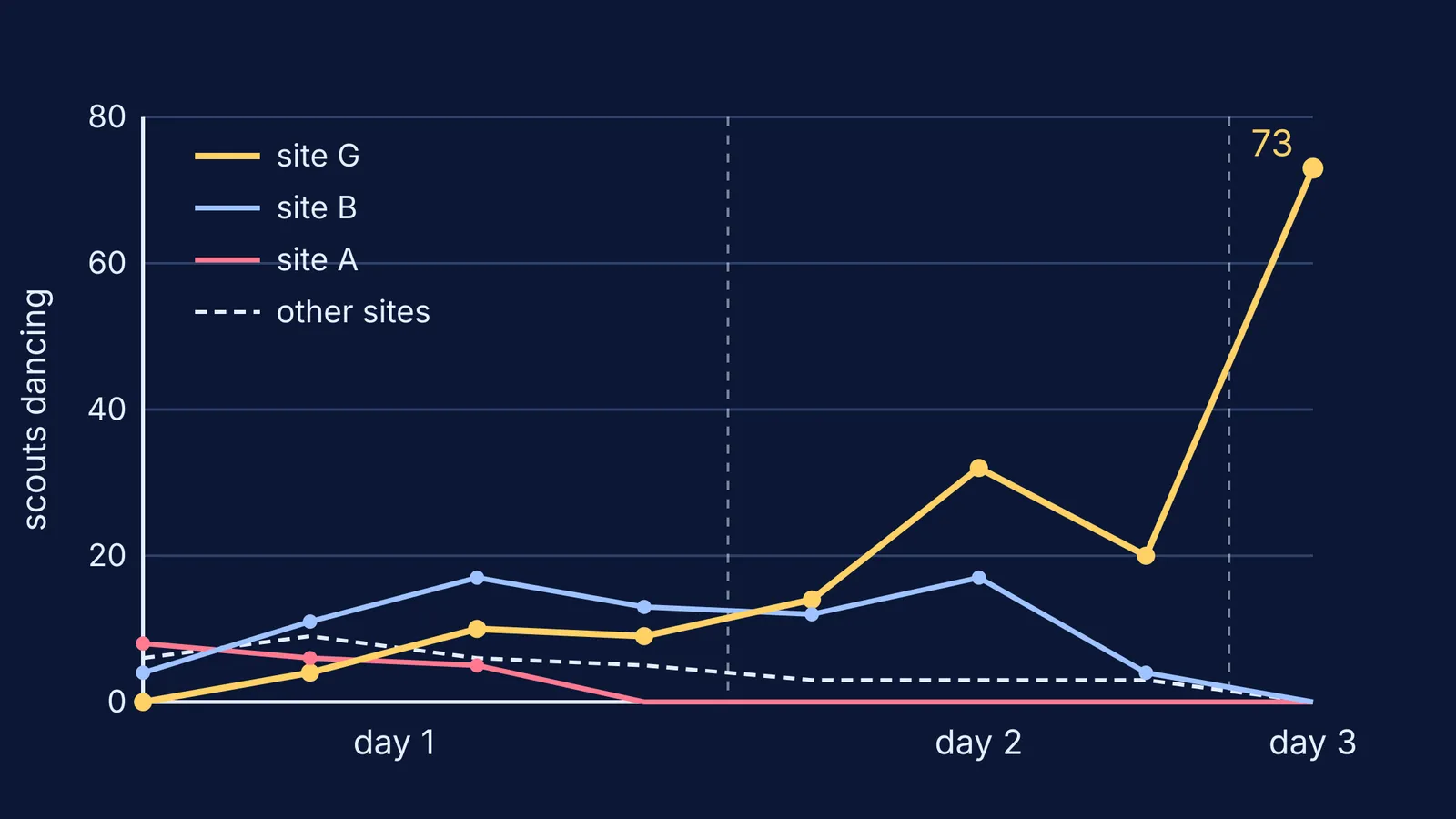
Figure 5 of the American Scientist article tracks a swarm from 20 to 22 July 1997. Its scouts reported 11 sites over about 16 hours of dancing. Four snapshots:
Day 1, 11:00 to 13:00: 18 dancers across six sites. Site A leads with 8. Site G has not been found yet.
Day 1, 15:00 to 17:00: site B leads with 17 dancers; G has 10.
Day 2, 9:00 to 11:00: G pulls ahead with 32 dancers to B's 17.
Day 3, 9:00 to 11:58: all 73 dancers support G, the site the swarm chose.
The lesson: the first site found did not win. Positive feedback, fading support and a quorum let a later, better option overtake an early one.
Why is a hanging swarm usually calm?
Most spring swarm clusters of European honeybees are extremely docile; it takes something like being hit with sticks and stones or squirted with a hose to make them defensive, says the UC guide. NC State Extension gives two reasons: the bees feed before swarming, and away from their nest they are less defensive. The UC guide adds that swarming bees are much less defensive than bees protecting brood.
Calm is not harmless: swarms are docile unless provoked, notes the University of Illinois Extension. In India, do not confuse a swarm with the giant rock bee, Apis dorsata, which builds open nests, with comb to defend, on branches, rocky ledges, buildings and water towers (PLOS ONE, 2024). For why a worker bee's sting costs her life, read why honeybees sting only once.
What should you do if a swarm lands near your home?
A checklist from the Illinois, UC and NC State advice:
Look for wax comb. A bare cluster of bees is a swarm; bees that have started building comb are settling in.
Keep children, pets and others away; never throw stones or spray water.
Wait. Most swarms move on within a few hours to a few days.
If it is still there after a week, or must be moved, call a local beekeeper.
If anyone in the house is allergic to bee stings, keep them well away from the swarm.
For another insect that takes to the air in swarms, read why winged termites swarm after the first rain.
How can you study collective decisions like this?
Explain the worked example aloud without notes: who votes, how support grows and fades, what triggers takeoff. If a link feels shaky, Fermi's AI tutor decides whether to explain, ask or show, and checks your understanding as it goes. The Fermi Concept Library gives each biology concept its own lesson.
Next spring, you will know what that video shows: a new colony waiting for its scouts to finish voting.


