On this page
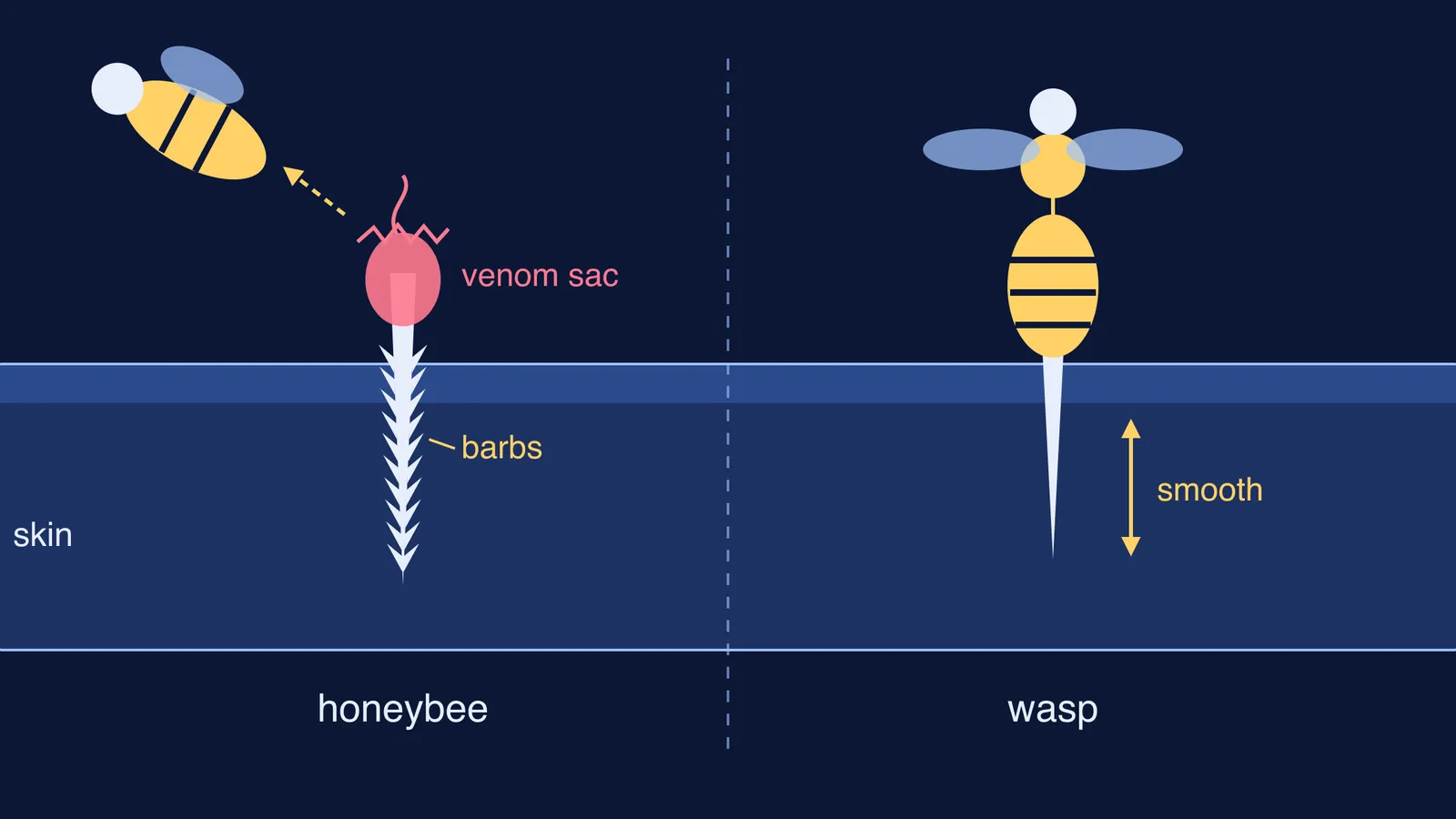
If a honeybee stings you, a tiny dark spike stays in your skin and the bee usually dies. A wasp can fly off and sting again. The difference lies in tiny barbs on the sting, and in how honeybee colonies defend themselves.
Why does a honeybee die after stinging?
A worker honeybee's sting is not a single needle but a central stylet and two lancets that slide back and forth. In a 2023 study, Fiorella Ramirez-Esquivel and Sridhar Ravi reported that the lancets bear on average 10 barbs each, all facing backwards (Ramirez-Esquivel and Ravi, iScience, 2023). Rear-facing barbs lower the force needed to push the sting in and raise the force needed to pull it out.
Sting autotomy is the detaching of the stinger from the bee's body, after which it keeps stinging on its own (Ramirez-Esquivel and Ravi, 2023). When a worker stings a vertebrate such as a person, the barbs hold. The sting tears away with its venom sac, muscles and nerve centre, sometimes with part of the lower gut. The worker usually dies, though death can take 18 to 114 hours. The detached sting keeps stinging and injecting venom for a short time; a worker carries roughly 1 to 2 mg of liquid venom, the paper notes.
Writing in BBC Science Focus, Luis Villazon explains that the barbed ratchet did not evolve as a suicide mechanism: honeybees can pull their stings out after stinging other insects, but mammal skin is too fibrous to release the sting.
Why can a wasp sting you again?
Most wasps carry a smooth sting. UC pest specialists put it plainly: “Wasp stingers have no barbs and can be used repeatedly, especially when the wasp gets inside clothing” (UC IPM: Yellowjackets and Other Social Wasps). For a very different venom system, see how snake venom works, from glands to fangs.
There are exceptions. Some social wasps in the tribes Epiponini, Polistini and Rhopalidiini also lose their stings (Ramirez-Esquivel and Ravi, 2023). Studying 28 species of Neotropical social wasps, Maria de Fátima Manzoli-Palma and Nivar Gobbi found that sting autotomy was positively correlated with the number of barbs and with how social the species was (Journal of Hymenoptera Research, 1997).
Why would evolution favour a sting that kills the stinger?
For one bee, autotomy is a disaster. For the colony, it can pay. Manzoli-Palma and Gobbi point to the high degree of kinship inside social insect colonies and suggest the behaviour can be thought of as “defensive altruism” (Journal of Hymenoptera Research, 1997): a worker that dies defending the nest protects close relatives. Back in 1971, Henry R. Hermann had already described sting autotomy as a defensive mechanism in certain social Hymenoptera.
The lost sting also calls for help. An alarm pheromone released at the base of the honeybee sting makes other bees more likely to sting and helps them find the target (Visscher, Vetter and Camazine, UC Riverside). For more on insect societies, read how ant colonies divide work between queen, workers and soldiers and why paper wasps work for a queen.
How do you answer this in a biology exam?
Build your answer in four steps, plus a contrast if marks allow:
Structure: a stylet and two lancets with backward-facing barbs.
Mechanism: barbs anchor in fibrous mammal skin; as the bee pulls away, the sting, venom sac, muscles and nerve centre tear off (sting autotomy).
Cost: the worker usually dies.
Benefit: the detached sting keeps pumping venom, alarm pheromone recruits other workers, and a colony of close relatives is protected (defensive altruism).
Contrast: most wasps have smooth stings and sting repeatedly; a honeybee can usually withdraw its sting from another insect.
Some ideas are easier to see than to read, and the Fermi Simulation Lab has interactive simulations for them. To place autotomy among other adaptations, the Fermi Concept Library gives every biology concept its own lesson and its place in the map.
What should you do if a honeybee stings you?
Speed matters more than method. In a small trial, P. Kirk Visscher, Richard Vetter and Scott Camazine found that weal size grew with the time before the sting was removed, even within a few seconds, while scraping and pinching made no difference (Visscher, Vetter and Camazine, The Lancet, 1996). The same authors add that if more bees are around, getting to safety comes first (UC Riverside).
Get the sting out as soon as you can; the NHS suggests scraping it sideways with a fingernail or the edge of a bank card (NHS: insect bites and stings).
Wash the area with soap and water (NHS, same page).
If it swells, hold an ice pack wrapped in a cloth on it for at least 20 minutes (NHS, same page).
Call emergency services at once if the lips, mouth, throat or tongue suddenly swell, breathing becomes difficult, or the person becomes very confused or faints and cannot be woken (NHS, same page).
A honeybee's sting is built for insect fights; losing it in your skin is the hive's last-resort defence.