

On this page
Every winter, the high Himalayan slopes turn cold and the food supply for small insect- and seed-eating birds shrinks. Some birds answer that with a journey across continents. Most Himalayan birds that breed high up simply move down the same mountain, then come back up in spring.
What is altitudinal migration?
Altitudinal (or elevational) migration is the seasonal movement of populations up or down a mountain, as defined in a 2025 study in Royal Society Open Science by Tarun Menon, Paul Elsen and Umesh Srinivasan. Using eBird, a citizen science sightings database, they compared the breeding-season (May to August) and winter (December to February) elevation ranges of 377 Himalayan bird species.
Among species breeding above 2,500 m, 65% in the eastern Himalaya and 74% in the western Himalaya moved downslope in winter (Menon et al., 2025). The study sorted the movers into five patterns:
Displace: the winter range sits entirely below the summer range; average drop 1,524 m (east) and 2,153 m (west).
Shift: both the top and bottom of the range drop, the bottom by more than 200 m; average 937 m (east) and 986 m (west).
Expand: the bottom of the range drops but the top stays put; average 392 m and 416 m.
Contract: the top of the range drops but the bottom stays put; average 560 m and 805 m.
Upslope: a few lower-elevation breeders move up after breeding, by about 311 m on average.
Why do Himalayan birds move downhill in winter?
Temperature. A 2023 study in Global Ecology and Biogeography by Tarun Menon, Vijay Ramesh and Sahas Barve analysed 302 species and found that up to 65% of Himalayan birds shifted downslope in winter. The species that shifted most stayed within the narrowest yearly temperature range, suggesting they track a narrow band of temperatures.
Food. Insect-eaters and seed-eaters moved farther downslope than fruit-eaters and omnivores, as Down To Earth reported from the 2023 study. In the 2025 study, insect-eaters were more likely to migrate, while omnivores were more likely to stay resident.
Body size and territory. Downslope migrants tended to be smaller than resident species, and weakly territorial birds were more likely to move than strongly territorial ones (Menon et al., 2025).
How much warmer is 1,900 m lower down?
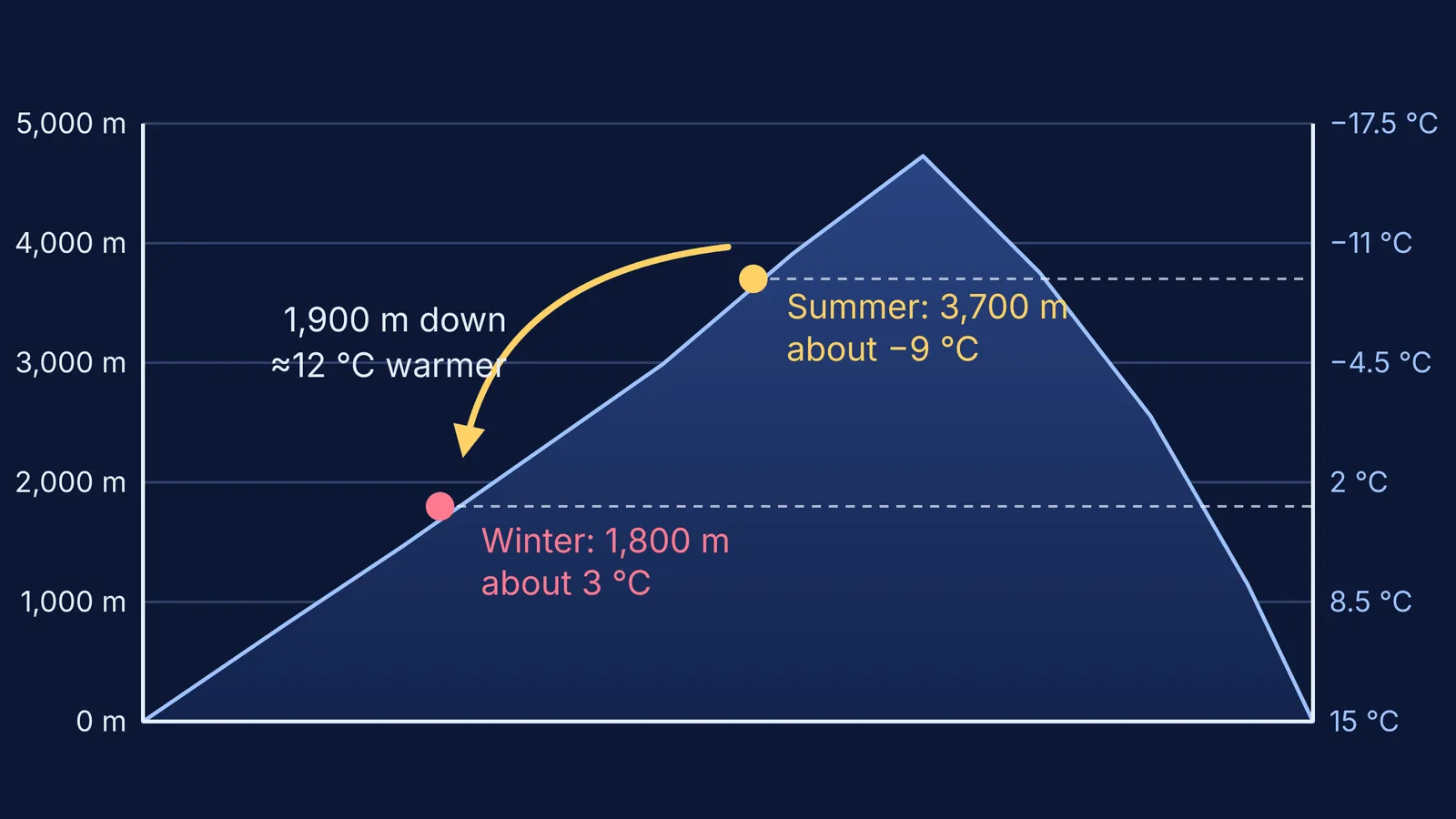
The buff-barred warbler moves nearly 1,900 m downslope, from about 3,700 m to 1,800 m, according to Down To Earth's report on the 2023 study. NASA's standard model of Earth's atmosphere gives the temperature in the lowest layer as T = 59 − 0.00356h, in degrees Fahrenheit with h in feet.
Convert the slope to metres: 0.00356 °F per foot × 3.281 feet per metre = 0.01168 °F per metre.
Convert to Celsius: 0.01168 ÷ 1.8 = 0.0065 °C per metre, or about 6.5 °C per 1,000 m.
Multiply by the drop: 0.0065 × 1,900 m ≈ 12 °C.
So, in the textbook atmosphere, the warbler's winter home is about 12 °C warmer than its summer home. Real slopes vary with sun, wind and season, so treat this as an estimate.
How is it different from long-distance migration?
Compare the warbler with the Amur falcon, which the Convention on Migratory Species describes migrating from Siberia, China and Mongolia to southern Africa, stopping to refuel on termites in northeast India in October and November. Read why Amur falcons stop in Nagaland for that stopover.
Distance: in the 2025 study, average downslope moves ranged from about 400 m to more than 2,000 m vertically (Menon et al., 2025); long-distance migrants cross oceans and continents.
Borders: altitudinal migrants usually stay in the same mountain range; long-distance migrants cross many countries.
Flexibility: of the 154 species found in both regions, 35% followed different patterns in the eastern and western Himalaya (Menon et al., 2025).
For the spring side of the story, see how longer days switch on bird breeding, and for the physiology, why a bird's body temperature is higher than yours.
The valleys matter for conservation too. Tarun Menon, a PhD scholar at the Indian Institute of Science and lead author of the 2023 study, told Mongabay India: "Lower elevation habitats cannot be ignored. They are most at risk to land use changes and urbanisation."
How can you spot altitudinal migrants yourself?
If you live in or visit the hills, try this plan:
Pick one spot and note its altitude from a map app.
Record the birds there in May to August and again in December to February, the seasons the 2025 study used.
Look for species that appear only in winter.
For each one, ask what it eats, how big it is and whether it defends a territory, then check your guess against the patterns above.
If words like migration, hibernation and thermal tolerance blur together while you revise, the Fermi Concept Library gives each concept in biology its own lesson and its place in the map, so you can see how they connect.


