

On this page
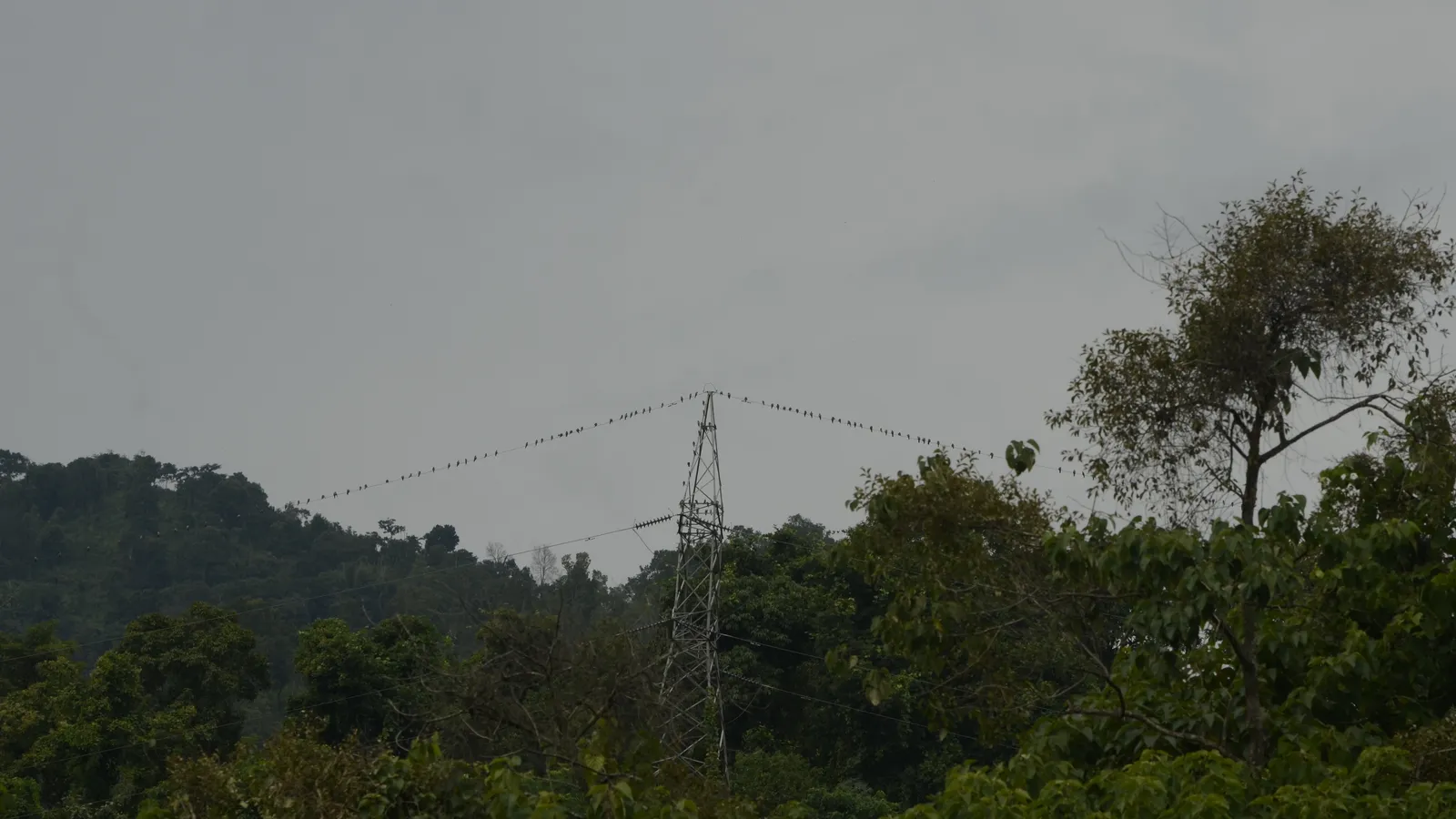
Every autumn, Amur falcons gather in Nagaland in flocks of more than 100,000 birds and stay for about three to four weeks to feed and rest, according to a Wildlife Institute of India (WII) satellite-tracking report. Here is why they stop, what the tags showed, and a map you can draw.
How far does the Amur falcon migrate?
The Amur falcon (*Falco amurensis*) travels up to 22,000 km in a year, from eastern Asia to southern Africa and back, according to the WII technical report. One WII-tagged falcon bred as far north as Hailar in Inner Mongolia, China; the tagged birds wintered in the grasslands of Botswana, Mozambique, Zimbabwe and South Africa.
The hardest leg is the sea. A 2026 study in *Ibis* by Bernd-Ulrich Meyburg and colleagues describes a non-stop crossing of the Indian Ocean of about 2,800 km (Meyburg et al., Ibis). There is nowhere to land and nothing to eat, a hard test of how migratory birds find their way.
Why do Amur falcons stop in Nagaland?
Because Nagaland offers a huge, well-timed meal before the long sea crossing. The falcons arrive in October and November, when winged termites swarm out of the ground.
A 2024 *Journal of Raptor Research* paper led by Amarjeet Kaur of WII examined more than 1,000 regurgitated pellets from Nagaland roosts, collected in October and November of 2017 and 2018 (Kaur et al. 2024; summary on Phys.org). Termites were the most common prey across both years and three roost sites, from two species, *Odontotermes feae* and *Odontotermes horni*. Kaur and her team noted that "the synchronization between termite emergence and the presence of Amur falcons is remarkable."
The study estimates that one million falcons can eat about two billion termites in just over 15 days (Phys.org). Termites contain easily digestible protein and high levels of fat, as the British Ornithologists' Union summary explains.
What did satellite tagging reveal?
In 2012, 120,000 to 140,000 falcons were killed over about ten days around the Doyang reservoir. Village councils then called for a hunting ban, and in November 2013 three falcons named Naga, Wokha and Pangti were tagged; Naga was tracked for 1,117 days (Mongabay India).
WII's tagging in Manipur in 2018 and 2019 added detail (WII report):
After about two weeks in northeast India, tagged falcons reached Somalia, close to 6,000 km away, in an average of 6.5 days.
Autumn migration took about 63 days; spring took about 49.
The route is a loop, and the birds passed through or stopped in 21 countries including India.
In spring, they rested in Somalia for an average of 14 days before crossing the Arabian Sea.
They showed high fidelity to their breeding, wintering and stopover sites.
Meyburg's team found spring sea crossings took about 60 hours with stronger tailwinds, while autumn crossings took about 78 hours (Meyburg et al., Ibis). In November 2026, Alang, a young female WII tagged in Manipur in November 2025, flew about 5,700 km non-stop to Somalia in 101 hours (Dawan Africa).
How can you trace the Amur falcon's route on a map?
Take a blank map of Asia and Africa. Mark these stops in order, following the tracks in the WII report:
Breeding grounds in northeast Asia, as far north as Hailar in Inner Mongolia (arrive May, leave September or October).
South to northeast India: Nagaland and Manipur (October and November).
West across peninsular India to the Arabian Sea coast.
Over the sea to Somalia, then south through East Africa.
Wintering grounds in Zimbabwe, Botswana, Mozambique and South Africa (arrive December or January, leave March or April).
Spring: north to Somalia, rest about two weeks, cross the sea to India, then return to the breeding grounds.
Use one colour for autumn and another for spring, then draw the equator: the falcon crosses it twice a year. Unlike monarch butterflies, which migrate across generations, one falcon flies the whole loop.
Can you check the numbers yourself?
Three quick checks, with figures from the WII report, Dawan Africa and Phys.org:
Speed: 6,000 km in 6.5 days is 6,000 ÷ 156 hours, about 38 km/h averaged over day and night. Alang's 5,700 km in 101 hours works out to about 56 km/h.
Meals: 2 billion termites ÷ 1 million falcons = 2,000 termites per bird. Over 15 days, that is about 130 termites a day.
Tag load: WII's 2025 tags weighed about 3.5 to 4 g, on falcons of about 150 g (The Better India). A 3.5 g tag is about 2.3% of that body weight.
If average speed and unit conversions trip you up, the Fermi Problem Library has worked problems with a step-by-step solver that explains the reasoning rather than printing an answer.
Next October, look at the power lines around Doyang: the falcons lined up on them are fuelling up for a long journey.


