

On this page
Every autumn, millions of monarch butterflies leave the northeastern United States and Canada for a few mountains in central Mexico. None of them has made the trip before. How they find the way is one of biology's neatest puzzles, and it has a cousin in India's Ghats.
How do monarch butterflies migrate across generations?
The migration is a relay, not one long flight. The US Fish and Wildlife Service describes four generations over the course of a summer, each completing its life cycle in about four weeks, each migrating north.
Then shorter days, cooler temperatures and ageing milkweed trigger a different kind of butterfly. This super generation lives up to eight months, eight times longer than its parents and grandparents, and waits until spring to mate, the same FWS page says. The autumn migration typically starts in mid-August, and the butterflies fly more than 3,000 miles (about 4,800 km) to Mexico, about 50 miles (80 km) a day.
In Mexico the monarchs huddle by the millions on oyamel fir trees, which create a sheltering microclimate, as National Geographic reports. In spring they start north, breed, and the relay begins again.
How does a monarch's Sun compass work?
A Sun compass holds a direction by keeping a set angle to the Sun. But the Sun moves across the sky, so a fixed angle would curve you off course. A time-compensated Sun compass uses an internal clock to know where the Sun should be, and adjusts the angle.
Scientists had thought that clock was in the brain. In 2009, Christine Merlin, Robert Gegear and Steven Reppert reported in Science that it is in the antennae. Monarchs with their antennae removed could not orient south, according to the University of Massachusetts Medical School's release. Clear paint on the antennae left them on course; black paint, which blocks light, sent them in a wrong but fixed direction. A 2012 follow-up described by Worcester Polytechnic Institute found that each antenna's clock works independently and either is enough, but blacking out one antenna sent the butterflies the wrong way.
The Sun is not their only guide. A 2014 paper in Nature Communications by the same group, "A magnetic compass aids monarch butterfly migration", reports that monarchs can also orient by Earth's magnetic field, which may help when the Sun cannot be seen. To see why iron confuses an ordinary compass, read our piece on why a compass points wrong near iron.
Try it: steer like a monarch for one morning
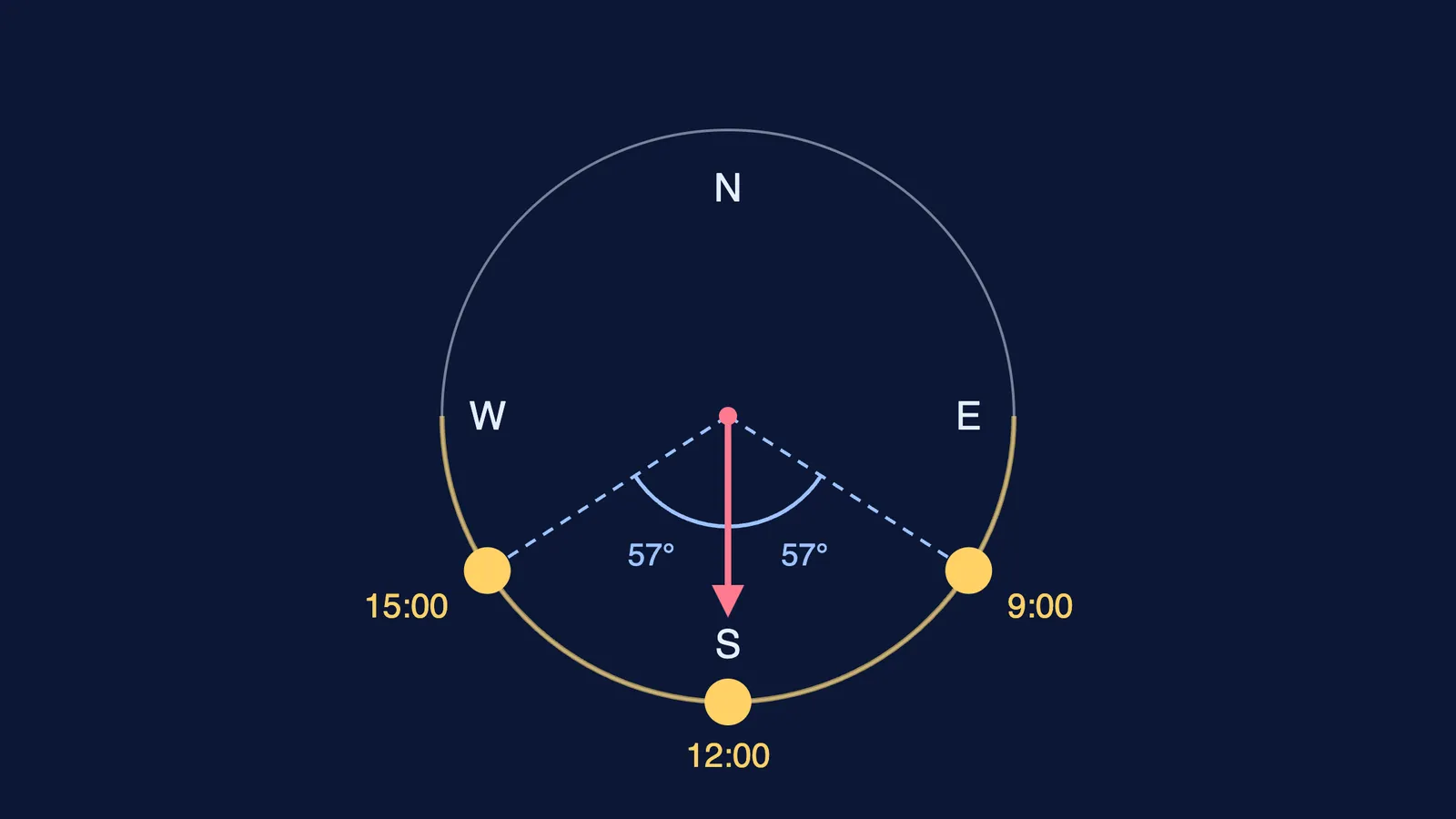
Here is the butterfly's problem, done with Class 11 trigonometry. Take an equinox, when the Sun rises due east and sets due west. Let H be the hour angle (15 degrees for every hour from solar noon) and φ your latitude. The Sun's angle θ east or west of due south is given by tan θ = tan H / sin φ.
A monarch at 40 degrees north at 9:00 solar time: H = 45 degrees, sin 40 = 0.643, so tan θ = 1.556 and θ = 57 degrees. To fly south it keeps the Sun 57 degrees to its left.
At noon, H = 0, so the Sun is straight ahead.
At 15:00 the Sun is 57 degrees to its right.
Now try Bengaluru, at about 13 degrees north: sin 13 = 0.225, so at 9:00 θ = 77 degrees.
So the Sun's direction does not change at a steady rate, and the angle to hold depends on where you are. At 13:00 and 40 degrees north the formula gives θ = 23 degrees, so a butterfly with a stopped clock would be more than 20 degrees off course an hour after noon. If the Sun's path is hard to picture, the Fermi Simulation Lab has interactive simulations for ideas that are easier to see than to read.
Do butterflies migrate in India too?
Yes. Four milkweed butterflies, the Double-branded Crow, Common Crow, Dark Blue Tiger and Blue Tiger, migrate between the Western Ghats and the southern Eastern Ghats, according to NCBS Bengaluru. The journey is 350 to 500 km. They leave the Western Ghats between April and June, before the south-west monsoon, and return between October and December. Swarms of millions pass near Bengaluru.
Vaishali Bhaumik and Krushnamegh Kunte studied these migrants in Oikos. Migrants stay in reproductive diapause, not breeding on the way, and females invest significantly more in abdominal mass than males do. The butterflies die soon after laying eggs, and NCBS says the return is made by newly emerged butterflies of the next generation, so, as with monarchs, more than one generation shares the round trip.
New to butterflies? Start with our guide to telling a butterfly from a moth.
How can you watch the Ghats migration?
You can collect real data from a park, terrace or school ground in south India.
When: April to June and October to December, on sunny mornings.
What: dark butterflies with blue or white markings, all flying the same way rather than flitting between flowers.
Log: the date, time, rough count per minute and direction of flight. Note where the Sun is too.
Test: is the angle between the flight path and the Sun the same at 9:00 and at 15:00? If the direction holds while the angle changes, you are watching a time-compensated compass at work.
A few sunny mornings of notes make a real experiment to share with your biology teacher.


