

On this page
Hold a pet budgie and it feels warm in your hands. A typical bird really does run a few degrees hotter than you, and the energy cost of flight is a big part of the reason.
What is a bird's normal body temperature?
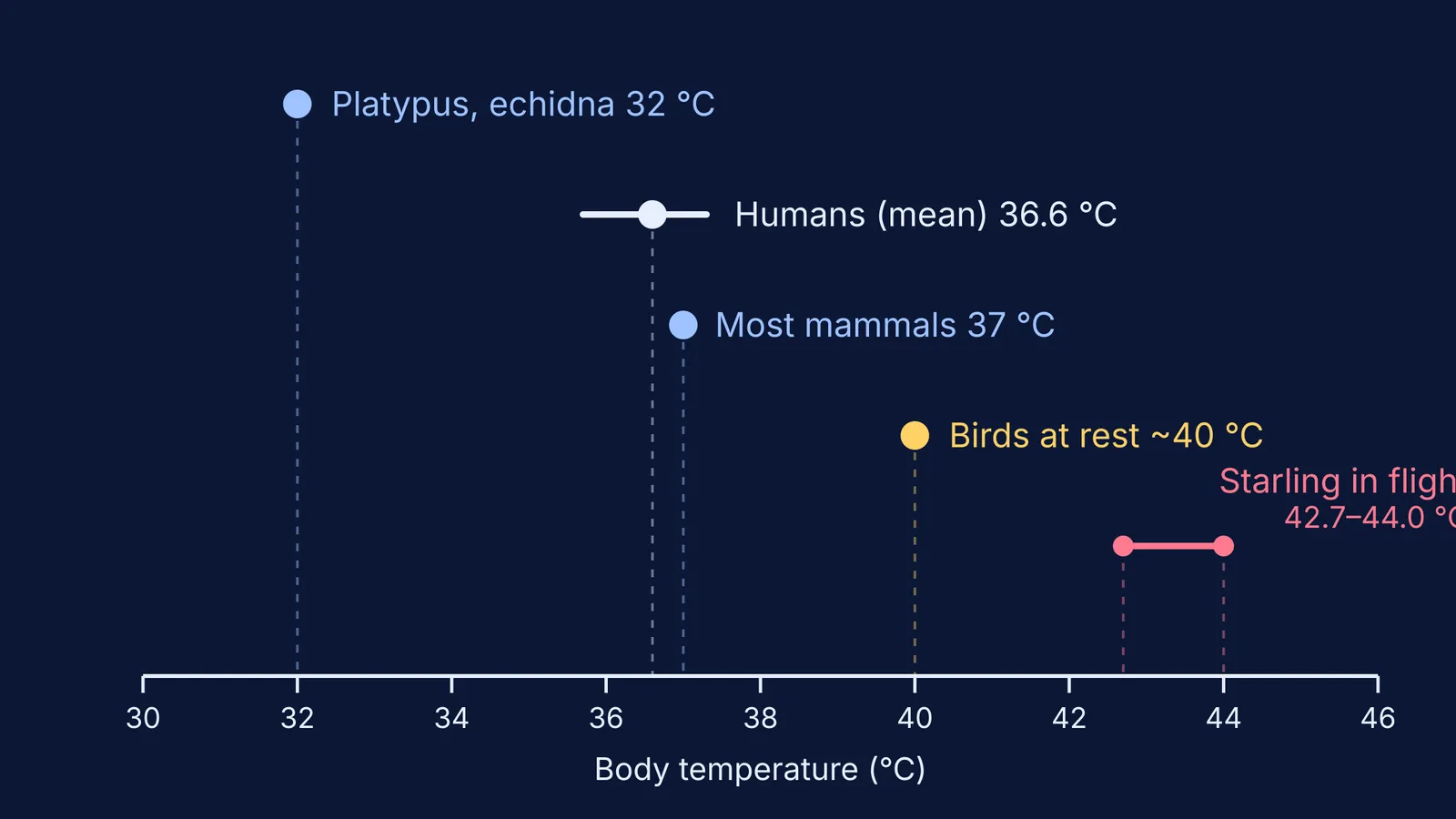
Most birds hold their core at about 40 °C. A 2023 review of basal metabolic rate in 1,817 species of mammals and birds, by Gavrilov, Golubeva and Bushuev in ZooKeys, states it plainly: living mammals run at 37 °C, the egg-laying monotremes (platypus and echidnas) at 32 °C, and birds at about 40 °C.
Birds get hotter still when they work hard. In a 1976 wind-tunnel study in the Journal of Experimental Biology, J. R. Torre-Bueno used radiotelemetry to track the core temperature of starlings during 30-minute flights. Their average core temperature in flight was 42.7 °C in one bird and 44.0 °C in another, 2 to 4 °C above their resting temperature. The paper calls these among the highest steady-state temperatures observed in any animal.
How does that compare with humans and other mammals?
Your own normal is a little below the textbook 37 °C. A BMJ study of 35,488 outpatients without infections found a mean body temperature of 36.6 °C, with 95% of people between 35.7 and 37.3 °C.
Side by side, using the ZooKeys review and the starling flight study:
Platypus and echidnas: about 32 °C
You: about 36.6 °C on average
Most mammals: about 37 °C
Most birds at rest: about 40 °C
A starling in steady flight: 42.7 to 44.0 °C
A resting bird is about 3 °C warmer than you; a flying one can be 6 °C warmer or more.
Why is a bird's body temperature higher than a human's?
Birds and mammals are both endotherms: they make their own body heat from metabolism (see our explainer on why birds and mammals are warm-blooded). The difference is how much heat a bird makes and what it does with it.
Flapping flight burns energy fast. In GPS-tracked black-legged kittiwakes, flapping flight cost 5.54 times basal metabolic rate, the most expensive of all the behaviours measured. Gliding cost only 0.80 times basal metabolic rate, about the same as resting at the colony.
Most of that energy becomes heat. Muscles are poor engines. A study of starlings flying in a wind tunnel notes that previous estimates of whole-animal flight efficiency ranged from 0.07 to 0.19. That means only about 7 to 19% of the energy a flying bird burns becomes mechanical work; the other 81 to 93% is released as heat.
Feathers hold the heat in. Torre-Bueno's starlings did not use their high temperature to get rid of heat. Instead, the 1976 paper concluded that the birds adjusted their feather insulation to maintain a high temperature, presumably because it is necessary for flight.
The ZooKeys review adds some physics: to shed heat through the skin, an endotherm has to be warmer than its surroundings, and the higher its body temperature, the more effective that heat loss is. The same review links higher body temperatures to higher metabolic rates across groups of mammals and birds.
A high-power body also needs a strong supply line: see how air sacs and hollow bones suit a bird for flight and why small animals have fast heart rates.
Worked example: how much heat does a flapping bird make?
Call the bird's basal metabolic rate 1 unit; at rest, all of it ends up as heat.
Flapping flight uses 5.54 units (the kittiwake study).
With an efficiency of 0.07 to 0.19 (the range quoted in the starling study), the share released as heat is 1 − 0.19 = 0.81 up to 1 − 0.07 = 0.93.
Heat while flapping = 5.54 × 0.81 ≈ 4.5 units, up to 5.54 × 0.93 ≈ 5.2 units.
While it flaps, the bird is making roughly 4.5 to 5 times as much heat as its whole body makes at rest. This mixes a kittiwake's cost with an efficiency range from starling studies, so treat it as an estimate, not a measurement. Even so, it makes a 2 to 4 °C rise in core temperature during flight easy to believe.
How do you use this in an exam answer?
Write the chain in order: flight, high metabolic rate, heat from inefficient muscles, insulation by feathers, a core of about 40 °C (ZooKeys review). In a physics-style question, show the split: total power × (1 − efficiency) = heat.
If endothermy, metabolic rate or heat transfer still feel shaky, the Fermi Concept Library gives every concept in physics, chemistry and biology its own lesson and its place in the map. For practice turning ratios like these into numbers, the Fermi Problem Library has worked problems with a step-by-step solver that explains the reasoning rather than printing an answer.


