On this page
A mouse and an elephant both keep their bodies at a steady temperature, yet one heart races and the other beats slowly. The reason starts with geometry. Learn the chain from size to heat loss to oxygen demand and you can answer any version of this question.
Why do small animals lose heat faster?
Heat leaves a body through its surface, but heat is made by the whole volume of living tissue. If you double an animal's length, its surface area goes up four times (length squared) but its volume goes up eight times (length cubed). So the surface-area-to-volume ratio falls as an animal gets bigger.
OpenStax Biology 2e puts it directly: smaller endothermic animals have a greater surface area for their mass, so they lose heat faster and need more energy to keep a constant internal temperature.
Worked example: the cube animal
Model each animal as a cube of side L. Surface area is 6L squared, volume is L cubed, so the ratio is 6/L.
Mouse-sized cube, L = 3 cm: surface 54 cm squared, volume 27 cm cubed, ratio 2 per cm.
Elephant-sized cube, L = 150 cm: surface 135,000 cm squared, volume 3,375,000 cm cubed, ratio 0.04 per cm.
Divide 2 by 0.04: the small cube has 50 times more surface for every cubic centimetre of body.
Real animals are not cubes, but the 1/L pattern holds for any shape you scale up evenly.
How much faster is a small animal's metabolism per gram?
To replace all that lost heat, each gram of a small animal has to burn more fuel. In the comparison used by OpenStax Biology 2e, a 35 g mouse uses 890 cubic millimetres of oxygen per gram per hour and a 4,500 kg elephant uses 75. That is about 12 times more oxygen per gram for the mouse.
Across many species the pattern is smooth. A study of 619 mammal species found that basal metabolic rate rises with body mass to the power 2/3 (White and Seymour, PNAS 2003). Scientists still debate whether the exponent is 2/3 or 3/4 (that paper argues for 2/3), but either way the exponent is less than 1. An elephant burns far more energy in total, but each gram of elephant burns much less than each gram of mouse.
Why does a faster metabolism need a faster heart rate?
Burning fuel needs oxygen, and blood carries it to every tissue. If every gram needs more oxygen each minute, the heart must deliver more blood per gram each minute, and small hearts do that largely by beating faster.
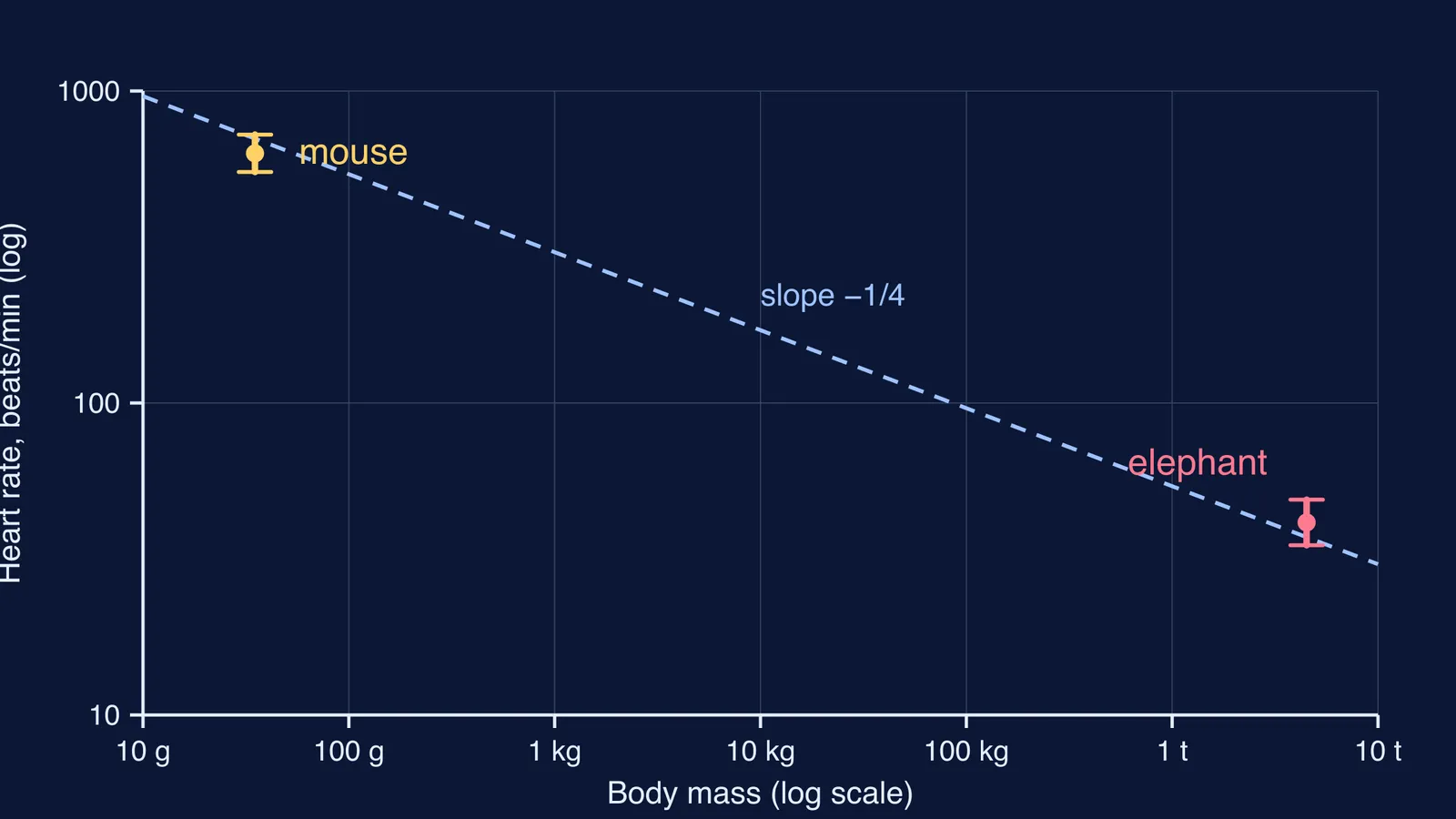
Resting heart rates in conscious mice measured by telemetry range from 550 to 725 beats per minute, and across mammals heart rate scales with body mass to the power minus 1/4 (Kaese and Verheule, Frontiers in Physiology 2012). An ECG study of four elephants recorded heart rates of 35 to 49 beats per minute (Loypetjra, Thai Journal of Veterinary Medicine 1991). In a larger ECG study of 27 Asian elephants, heart rate tended to get slower with age (Bartlett and colleagues, Journal of Zoo and Wildlife Medicine 2009).
Check the minus 1/4 rule yourself
Using the masses from the OpenStax comparison, the elephant is about 4,500,000 g divided by 35 g, or roughly 128,600 times heavier than the mouse. The fourth root of 128,600 is about 19, so the rule predicts that the mouse's heart beats about 19 times faster. The measured ranges give 550 divided by 49 at the low end (about 11) and 725 divided by 35 at the high end (about 21). The prediction lands inside that range.
How do you answer this question in an exam?
Examiners want the chain in order, with no missing links:
Smaller body, so a larger surface-area-to-volume ratio (ratio is proportional to 1/L).
Larger ratio, so heat is lost faster for each gram of tissue.
Faster heat loss, so a higher metabolic rate per gram is needed to keep body temperature constant.
Higher metabolic rate per gram, so more oxygen is needed per gram each minute, which means faster breathing and a faster heart rate.
Then add one number, such as the mouse and elephant heart rates above, and say "per gram" every time you mention metabolic rate.
If step 1 or step 4 feels shaky, the Fermi Concept Library has every concept in physics, chemistry, biology, mathematics and computing, each with its own lesson, so you can go back over the ideas behind each step. For the arithmetic, the Fermi Problem Library has worked problems with a step-by-step solver that explains the reasoning rather than printing an answer.
Next time you see a sparrow on a cold morning, run the four steps in your head.