

On this page
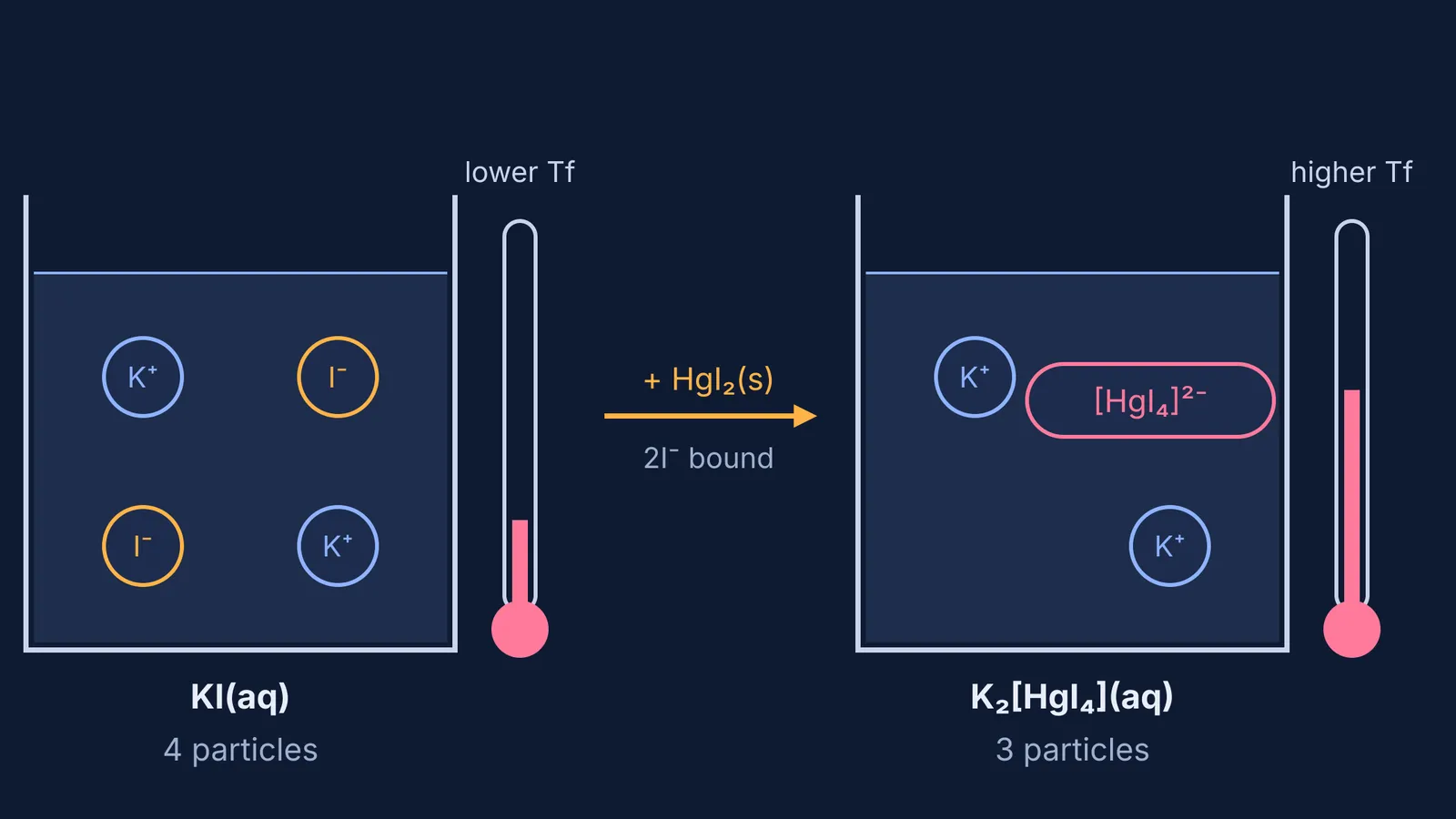
Shake red mercury(II) iodide with water and nothing happens: HgI₂ is insoluble. Shake it with potassium iodide solution instead and the red solid disappears. A solid has dissolved, so you might expect more particles in solution and a lower freezing point. The opposite happens. The freezing point goes up. This post shows why, with a full calculation, and turns it into a habit you can use on any colligative property question: count the particles after the reaction, not before.
What happens when HgI₂ dissolves in KI solution?
HgI₂ reacts with iodide ions to form the soluble tetraiodomercurate(II) complex:
HgI₂(s) + 2KI(aq) → K₂HgI₄
As an ionic equation, with K⁺ left out as a spectator:
HgI₂(s) + 2I⁻(aq) → [HgI₄]²⁻(aq)
Check the balance. Left: 1 Hg, 4 I, charge 2−. Right: 1 Hg, 4 I, charge 2−. Each formula unit of HgI₂ takes two free iodide ions out of solution and locks them, together with its own two iodides, into one complex anion. This is the same K₂[HgI₄] that, made alkaline, becomes Nessler's reagent; its use as an ammonia test is covered in the test for the ammonium ion.
Why does the number of dissolved particles fall?
Colligative properties depend on the number of solute particles per kilogram of solvent, not on what the particles are. So follow the particle count through the reaction.
Before: HgI₂ is a solid. It contributes nothing to the solution, because it is not dissolved.
Removed: two I⁻ ions per HgI₂ that reacts.
Added: one [HgI₄]²⁻ ion per HgI₂ that reacts.
K⁺: unchanged. It was free before and is still free after.
Net change: two particles out, one particle in. Every mole of HgI₂ that dissolves lowers the particle count by one mole. Fewer particles means a smaller depression of freezing point, so the solution freezes at a higher temperature than before.
This is not "freezing point elevation" in any new colligative sense. The solution still freezes below 0 °C. Its depression has simply become smaller because the particle count fell.
Worked example: how much does the freezing point rise?
0.200 mol KI is dissolved in 1.00 kg of water. Then 0.0500 mol HgI₂ is added and dissolves completely. Find the freezing point before and after. Take Kf of water as 1.86 K kg mol⁻¹.
Assumptions: KI dissociates completely (i = 2), the complex forms completely, the solution behaves ideally, and the volume change on adding the solid does not matter because molality uses the mass of water.
Before adding HgI₂
KI → K⁺ + I⁻, so 0.200 mol KI gives 0.400 mol of ions.
Particle molality = 0.400 mol / 1.00 kg = 0.400 mol kg⁻¹.
ΔTf = Kf × i × m = 1.86 × 0.400 = 0.744 K.
Freezing point = −0.744 °C.
After adding HgI₂
0.0500 mol HgI₂ needs 2 × 0.0500 = 0.100 mol KI.
KI left over = 0.200 − 0.100 = 0.100 mol, which gives 0.200 mol of ions (0.100 K⁺ + 0.100 I⁻).
K₂[HgI₄] formed = 0.0500 mol, which gives 3 × 0.0500 = 0.150 mol of ions (0.100 K⁺ + 0.0500 [HgI₄]²⁻).
Total particles = 0.200 + 0.150 = 0.350 mol, so particle molality = 0.350 mol kg⁻¹.
ΔTf = 1.86 × 0.350 = 0.651 K.
Freezing point = −0.651 °C.
The freezing point rises by 0.744 − 0.651 = 0.093 K. As a shortcut, the particle count fell by exactly 0.0500 mol (one per HgI₂), and 1.86 × 0.0500 = 0.093 K. The two routes agree, which is a useful check.
What if you keep adding HgI₂?
The 0.200 mol of I⁻ can bind at most 0.200 / 2 = 0.100 mol HgI₂. Up to that point, each extra mole of HgI₂ raises the freezing point by the same 1.86 K per mole per kilogram. At 0.100 mol HgI₂ all the free iodide is used up. The solution then holds 0.200 mol K⁺ and 0.100 mol [HgI₄]²⁻, 0.300 mol of particles, so ΔTf = 1.86 × 0.300 = 0.558 K and the freezing point is −0.558 °C.
Beyond that, extra HgI₂ has no free iodide to react with, so it stays as a red solid and the freezing point stops changing. A graph of freezing point against moles of HgI₂ added would rise in a straight line and then go flat.
Do all complex-forming reactions lower the particle count?
No, and that is why you must count every time. Compare AgCl dissolving in aqueous ammonia:
AgCl(s) + 2NH₃(aq) → [Ag(NH₃)₂]⁺(aq) + Cl⁻(aq)
Two dissolved NH₃ molecules are used up, and two ions appear. The particle count does not change, so the freezing point stays the same (treating NH₃ as un-ionised, which is reasonable for a weak base). In the HgI₂ case the complex is formed from ions that were already free, so the count falls.
The general habit, then, is the one used for fixed solutions in ranking colligative properties by i × m, applied after the reaction has run. If the van 't Hoff factor itself still feels shaky, colligative properties and the van 't Hoff factor covers dissociation and association first.
For more questions where a reaction changes the answer to a colligative property problem, the Fermi Problem Library has a step-by-step solver that explains the reasoning at each step.
What mistakes cost marks on this question?
Counting HgI₂ as a solute particle before it reacts. It is insoluble and contributes nothing.
Adding the complex's ions to the original KI ions without removing the iodide the complex used up.
Writing K₂[HgI₄] as giving 7 ions (2 K⁺ + Hg²⁺ + 4 I⁻). The complex ion stays intact, so i = 3.
Calling the result a negative ΔTf. The depression is still positive, just smaller.
Using molarity and worrying about the volume of the added solid. Molality depends only on the mass of water.
Quick checklist
HgI₂(s) + 2I⁻ → [HgI₄]²⁻: two free ions out, one ion in.
Each mole of HgI₂ dissolved removes one mole of particles.
Fewer particles means a smaller ΔTf, so the freezing point rises but stays below 0 °C.
0.200 mol KI in 1.00 kg water: −0.744 °C; after 0.0500 mol HgI₂: −0.651 °C.
The rise stops once all free iodide is bound (0.100 mol HgI₂ here, at −0.558 °C).
Always write the reaction, then count particles, then apply Kf × i × m.


