

On this page
In Class 12 you learn the Swarts reaction as one line: heat an alkyl chloride with a metal fluoride and fluorine replaces chlorine. Industry runs the same swap on a huge scale, one carbon down from the textbook freon. Chloroform is fluorinated to make HCFC-22, CHClF₂. The trouble is that the swap does not stop exactly where the chemist wants. A little CHClF₂ takes one more fluorine and becomes fluoroform, CHF₃, also called HFC-23, an extremely potent greenhouse gas. On 13 October 2016, India's environment ministry ordered every HCFC-22 producer to destroy it (PIB release).
How is HCFC-22 made from chloroform?
The IPCC's guidance on this process gives the overall reaction (IPCC Good Practice Guidance, HCFC-22 production):
CHCl₃ + 2HF → CHClF₂ + 2HCl
Check: 1 C, 3 H, 3 Cl and 2 F on each side.
The catalyst is antimony pentachloride, SbCl₅. The same IPCC document explains that SbCl₅ reacts with HF to form mixed antimony chloride fluorides, SbClₓFᵧ with x + y = 5, and these are what actually swap fluorine for chlorine on carbon. So the fluorine is carried in on antimony, exactly Swarts's idea, but the antimony is topped up with cheap HF instead of being used up as SbF₃. That is why this is not the NCERT recipe with SbF₃ or AgF. Our post on Finkelstein and Swarts reactions covers the classroom version, making CCl₂F₂ from CCl₄.
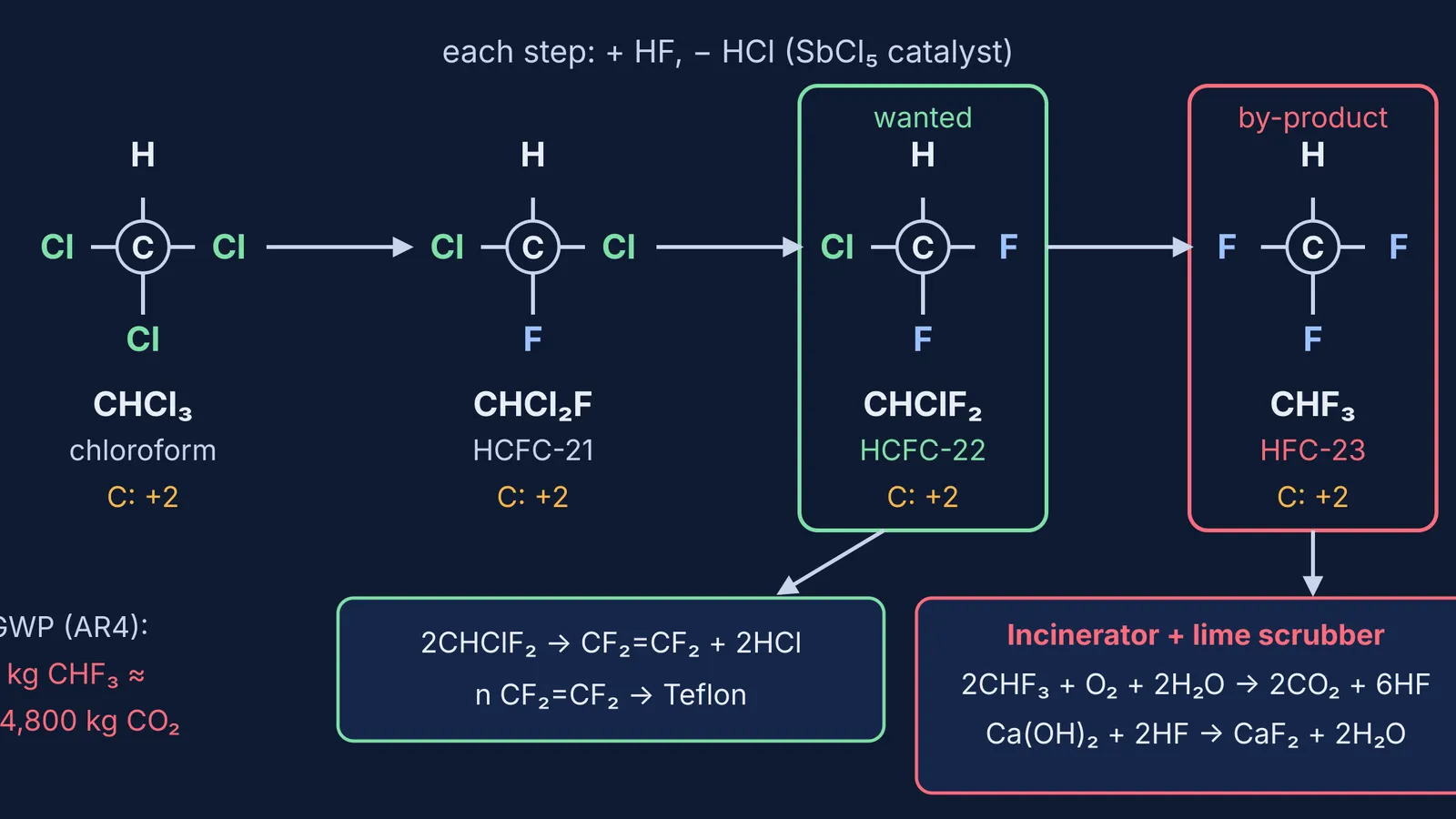
The chlorines are swapped one at a time:
CHCl₃ + HF → CHCl₂F + HCl (HCFC-21)
CHCl₂F + HF → CHClF₂ + HCl (HCFC-22, the product wanted)
CHClF₂ + HF → CHF₃ + HCl (HFC-23, the by-product)
Add steps 1 and 2 and you get the overall equation above. HF is acutely toxic, which is one more reason these plants are tightly controlled.
Why can't the plant stop at CHClF₂?
Because step 3 is the same reaction as steps 1 and 2. The catalyst cannot tell CHCl₂F from CHClF₂; it simply swaps a chlorine for a fluorine wherever it meets one. Each added fluorine lowers the boiling point, so the plant boils off the lighter products and sends chloroform and CHCl₂F back for more fluorination. Some CHClF₂ still reacts again before it escapes.
The IPCC's 2006 inventory guidelines put the default at 4% HFC-23 (0.04 kg per kg of HCFC-22) for older plants with no abatement. Process tuning can bring it down to 1.4–3%, but "it is not possible to completely eliminate HFC-23 formation this way" (IPCC 2006 Guidelines, Vol. 3, Ch. 3). The same chapter notes that HFC-23 is not removed by ordinary acidic, neutral or alkaline water scrubbing. Unless it is destroyed, it goes up the stack.
Is fluorinating chloroform a redox reaction?
No. Work out the oxidation number of carbon, taking H as +1, Cl as −1 and F as −1:
CHCl₃: x + 1 − 3 = 0, so C is +2
CHCl₂F: x + 1 − 2 − 1 = 0, so C is +2
CHClF₂: x + 1 − 1 − 2 = 0, so C is +2
CHF₃: x + 1 − 3 = 0, so C is +2
Carbon stays at +2 throughout. Chlorine and fluorine are both −1 on carbon, and both are −1 in HCl and HF. Nothing is oxidised or reduced. Every step is a substitution, like the Swarts reaction in your textbook.
Why make HCFC-22 if it is being phased out?
HCFC-22 contains chlorine, so it harms the ozone layer, and the Montreal Protocol is phasing out its use as a refrigerant. But it is also the starting material for Teflon. Heated strongly, two molecules lose HCl and join:
2CHClF₂ → CF₂=CF₂ + 2HCl
Tetrafluoroethene then polymerises to (–CF₂–CF₂–)ₙ. Production of HCFC-22 as a feedstock is allowed to continue, as the 2016 PIB release itself points out. So HFC-23 keeps being made too.
Why does India treat HFC-23 so seriously?
HFC-23 has no chlorine, so it does not destroy ozone. Its problem is warming. The PIB release gives its global warming potential (GWP) as 14,800: over 100 years, 1 kg traps as much heat as 14,800 kg of CO₂. That is the IPCC Fourth Assessment value; later reports give 12,400 (AR5) and 14,600 (AR6) (GHG Protocol GWP table). This post uses 14,800 throughout, to match the order.
According to the release, producers must build enough storage to cover incinerator downtime and must not release HFC-23. The ministry added that feedstock production of HCFC-22 would peak at about 1 million tonnes worldwide, and destroying the HFC-23 would avoid more than 444 million tonnes of CO₂ equivalent globally. Down To Earth reported a smaller figure for India alone, about 100 million tonnes over 15 years (Down To Earth). The two numbers measure different things: one is global, the other national.
For how chlorine in a CFC or HCFC does attack ozone, see freons and the ozone chain.
Worked example: what comes with a tonne of HCFC-22?
Molar masses: CHClF₂ 86.47, CHCl₃ 119.37, HF 20.01, HCl 36.46, CHF₃ 70.01, CO₂ 44.01, CaF₂ 78.07 g/mol.
Step 1: moles of product. 1,000,000 g ÷ 86.47 = 11,565 mol of CHClF₂.
Step 2: feed and by-product HCl. The equation is 1 : 2 → 1 : 2.
Chloroform: 11,565 × 119.37 = 1.381 t
HF: 2 × 11,565 × 20.01 = 0.463 t
HCl: 2 × 11,565 × 36.46 = 0.843 t
Mass check: 1.381 + 0.463 = 1.843 t in; 1.000 + 0.843 = 1.843 t out.
Step 3: the HFC-23. Take an illustrative 3% by mass, the top of IPCC's tuned range: 30 kg, which is 30,000 ÷ 70.01 = 428 mol of CHF₃. In CO₂ equivalent, 30 kg × 14,800 = 444,000 kg = 444 t CO₂e, from one tonne of product. Check against the ministry: 1 million tonnes × 0.03 × 14,800 = 444 million tonnes, the same ratio. At the IPCC default of 4%, it would be 592 t.
Step 4: destroying it. Thermal oxidation turns CHF₃ into CO₂ and HF:
2CHF₃ + O₂ + 2H₂O → 2CO₂ + 6HF
Check: 2 C, 6 H, 6 F and 4 O on each side. So 428 mol CHF₃ gives 428 mol CO₂ (18.9 kg) and 1,285 mol HF (25.7 kg).
Step 5: catching the HF. Lime neutralises it: Ca(OH)₂ + 2HF → CaF₂ + 2H₂O. That gives 1,285 ÷ 2 = 643 mol of CaF₂, which is 643 × 78.07 = 50 kg. CaF₂ is fluorite, the mineral behind the fluorite unit cell.
The trade is lopsided: about 19 kg of real CO₂ is released to avoid 444 t of CO₂ equivalent, roughly 23,000 times as much.
If you want more mole-ratio problems like this one, the Fermi Problem Library has a step-by-step solver that explains the reasoning rather than printing an answer.
Quick checklist
HCFC-22 route: CHCl₃ + 2HF → CHClF₂ + 2HCl, SbCl₅ catalyst carrying fluorine as SbClₓFᵧ.
Over-fluorination: CHClF₂ + HF → CHF₃ + HCl. It can be reduced, not prevented.
Carbon is +2 in CHCl₃, CHCl₂F, CHClF₂ and CHF₃: substitution, not redox.
HCFC-22 feeds Teflon: 2CHClF₂ → CF₂=CF₂ + 2HCl.
HFC-23: no ozone harm, GWP 14,800 (AR4).
Per tonne of HCFC-22 at 3% by-product: 30 kg CHF₃ = 444 t CO₂e; destruction gives 18.9 kg CO₂ and 50 kg CaF₂.


