

On this page
Take a breath from a party balloon and your voice comes out thin and cartoonish. Most people explain this by saying helium makes the vocal cords vibrate faster. It does not. The pitch of your voice, set by your vocal folds, stays almost the same. What changes are the resonances of your throat and mouth, called formants, and they move up because sound travels faster in helium. That is a closed-pipe problem you can solve with JEE physics.
Do not try this yourself. Breathing helium in place of air can starve you of oxygen, and gas taken straight from a pressurised cylinder can damage the lungs. The University of New South Wales speech acoustics page gives the same warning.
What sets the pitch of your voice?
Your vocal folds open and close many times a second, chopping the air from your lungs into puffs. That rate is the fundamental frequency, which you hear as pitch. It is set by the tension, length and mass of the folds, as explained in how your vocal cords make sound and what sets the pitch. The gas around the folds hardly affects it.
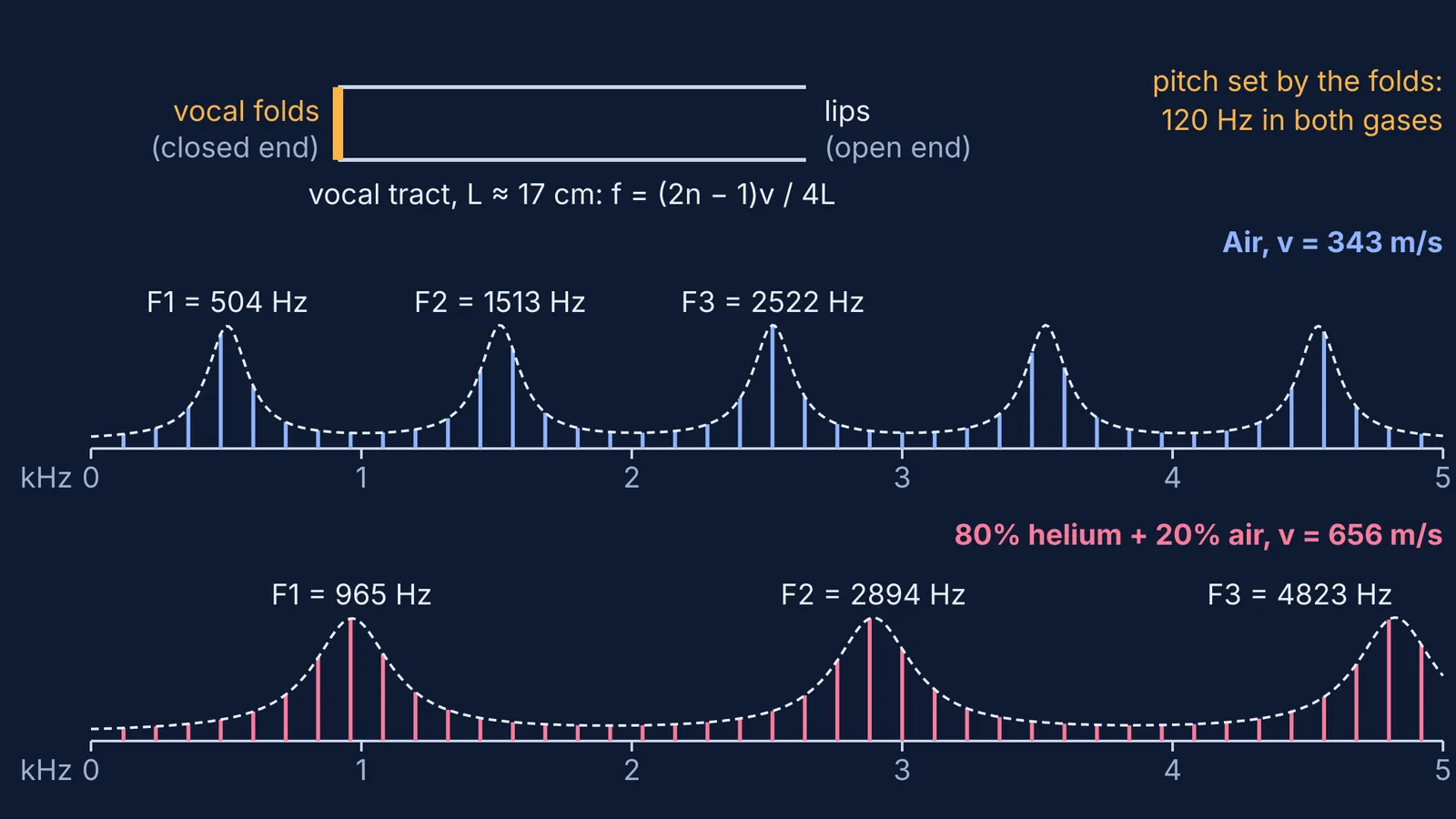
The puffs are not a pure tone. A typical adult male voice at 120 Hz also contains harmonics at 240, 360, 480 Hz and so on, every whole multiple of 120 Hz. Breathe helium and the folds still vibrate at about 120 Hz, so the harmonics stay at the same frequencies.
What are formants?
Above the folds is the vocal tract: the throat, mouth and lips. For a neutral vowel like the "uh" in "but", it behaves roughly like a uniform tube about 17 cm long. It acts as closed at the folds, where the opening is tiny compared with the tract, and open at the lips.
A tube like this has resonances. Harmonics from the folds that fall near a resonance come out loud; those between resonances come out weak. The peaks in the output spectrum are the formants. You change their positions with your tongue and lips, and that is how you tell one vowel from another.
So the voice has two separate parts: the folds decide which frequencies are present, and the tract decides which of them are loud. The loudness pattern of the harmonics is the timbre, the same idea that makes two instruments sound different on the same note.
How do you calculate the formants of the vocal tract?
A pipe closed at one end has a pressure antinode at the closed end and a node at the open end, so it fits λ/4, 3λ/4, 5λ/4 and so on. The resonances are:
Fₙ = (2n − 1) v / 4L, with n = 1, 2, 3…
Only odd multiples of v/4L appear. With L = 0.17 m (a typical adult value, used here as an assumption) and v = 343 m/s in air at 20 °C:
F₁ = 343 / (4 × 0.17) = 504 Hz
F₂ = 3 × 504 = 1513 Hz
F₃ = 5 × 504 = 2522 Hz
These match the round values of about 500, 1500 and 2500 Hz usually quoted for a neutral vowel. Notice that the wavelength of the first resonance is 4L = 68 cm whatever gas fills the tube. The wavelength is fixed by the shape; the frequency follows from f = v/λ.
Worked example: how far do the formants move in helium?
A real lungful is never pure helium. Assume, as a round illustration, a mixture that is 80% helium and 20% air by moles, at 20 °C (293 K).
Molar mass of the mixture. M = 0.8 × 4.00 + 0.2 × 28.97 = 9.00 g/mol.
Heat capacities. Helium is monatomic, Cv = 3R/2. Air is mostly diatomic, Cv = 5R/2. Mixture: Cv = 0.8 × 1.5R + 0.2 × 2.5R = 1.70R, and Cp = Cv + R = 2.70R.
Ratio of heat capacities. γ = 2.70/1.70 = 1.59.
Speed of sound. v = √(γRT/M) = √(1.588 × 8.314 × 293 / 0.0090) = 656 m/s.
Scale factor. 656/343 = 1.91. Every formant rises by this factor, because L is unchanged and F is proportional to v.
New formants. F₁ = 965 Hz, F₂ = 2894 Hz, F₃ = 4823 Hz.
Pitch. Still about 120 Hz. The harmonics are the same comb of frequencies; only the peaks of the envelope moved.
For pure helium, v = √(1.667 × 8.314 × 293 / 0.004) = 1007 m/s, and F₁ would be 1481 Hz, 2.9 times the value in air. The general mixture method, with a hydrogen and oxygen example, is in speed of sound in a gas mixture.
Why does the voice sound higher if the pitch is the same?
In air, F₁ at 504 Hz makes the fourth harmonic (480 Hz) loud. In the helium mix, F₁ at 965 Hz makes the eighth harmonic (960 Hz) loud instead. Energy moves from the low harmonics to higher ones. Your ear hears that as a brighter, thinner sound, the kind it links with a small speaker such as a child or a cartoon animal, because a shorter tract would also push the formants up.
The formants also move away from where your listener expects each vowel, so vowels in helium speech are hard to tell apart. Divers who breathe helium–oxygen mixtures at depth have the same problem, which is why their speech is often hard to follow.
What does a heavy gas like sulphur hexafluoride do?
It does the opposite. The speed of sound in sulphur hexafluoride (SF₆) is about 133 m/s at 11 °C, according to the Engineering ToolBox table of speeds of sound in gases. That is roughly 0.39 times the speed in air, so the formants fall by roughly that factor: F₁ drops to about 196 Hz. The voice sounds deep and booming, but again the folds set the same pitch. SF₆ is also not safe to breathe in place of air.
To see standing waves form in closed and open pipes, try the Simulation Lab, which has interactive simulations for ideas that are easier to see than read.
Quick checklist
Pitch is set by the vocal folds and barely changes in helium.
Formants are resonances of the vocal tract, a tube closed at the folds and open at the lips.
Fₙ = (2n − 1)v/4L; with L = 17 cm in air, 504, 1513 and 2522 Hz.
An 80% helium mix has M = 9.0 g/mol, γ = 1.59 and v = 656 m/s, so formants rise by 1.91 times.
Average heat capacities, not γ values or speeds.
Heavy gases lower the formants. Do not breathe either kind.


