

On this page
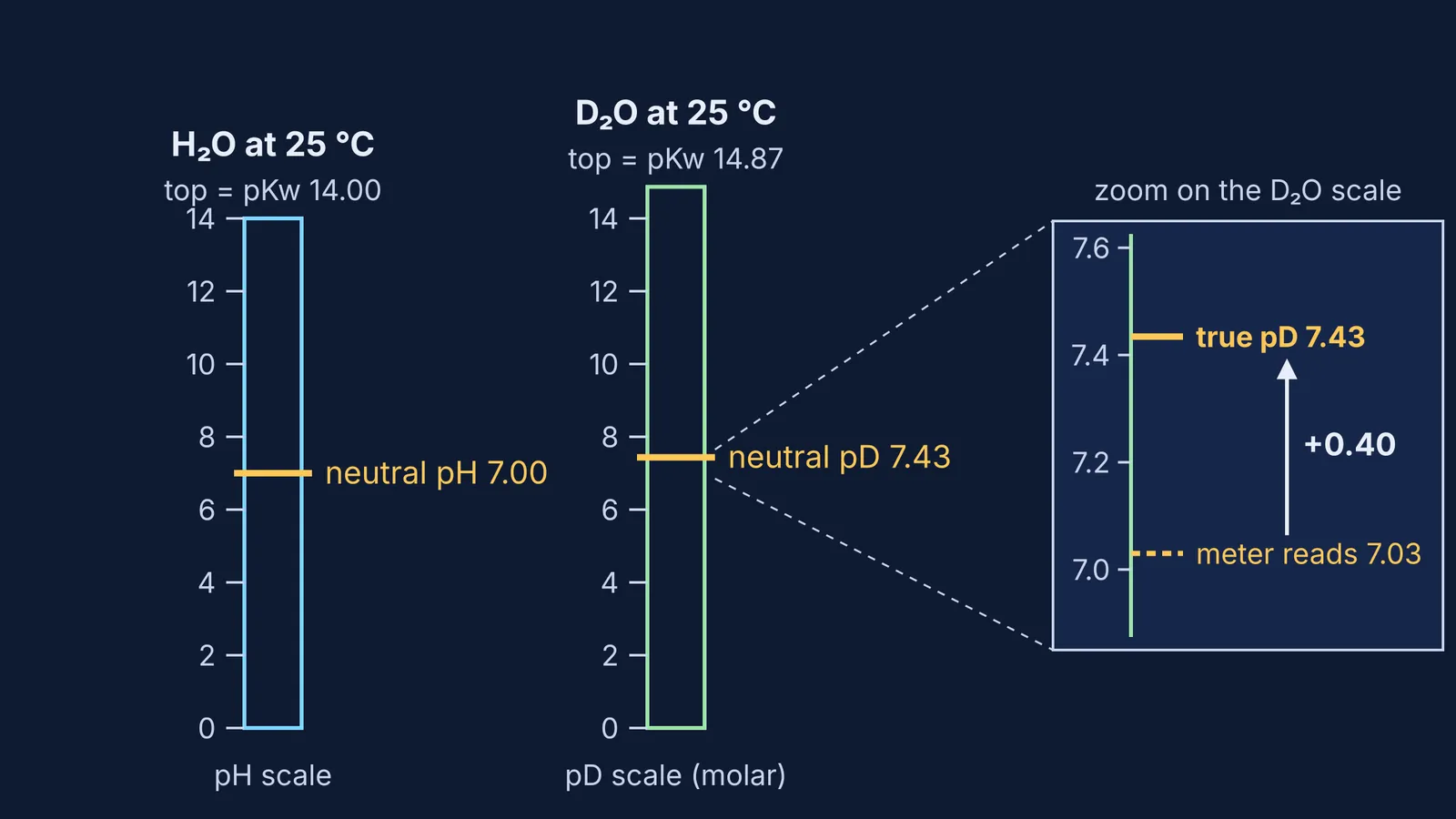
Ask the pH of pure heavy water, D₂O, and most people say 7. It is not. At 25 °C neutral heavy water has a pD of about 7.43. Odder still, a normal pH meter dipped into it shows about 7.0. Two separate effects are at work, and they almost cancel. Here are both, with the numbers, and what to write when an exam gives you the ion product of D₂O.
What is pD, and why is neutral heavy water not 7?
In heavy water the acidic particle is D⁺ (strictly D₃O⁺), so chemists write pD = −log a(D⁺), the activity of D⁺. In dilute solution treat it as −log[D⁺], as you do for pH.
Water of either kind ionises a little:
D₂O ⇌ D⁺ + OD⁻ Kw(D₂O) = [D⁺][OD⁻]
In pure D₂O, [D⁺] = [OD⁻], so neutral pD = ½ pKw(D₂O), the same rule as for water. But D₂O ionises less, so its pKw is larger and half of it is more than 7.
The ion product was measured by A. K. Covington, R. A. Robinson and R. G. Bates (J. Phys. Chem. 70, 3820, 1966). The value most often tabulated from their work is pKw = 14.955 at 25 °C, on the molal scale (moles per kilogram of D₂O). The open-access survey by Robinson, Paabo and Bates gives the same 14.955 beside 13.997 for ordinary water, both molal (J. Res. NBS 73A, 299, 1969).
Which pKw should you use: molal 14.955 or molar 14.87?
Exam questions use molarity, so you want the molar value. In dilute solution, molarity = molality × solvent density (kg/L), and Kw contains two concentrations, so:
pKw(molar) = pKw(molal) − 2 log(density)
D₂O has a density of about 1.104 g/mL at 25 °C. So pKw(molar) = 14.955 − 2 × log(1.104) = 14.955 − 0.086 = 14.87. That gives Kw(D₂O) ≈ 1.35 × 10⁻¹⁵ on the molar scale, and neutral pD = 14.87 ÷ 2 = 7.43.
On the molal scale, neutral pD is 14.955 ÷ 2 = 7.48. Both are right; quote one and name its scale. For H₂O the scales differ by only 0.002, because its density is close to 1 g/mL.
On the molar scale Kw(H₂O) is about 7.4 times Kw(D₂O); on the molal scale (13.995 against 14.955) about 9.1. A ratio without a scale is incomplete.
If temperature changing neutral pH is new to you, read why neutral pH is not always 7 and how Kw changes with temperature first. Heavy water does the same thing by changing the isotope instead of the temperature.
Why does heavy water ionise less than ordinary water?
Deuterium has the same electrons as hydrogen, so the O–D bond has the same electronic strength as O–H. What differs is mass. Even at absolute zero a bond vibrates with a zero-point energy, and a heavier atom vibrates at a lower frequency, so O–D sits lower in its energy well.
Starting lower, the O–D bond needs a little more energy to give up D⁺. Summed over the bonds that change, that tips the equilibrium toward un-ionised D₂O. This is an equilibrium isotope effect: the same mass effect that slows C–D bond breaking, but shifting where equilibrium lies, not how fast it is reached.
So "isotopes have the same chemical properties" holds for which reactions happen, not for exact equilibrium constants. For how D₂O is made and used, see heavy water: preparation, properties and uses.
Why does a pH meter read about 7.0 in neutral D₂O?
A glass electrode is a voltmeter calibrated with H₂O buffers. In D₂O the glass and junction respond differently, and the reading comes out lower than the true pD.
P. K. Glasoe and F. A. Long measured this with dilute DCl in D₂O and four commercial glass electrodes. The meter read about 0.40 below the true pD, which gave the correction still in common use (J. Phys. Chem. 64, 188, 1960):
pD = meter reading + 0.40
Covington, Paabo, Robinson and Bates later refined it to about 0.41 and tied it to a standard pD scale (Anal. Chem. 40, 700, 1968). It holds for an electrode calibrated in H₂O buffers and is approximate, not exact.
Put the two effects together. Neutral pD is 7.43; the meter reads 0.40 less, so it shows 7.43 − 0.40 = 7.03. Reading "7.0" and thinking "pD 7, just like water" gets the right word for the wrong reason: two unrelated numbers nearly cancel. (D₂O left open also absorbs CO₂, which lowers the reading further.) For how the meter turns a voltage into a pH, see how a glass electrode pH meter works.
Worked example: neutral D₂O, a meter reading, and an acid
Take Kw(D₂O) = 1.35 × 10⁻¹⁵ (molar scale, 25 °C).
Neutral D₂O. [D⁺] = √(1.35 × 10⁻¹⁵) = 3.7 × 10⁻⁸ M. pD = −log(3.7 × 10⁻⁸) = 7.43. For H₂O, [H⁺] = 1.0 × 10⁻⁷ M, about 2.7 times more (the square root of 7.4).
A meter reading. A glass electrode calibrated in H₂O buffers reads 7.03 in a sample of pure D₂O. pD = 7.03 + 0.40 = 7.43. That equals ½ pKw, so the sample is neutral.
A strong acid. 0.010 M DCl in D₂O is fully ionised, so [D⁺] = 0.010 M and pD = 2.00, the same as for HCl in water. pOD = 14.87 − 2.00 = 12.87, not 12.00. The meter would read about 2.00 − 0.40 = 1.60.
A weak acid. Acetic acid is weaker in D₂O. Robinson, Paabo and Bates list pKa = 4.756 in H₂O and 5.313 in D₂O on the molal scale, which is about 5.27 on the molar scale (same 1969 source). For 0.10 M acid in D₂O, [D⁺] ≈ √(Ka × C), so pD ≈ ½(5.27 + 1.00) = 3.14. The same acid in H₂O gives pH ≈ ½(4.76 + 1.00) = 2.88. The quadratic agrees to 0.01, since the acid is about 1% ionised.
What should you write in a board or JEE/NEET answer?
NCERT's "neutral pH is 7" is correct for H₂O at 25 °C; heavy water has its own Kw. Write, in order: neutral means [D⁺] = [OD⁻]; therefore pD = ½ pKw(D₂O); and with the given Kw this is greater than 7 because D₂O ionises less than H₂O. If a reason is asked, write "lower zero-point energy of the O–D bond makes D⁺ harder to remove". Mention the meter correction only if the question involves a pH meter reading.
To practise turning a given Kw into pH, pD or pOH, Fermi's AI tutor for JEE prep can work through Kw numericals with you, and ionic equilibrium is in the Concept Library.
Quick checklist
pD = −log a(D⁺), treated as −log[D⁺] in dilute solution.
Kw(D₂O) at 25 °C: pKw 14.955 (molal) or about 14.87 (molar, Kw ≈ 1.35 × 10⁻¹⁵).
Neutral pD = ½ pKw: about 7.43 (molar) or 7.48 (molal). Say which scale.
D₂O ionises less because the O–D bond has lower zero-point energy.
Glass electrode in D₂O: pD = reading + 0.40 (Glasoe and Long) or 0.41 (Covington et al.).
A meter reading about 7.0 in pure D₂O is neutral only because 7.43 − 0.40 ≈ 7.03.
Weak acids are weaker in D₂O: acetic acid pKa about 5.3 against 4.76.


