On this page
Heavy water turns up in JEE questions on hydrogen and cools and moderates India's pressurised heavy water reactors. Here is how it is made, how it differs, and the reactions to know.
What is heavy water (D2O)?
Heavy water is water in which both hydrogen atoms are deuterium (D), the hydrogen isotope with one proton and one neutron. India's Heavy Water Board notes that deuterium has double the mass of ordinary hydrogen because of that extra neutron. The molar mass of D2O is 20.028 g/mol, against 18.015 g/mol for H2O, according to PubChem's entries for deuterium oxide and water.
Harold Urey confirmed the heavier isotope in 1931, and G. N. Lewis first produced pure heavy water in 1933, according to the Atomic Heritage Foundation. Lewis and Ronald T. Macdonald gave "1 in 6500" as a provisional value for deuterium's share of the hydrogen in ordinary water (Lewis and Macdonald, Journal of Chemical Physics, 1933).
Chemistry depends on electrons, not neutrons, so D2O undergoes the same reactions as H2O; here is why isotopes have the same chemical properties.
How is heavy water prepared by electrolysis?
During electrolysis, ordinary hydrogen leaves as gas faster than deuterium, so the remaining water gets slightly richer in deuterium. Repeating this many times compounds the effect.
Lewis and Macdonald electrolysed 20 litres of water from an old commercial electrolytic cell in four stages, down to half a cubic centimetre in which two-thirds of the hydrogen was deuterium. They wrote that further concentration to 99 percent was possible (Lewis and Macdonald, 1933). Norsk Hydro adapted its Norwegian plant to electrolysis, and by early 1935 it was selling 99% heavy water for about 50 cents per gram (Atomic Heritage Foundation).
The catch is electricity: a 2011 conference paper describes electrolysis as multi-stage and heavy on electrical energy (Ozemoyah et al., 2011). India's Heavy Water Board uses chemical exchange instead: the H2S-H2O bithermal and NH3-H2 monothermal processes (HWB). The same paper describes combined electrolysis and catalytic exchange (CECE) units that upgrade reactor heavy water diluted with light water.
How is D2O different from H2O?
Values below are from PubChem's entries for D2O (Merck Index) and water.
Melting point: D2O 3.81 °C, H2O 0 °C.
Boiling point: D2O 101.42 °C, H2O 212 °F (100 °C) at 760 mmHg.
Maximum density: D2O 1.1059 g/cm³ at 11.23 °C, H2O 1.000000 g/mL at 3.98 °C.
Molar mass: D2O 20.028 g/mol, H2O 18.015 g/mol.
A quick check: the molecules are almost the same size, so density should scale with molar mass. Predicted density: 1.000 × 20.028 / 18.015 = 1.112 g/cm³. The measured maximum, 1.1059 g/cm³, is within about 0.5% of that.
Why is heavy water used as a moderator?
A moderator slows the fast neutrons released in fission by letting them bounce off light nuclei. In a head-on elastic collision with a nucleus of mass number A, a neutron keeps a fraction ((A − 1)/(A + 1))² of its kinetic energy. That fraction is 0 for hydrogen (A = 1), 1/9 for deuterium (A = 2) and 225/289, about 0.78, for oxygen (A = 16). (Here is the derivation of energy transfer in a head-on collision.) Per collision, ordinary hydrogen slows neutrons best.
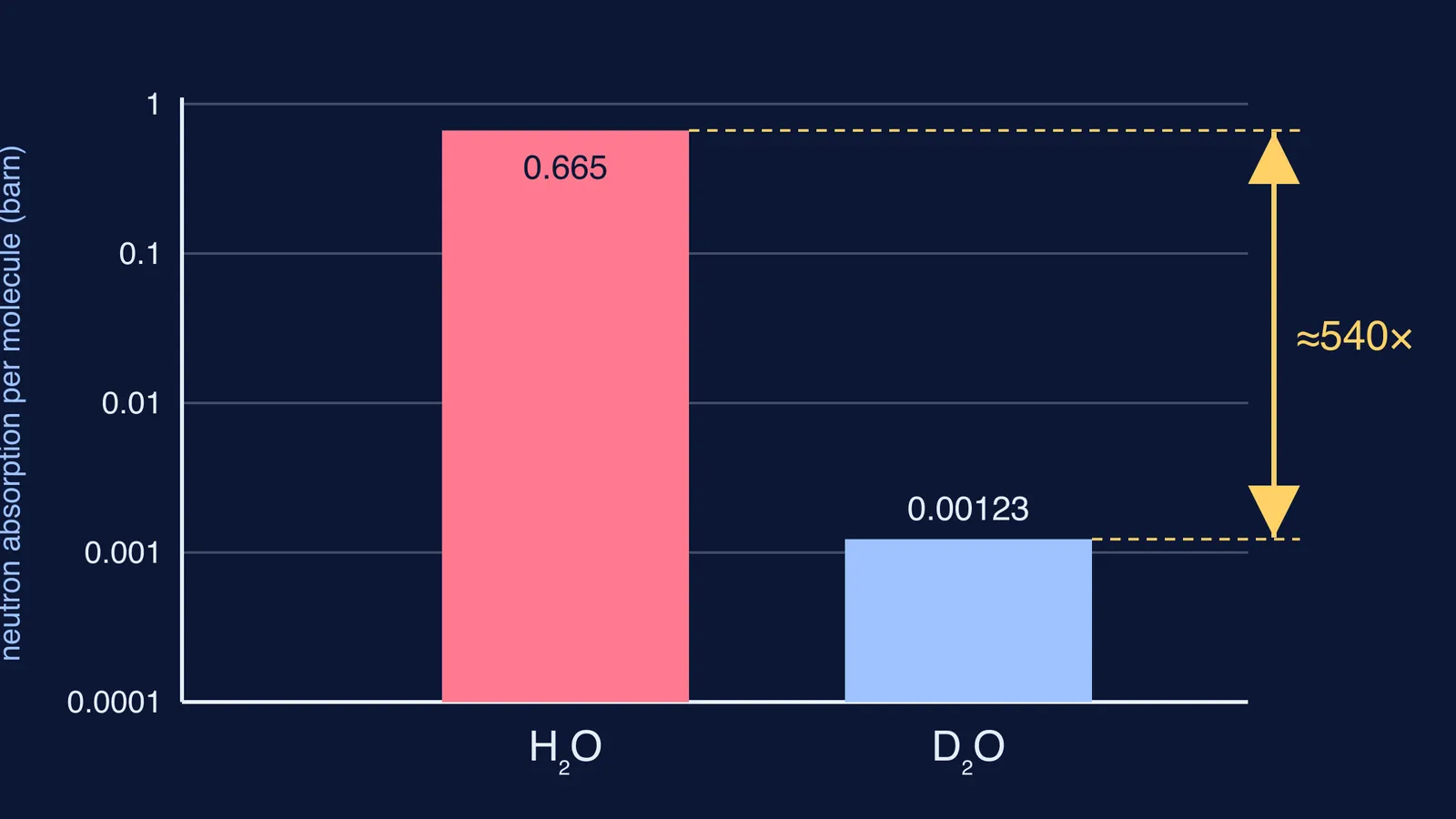
But hydrogen also swallows neutrons. The NIST Center for Neutron Research lists absorption cross sections for 2200 m/s (thermal) neutrons of 0.3326 barn for ¹H, 0.000519 barn for ²H and 0.00019 barn for oxygen. Add them up for each molecule:
H2O: 2 × 0.3326 + 0.00019 = 0.6654 barn.
D2O: 2 × 0.000519 + 0.00019 = 0.001228 barn.
Ratio: 0.6654 / 0.001228 ≈ 540.
Per molecule, D2O's absorption cross section for thermal neutrons is about 540 times smaller than H2O's. With natural uranium fuel, ordinary water absorbed too many neutrons to work as a moderator, which is why heavy water became so valuable (Atomic Heritage Foundation). Nuclear-grade heavy water is used as both moderator and coolant in pressurised heavy water reactors, and the Heavy Water Board specifies it at 99.82 to 99.91% D2O.
The 2011 paper calls moderation heavy water's largest use by far, and also lists neutrino detection, doubly labelled water for metabolic studies, and deuterium-labelled compounds.
Which reactions of D2O come up in exams?
Write the H2O reaction, then swap each H from water for D:
2Na + 2D2O → 2NaOD + D2
CaC2 + 2D2O → C2D2 + Ca(OD)2
Al4C3 + 12D2O → 3CD4 + 4Al(OD)3
Mg3N2 + 6D2O → 3Mg(OD)2 + 2ND3
Ca3P2 + 6D2O → 3Ca(OD)2 + 2PD3
SO3 + D2O → D2SO4
Check each one: count D on both sides (in reaction 3, 24 = 3 × 4 + 4 × 3), then count O, since every O on the right came from D2O.
CD4, ND3 and PD3 are deuterated covalent hydrides; see types of hydrides. To practise, the Fermi Problem Library has a step-by-step solver that explains the reasoning rather than printing an answer, and isotopes have their own lesson in the Fermi Concept Library.