

On this page
The thin lines across a car's rear window are a heater. Press the demister button and current flows through every one of them, warming the glass. Two design choices in that grid are Class 12 current electricity: the lines are wired in parallel, and on a window that narrows towards the top, a shorter line must be thinner to heat the same as a long one.
How is a heated rear window wired?
The heater is printed onto the glass. A US patent on heated backlights, US 4,728,781, describes the usual construction:
Material: a silver ceramic paste, silkscreened onto the glass and then fired in a furnace so it bonds to the surface.
Layout: thin horizontal lines joined at their ends by wider bus bars near the edges of the window.
Size: lines about 1/32 inch (0.8 mm) wide, spaced about 1 inch (2.5 cm) apart.
Current: the patent's design runs from a 12 V car supply and allows 18 to 22 A, nominally 20 A. That is about 240 W.
One bus bar connects to the positive supply, the other to the car body (0 V). Every line runs between them, so every line has the full supply voltage across it: a parallel connection.
Why are the heater lines in parallel and not in series?
A break kills only one line. Each line has its own path between the bus bars, so a scratch that cuts one line stops only that line. In series, one break would leave the whole window cold.
Thin lines are possible. Each line gets the whole voltage, so it can have a fairly high resistance. In series, all the lines together would need a low resistance, so each would be much thicker.
With the worked example below (12 lines of 1.2 m, 180 W at 13.5 V): in parallel, each line is 12.2 Ω, which is 10.1 Ω per metre. In series, the whole 14.4 m chain could only be 1.01 Ω, which is 0.070 Ω per metre. The series lines would need 144 times the cross-section, which is 12², to do the same job. Lines that thick would block the view.
Worked example: current, resistance and resistivity of one line
These numbers are illustrative, not a particular car: 12 lines, each 1.2 m long, drawing 180 W in total at 13.5 V. The supply runs above 12 V while the engine charges the battery.
Total current. I = P/V = 180/13.5 = 13.3 A.
Current per line. The lines are identical and in parallel, so each carries 13.3/12 = 1.11 A.
Resistance per line. R = V/I = 13.5/1.11 = 12.2 Ω.
Power per line. 180/12 = 15 W, which is 12.5 W per metre of line.
Resistivity needed. Take a line 1 mm wide and 10 µm thick, close to the patent widths above and to the 10 to 14 µm thickness measured for printed grids in US 7,297,902. Then A = 1 × 10⁻³ × 10 × 10⁻⁶ = 1 × 10⁻⁸ m², and ρ = RA/L = 12.2 × 10⁻⁸/1.2 = 1.0 × 10⁻⁷ Ω m.
Sense check. Pure silver is about 1.6 × 10⁻⁸ Ω m, so the paste is about six times worse. That is reasonable for silver particles held in a glassy binder.
Sizing a single heater wire for a given power is covered in how to find the length of nichrome wire for a heater.
Why must shorter lines be thinner?
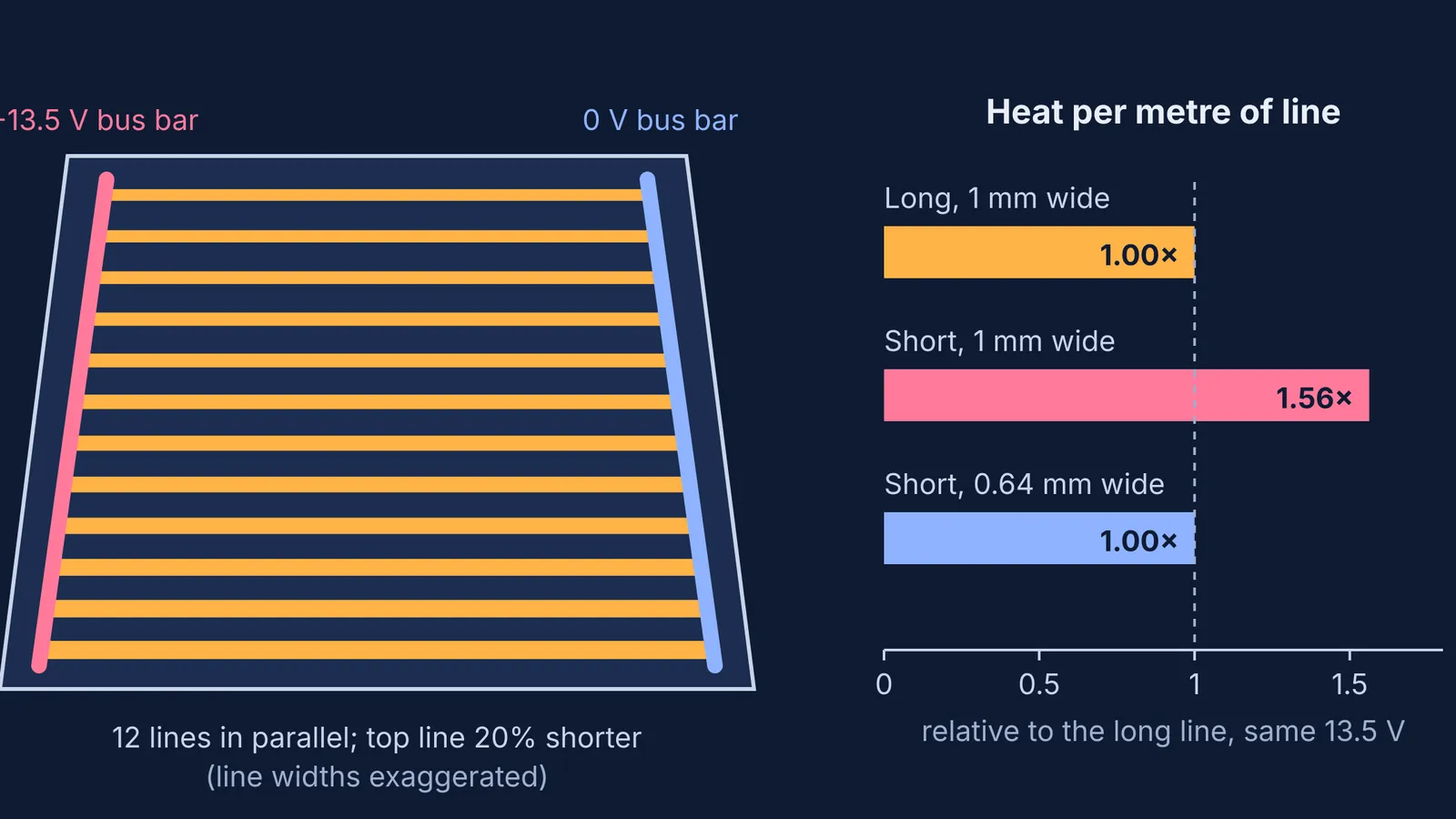
A rear window is often narrower at the top, so the top lines are shorter. With the same 13.5 V across each, a shorter line of the same width has less resistance, so it draws more current and more power. The key step, that a shorter element at fixed voltage gives more heat, is explained in why a shorter heater coil gives more heat.
For even heating you want the same power per metre of line. For a line of length L, width w and thickness t:
R = ρL/(wt)
P = V²/R = V²wt/(ρL)
Power per metre = P/L = V²wt/(ρL²)
So at fixed V, the heat per metre goes as w/L².
Worked case. A top line is 20% shorter: 0.96 m instead of 1.2 m.
Same width. The heat per metre rises by (1.2/0.96)² = 1.5625, about 1.56 times. R drops to 9.72 Ω and P rises to 18.75 W, which is 19.5 W per metre against 12.5 W per metre for the long line.
Fix the width. To bring w/L² back to the same value, scale w by L². The width must be (0.96/1.2)² = 0.64 times as wide: 0.64 mm instead of 1 mm.
Check. At 0.64 mm, R = 15.2 Ω, P = 12.0 W, and P/L = 12.5 W per metre, the same as the long line.
US 7,297,902 notes that grid lines may be tapered depending on the window's shape, and that line width is one way to set a line's resistance. Not every car uses this exact scaling.
How long does a heated rear window take to clear frost?
Take 0.1 mm of frost, treated as ice at 0 °C, over 0.6 m² of glass, with the illustrative 180 W grid.
Mass of ice. 0.6 × 0.1 × 10⁻³ × 917 = 0.055 kg.
Heat to melt it. 0.055 × 334 000 = 18.4 kJ. At 180 W that is 102 s.
Heat to warm the glass. A 4 mm sheet of 0.6 m² is about 6 kg. Warming it by 10 K with c ≈ 840 J/(kg K) needs 6 × 840 × 10 = 50.4 kJ, another 280 s.
Total. About 380 s, or 6 minutes, before counting the heat the glass loses to cold air outside. The real time is longer.
The glass, not the ice, takes most of the energy. Fog is different: it is condensation inside, and it clears once the glass is warmed above the dew point. Why glass fogs in the first place is in why your bathroom mirror fogs up after a hot shower.
How do you find a broken line with a voltmeter?
Connect one voltmeter lead to the 0 V bus bar and touch the other along a line. On a healthy line the potential falls smoothly from 13.5 V at one bus bar to 0 V at the other. On a broken line no current flows. Every point on the positive side of the break sits at 13.5 V, every point beyond it at 0 V, and the reading jumps at the break.
For series and parallel problems like these, the Fermi Problem Library has a step-by-step solver that explains the reasoning.
Quick checklist
Heater lines run between two bus bars, so they are in parallel and each has the full supply voltage.
Parallel wiring means one break leaves the other lines working, and lets each line be thin.
Illustrative grid: 180 W at 13.5 V, 1.11 A and 12.2 Ω per line.
At fixed V, heat per metre goes as w/L²; a line 20% shorter needs 0.64 times the width.
Warming the glass takes more energy than melting thin frost.
A voltmeter reading that jumps from 13.5 V to 0 V marks a break.


