

On this page
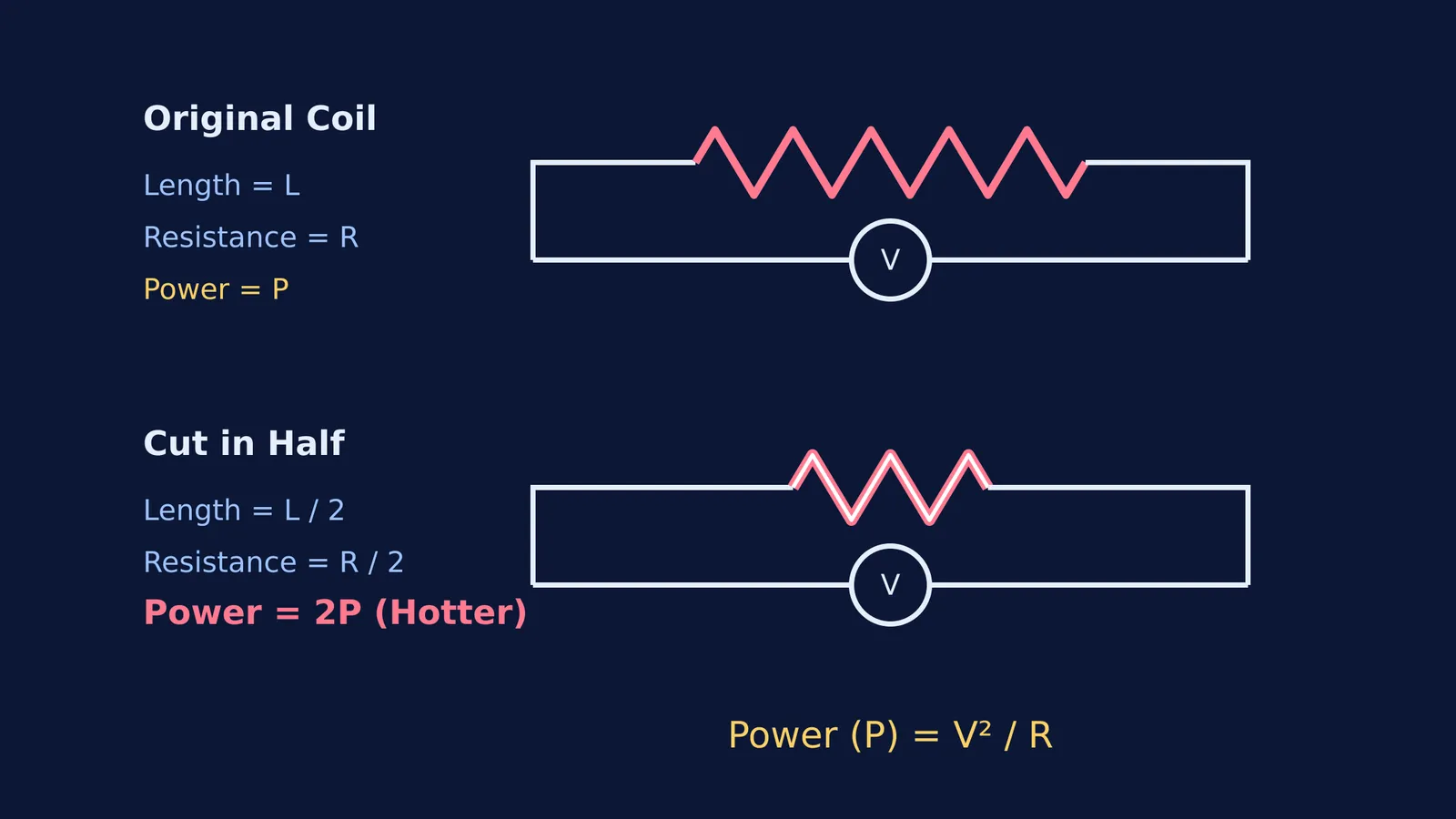
The question seems backwards at first glance. If you want more heat, shouldn't you use more heating wire? But if you cut a nichrome heater coil in half and plug it back into the same socket, it glows much brighter and hotter.
Understanding this counter-intuitive result is a classic physics test of Ohm's law and electrical power. Let us look at why shortening the wire turns up the heat, and why it is a dangerous thing to try at home.
Why does a shorter coil have less resistance?
Resistance is a measure of how hard it is for electrons to push through a material. It depends on the material itself, the thickness of the wire, and its length.
The formula for the resistance (R) of a solid wire is R = ρL/A, where ρ is the resistivity of the metal, L is its length, and A is its cross-sectional area.
When you cut a heater coil in half, you are dividing its length (L) by two. Because the length and the resistance are directly proportional, the new resistance is exactly half of the original. The cross-sectional area and the material's resistivity remain completely unchanged.
How does resistance affect heat?
We often think that more resistance means more heat, because resistance is what causes the friction-like heating in the first place. But we have to look at the whole electrical circuit to see what is really happening.
According to OpenStax College Physics, the rate at which electrical energy turns into heat is called electric power (P). When a home appliance is plugged into a wall outlet, the voltage (V) it receives is constant.
For a constant voltage, the power formula is: P = V² / R
This equation shows an inverse relationship between resistance and power. If you decrease the resistance R while keeping the voltage V the same, the power P goes up.
A worked example: cutting the coil in half
Let us put numbers to the OpenStax College Physics power equation to see exactly how much hotter the coil gets when connected to the mains supply.
1. The Original Coil Imagine a room heater designed to produce 1000 watts of power on a 200-volt supply. Using P = V² / R, we can find its normal operating resistance: 1000 = 200² / R 1000 = 40000 / R R = 40 ohms
2. The Cut Coil Now, you snip the heating coil in half. Its new resistance is exactly half of 40 ohms: New R = 20 ohms
3. The New Power Plug the shorter coil back into the steady 200-volt supply: New P = V² / New R New P = 200² / 20 New P = 40000 / 20 New P = 2000 watts
By cutting the coil in half, the heat output has doubled from 1000 watts to 2000 watts. If you cut it to one-quarter of its length, the power would quadruple to a massive 4000 watts.
If you struggle to picture how voltage, current and resistance balance out dynamically, the Fermi Simulation Lab has interactive simulations for the ideas that are easier to see than to read. For deeper dives into how resistance varies when stretching instead of cutting, you can explore Stretching a wire: how its resistance changes with length.
Why is it dangerous to shorten a heater coil?
While it sounds like a clever and quick way to upgrade a room heater, doing this in real life usually ends in a blown fuse, a tripped breaker, or a melted wire.
The heating wire (often made of a special alloy like nichrome) is chosen by engineers to handle a specific maximum temperature and a specific maximum current. As noted in OpenStax College Physics, a sudden power increase can quickly burn out a component. When you halve the resistance, the current doubles. The wire must now dissipate twice as much heat energy, but it has only half as much surface area to radiate that heat into the room.
The intense, concentrated heat will likely exceed the melting point of the nichrome alloy, causing the coil to snap and burn out almost instantly. It can also pull more current than your home wiring is safely rated for.
Checklist: Testing power formulas in exams
When you face a physics exam question about changing a component in a circuit, use this framework to avoid getting tricked:
Identify what changes: Are you changing length, cross-sectional area, or material? Find the new resistance first using R = ρL/A.
Identify what stays constant: Is the device plugged into a fixed voltage supply like a mains socket (use P = V² / R), or is it in a series circuit with a fixed constant current (use P = I²R)?
Calculate the ratio: Compare the new power to the old power using simple ratios rather than calculating full numbers to save time and reduce arithmetic errors.
If you want to practice tricky circuit problems like this without getting stuck on the algebra, the Fermi Problem Library offers worked problems with a step-by-step solver that explains the reasoning rather than printing an answer. You can also read up on related circuit strategies such as Cells, EMF and internal resistance: combinations and maximum power.


