

On this page
A person who looks and feels completely well can still pass on typhoid. It is a clear example of an idea worth getting right for Class 12 biology and NEET-UG: being infected is not the same as being ill.
How can a healthy person spread typhoid?
Typhoid is caused by the bacterium *Salmonella* Typhi and is usually spread through contaminated food or water, according to the WHO typhoid fact sheet. The same fact sheet says that even when symptoms go away, people may still carry the bacteria and spread it to others by shedding it in their faeces.
The US Centers for Disease Control and Prevention describes the same route: the bacteria are shed in stool and reach new people through food, drinks or water contaminated by sewage, or through food handled by someone who did not wash their hands after using the toilet (CDC).
As of 2019, about 9 million people get sick with typhoid and 110,000 die from it every year, according to WHO. People who carry the bacteria without feeling ill are one way it keeps reaching new people.
Where do typhoid bacteria hide in a carrier?
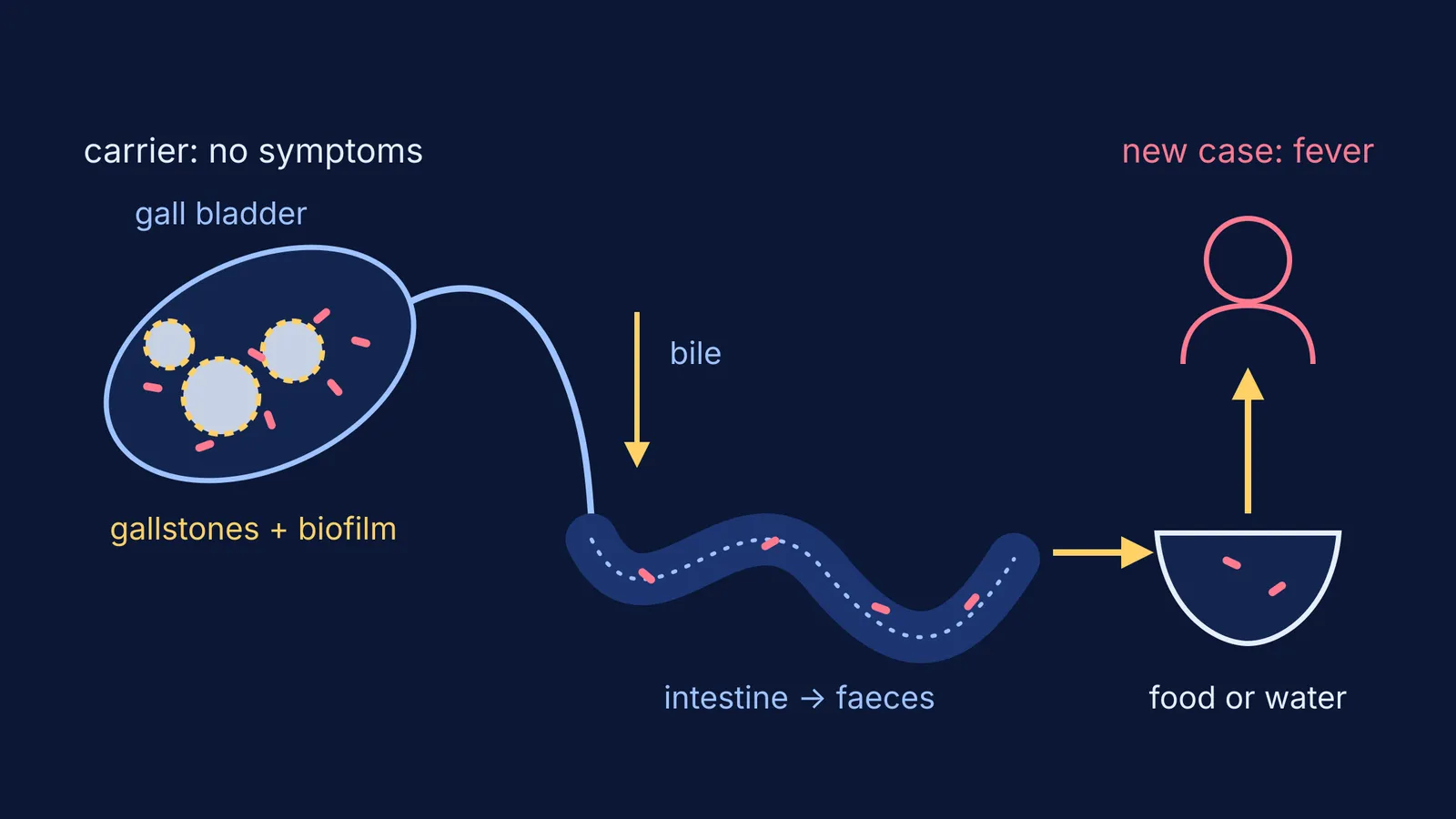
In a chronic carrier, *S.* Typhi settles in the gall bladder, the small sac under the liver that stores bile. A 2017 review in the International Journal of Molecular Sciences describes this as an asymptomatic chronic infection of the gall bladder and calls these carriers a reservoir for further spread (Di Domenico and colleagues, 2017).
In regions where typhoid is endemic, about 1–4% of infected people become chronic asymptomatic carriers, the same 2017 review reports. It also notes that about 90% of chronic carriers have gallstones, and that the bacteria can build a biofilm, a sticky protective layer, which may help the infection persist.
Follow the route in the diagram above. Bacteria in the gall bladder pass with bile into the intestine, leave the body in faeces and, if hands, food or water are contaminated, reach someone new. The carrier may feel nothing, while the person infected next can fall ill with typhoid fever.
Who was Typhoid Mary?
Mary Mallon was a cook for wealthy families in and around New York in the early 1900s. A 2013 history in the Annals of Gastroenterology tells her story (Marineli and colleagues, 2013). In 1906, 6 of the 11 people in one household where she cooked caught typhoid. A sanitary engineer investigating the outbreak found she had worked for 8 families before, and 7 of them had had typhoid cases.
She was isolated on North Brother Island in 1907 and released in 1910 under an agreement that she would work as a domestic but not as a cook. She went back to cooking, and at Sloane Maternity Hospital she infected at least 25 people, according to the same history. She was isolated again and stayed on the island until her death in 1938, 26 years of confinement in all. Doctors had offered to remove her gall bladder; she refused.
Her case is remembered because it showed that someone well enough to work in a kitchen every day could be the source of an outbreak.
Why is infection not the same as disease?
Infection means a pathogen has entered the body and is living and multiplying there. Disease means that infection is causing harm the body shows as signs and symptoms. A carrier separates them.
Use this three-question check when a question describes a person and a pathogen:
Is the pathogen inside the body and multiplying? If no, the person is not infected.
Does the person have signs or symptoms? If yes, they have the disease.
Is the pathogen leaving the body (in faeces, droplets or blood) while there are no symptoms? If yes, they are a carrier.
Worked example: a hotel cook has no fever, but a stool test grows *Salmonella* Typhi. Question 1 is yes, question 2 is no, question 3 is yes. The cook is infected, not diseased, and still infectious: a carrier. A classmate with a high fever and a positive test answers yes to questions 1 and 2, so they have typhoid fever.
What should you do with this at home and in revision?
At home, the routes WHO and CDC describe point to the same habits: wash hands with soap after using the toilet and before handling food, and drink safe water. This matters most for anyone who cooks for others.
For revision, read how typhoid is confirmed in the lab in our explainer on the Widal test for typhoid, see a different kind of carrier in amoebiasis and the housefly, and test yourself on the NCERT pathogen and disease table.
If infection, disease, vector and carrier still blur together, the Fermi Concept Library gives each biology concept its own lesson and shows where it sits in the map. To practise the three-question check, the Fermi Problem Library has worked problems with a step-by-step solver that explains the reasoning rather than printing an answer.


