

On this page
When you study human health and diseases for biology exams like NEET or board exams, you will encounter dozens of pathogens and vectors. One that often appears in multiple-choice questions is the link between amoebic dysentery and the common housefly.
While we usually associate flies with general poor hygiene, their exact role in the transmission of this specific disease is a precise biological mechanism. Understanding the difference between a mechanical carrier and a biological vector will help you secure marks and make sense of how diseases spread.
What causes amoebiasis?
Amoebiasis, also known as amoebic dysentery, is caused by *Entamoeba histolytica*. This is a protozoan parasite that makes its home in the large intestine of humans.
Unlike mild stomach bugs, the symptoms of amoebiasis can be severe. According to the US Centers for Disease Control and Prevention (CDC), an infected person may experience loose stools, abdominal pain, and stomach cramping, while severe cases can cause amebic dysentery with bloody stools. However, the CDC notes that only about 10% to 20% of people who are infected actually become ill from the parasite.
Inside the body, the parasite exists in two main forms. The active, feeding form is called a trophozoite, which lives in the intestine and causes the symptoms. However, before it leaves the body in faeces, it transforms into a hardy, semi-dormant structure called a cyst. It is these cysts that survive outside the human body and are responsible for transmitting the disease to new hosts.
How do houseflies act as mechanical carriers?
To understand transmission, you must separate the pathogen (*E. histolytica*) from the vehicle that moves it.
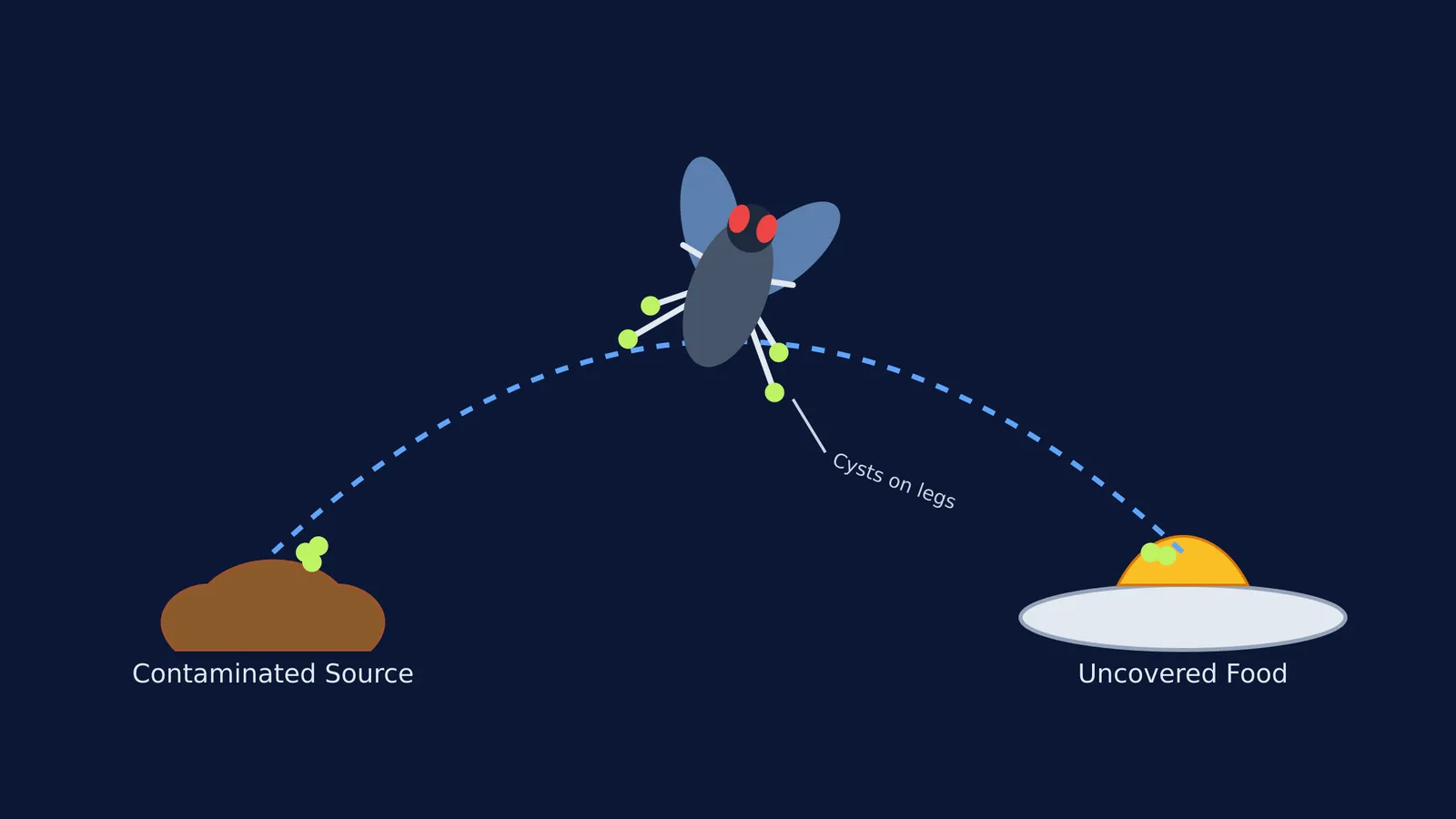
Houseflies (*Musca domestica*) act as mechanical vectors for the disease. This means the parasite does not grow, reproduce, or complete a part of its life cycle inside the fly. Instead, the fly acts like a dirty transport vehicle.
Contact: A housefly lands on the faeces of an infected person in areas with poor sanitation or open defecation.
Transport: The infective stages of the parasite, the cysts, stick to the fly's hairy legs, mouthparts, and sticky footpads. The cysts are highly resistant to environmental stress, allowing them to survive on the outside of the fly.
Contamination: The fly then flies away and lands on uncovered human food, drinks, or kitchen surfaces, physically depositing the cysts.
When a healthy person consumes this contaminated food or water, the cysts travel to their large intestine, completing the faecal-oral transmission route. Once safely inside the host's gut, the cysts break open to release the active trophozoites, and the cycle begins again.
How do you tell mechanical carriers from biological vectors?
Examiners love to test if you know the difference between these two terms. When reading an exam question about vectors, ask yourself what happens to the pathogen inside the insect.
Mechanical carriers simply move the pathogen from point A to point B without being infected themselves. They are just a physical bridge. The housefly carrying *Entamoeba histolytica* is the classic textbook example of a mechanical carrier.
Biological vectors host the pathogen while it develops, changes life stages, or multiplies. For instance, the female *Anopheles* mosquito is a biological vector for malaria, because the *Plasmodium* parasite must complete a specific, necessary phase of its life cycle inside the mosquito's gut and salivary glands.
How can you prevent mechanical transmission?
Because the transmission relies entirely on physical transfer, preventing the disease focuses on breaking that mechanical chain:
Protecting food: Keeping all food and drinking water covered stops flies from landing and depositing cysts.
Hygiene: Rigorous handwashing with soap and water after using the toilet and before preparing food stops direct faecal-oral transmission.
Sanitation: Proper disposal of human waste removes the source from which houseflies pick up the parasite.
How should you revise biological carriers for exams?
Pathogens, diseases, and their carriers are high-yield topics for biology students. If you find yourself confusing which mosquito carries dengue versus malaria, or mixing up bacterial and protozoan diseases, you should map them out.
You can review these distinctions in the Fermi Concept Library, which structures every biology topic into clear, manageable lessons. When you want to test your memory, sit down with Fermi's AI tutor. You can ask it to quiz you specifically on the transmission routes of human diseases. It holds a line of reasoning across a whole session, notices where you get stuck, and decides whether to explain or ask a guiding question to help you fix the gaps.
Read more:


