

On this page
According to the NCERT Class 12 Biology syllabus for Human Health and Disease, the Widal test is the standard diagnostic tool used to confirm typhoid fever. The disease is caused by the pathogenic bacterium *Salmonella typhi*, which generally enters the small intestine through contaminated food and water and migrates to other organs through the blood.
Infections trigger a sustained high fever of 39°C to 40°C, accompanied by weakness, stomach pain, constipation, headache, and loss of appetite. The syllabus also highlights the famous historical case of Mary Mallon, nicknamed "Typhoid Mary," a cook who acted as an asymptomatic carrier and spread the disease for years through the food she prepared.
What does the Widal test detect for typhoid?
The Widal test is a serological test, meaning it looks for substances in the blood serum. Specifically, it detects antibodies that the immune system produces to fight the *Salmonella typhi* bacteria.
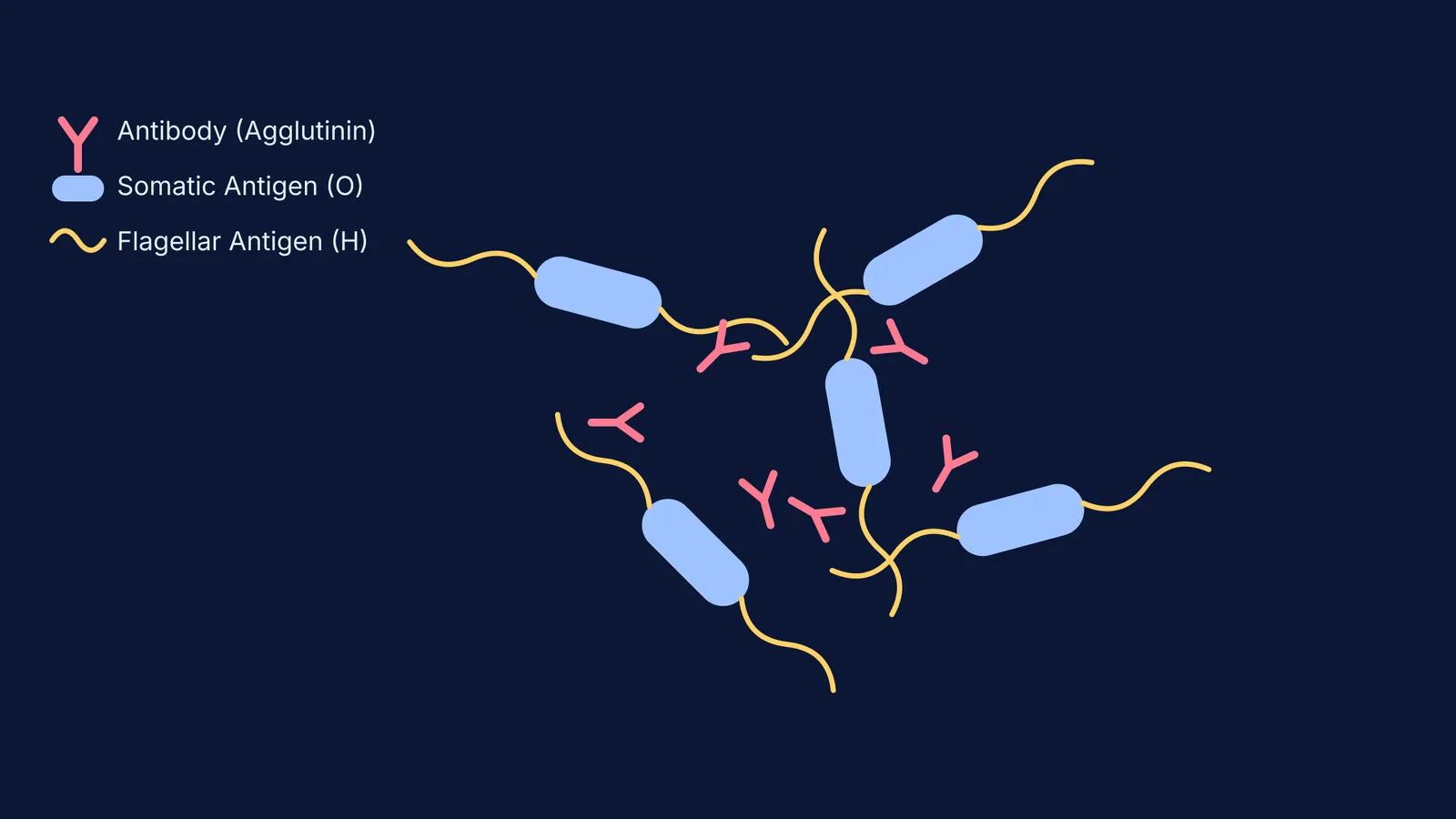
The test checks for antibodies against two main parts of the bacterium:
O antigen (somatic): This is the surface antigen found on the outer cell wall (the body) of the bacterium. Antibodies against this antigen typically appear early in the course of the infection and vanish relatively quickly after recovery.
H antigen (flagellar): This antigen is located on the flagella—the whip-like structures the bacterium uses for motility. Antibodies against the H antigen take longer to develop but persist in the bloodstream for a much longer period, sometimes for years.
If you are building a strong foundation in human health and immunology, the Fermi Concept Library has every concept in biology, each with its own lesson and its place in the map.
How does an agglutination test work?
The scientific principle behind the Widal test is agglutination. When a patient's blood serum is mixed with dead *Salmonella typhi* bacteria (the test reagent), any typhoid antibodies present in the serum will bind to the antigens on the bacteria.
Antibodies are Y-shaped proteins. The arms of the 'Y' have specific binding sites that match the shape of the antigens on the pathogen. Because each antibody has at least two binding sites, a single antibody can attach to two different bacteria at once. When millions of antibodies do this simultaneously, they create a large lattice or network of cross-linked bacteria. This mass is too heavy to stay suspended in the liquid and forms visible clumps.
In the Widal test, observing this clumping confirms that the patient's immune system has produced specific antibodies to fight the typhoid bacteria.
For a broader look at the pathogens tested in the biology syllabus, see our post on viruses, viroids and lichens: the misfits of five-kingdom biology.
What do O and H antigens mean in a titre?
A Widal test report provides numbers called titres, which represent the highest dilution of the patient's serum that still causes visible clumping. The serum is progressively diluted (1:20, 1:40, 1:80, 1:160, 1:320), and the highest dilution that still shows agglutination is recorded as the titre.
According to StatPearls, these numbers tell a doctor the current state of the infection:
O ≥ 1:160: A high titre of O antibodies usually appears early (around the end of the first week) and suggests an active, acute typhoid infection.
H ≥ 1:160: A high titre of H antibodies appears later but persists in the blood for much longer. It can indicate a current infection, but because these antibodies linger, it might also mean past exposure or a previous typhoid vaccination.
Checklist: Typhoid facts for Class 12 Biology
When revising this topic for board exams or NEET, ensure you can recall these specific points from the NCERT textbook:
Pathogen: *Salmonella typhi* (bacterium).
Site of infection: Enters the small intestine; migrates via blood.
Symptoms: Sustained high fever (39°C to 40°C), stomach pain, constipation, and loss of appetite.
Confirmation: The Widal test.
Historical note: Mary Mallon ("Typhoid Mary"), the cook who acted as a carrier.
If you are reviewing other diseases and their effects on the body, read our guide to opioids, cannabinoids and coca alkaloids: NEET's drug-abuse facts. For step-by-step help with past-year biology questions on these chapters, the Fermi Problem Library has worked problems with a step-by-step solver that explains the reasoning rather than printing an answer.


