

On this page
"Checking the bacterial contamination in drinking water by testing sulphide ion" sits on the CBSE Class 11 chemistry project list, and it is a good one: cheap, visual and real. The field version is the H₂S strip test. You put a strip of treated paper in a bottle of water, wait a day or two, and look for a black colour. The black is iron sulphide, made from hydrogen sulphide that certain gut bacteria release. This post covers how the test was designed, the chemistry behind the colour, how to read a set of results honestly, and what the test cannot tell you.
Where did the H₂S strip test come from?
It was published in 1982 by K. S. Manja, M. S. Maurya and K. M. Rao in the Bulletin of the World Health Organization. Their field work in several parts of India found that coliform bacteria in drinking water usually came with hydrogen-sulphide-producing bacteria. Detecting H₂S was much easier than counting coliforms, which needs a laboratory and an incubator at a fixed temperature. The authors reported good agreement with the standard most probable number (MPN) test, and used their test to monitor water during a hepatitis A outbreak in Gwalior.
The original medium on the paper strip contained:
Peptone, a protein digest that feeds the bacteria.
Dipotassium hydrogen phosphate, a buffer.
Ferric ammonium citrate, the iron source.
Sodium thiosulphate, the sulphur source.
A detergent, Teepol in the original paper.
Later kits change the amounts and the detergent, so check the recipe your kit or teacher uses.
How does the strip turn black?
The test does not detect sulphide already in the water. It grows bacteria and detects the H₂S they make.
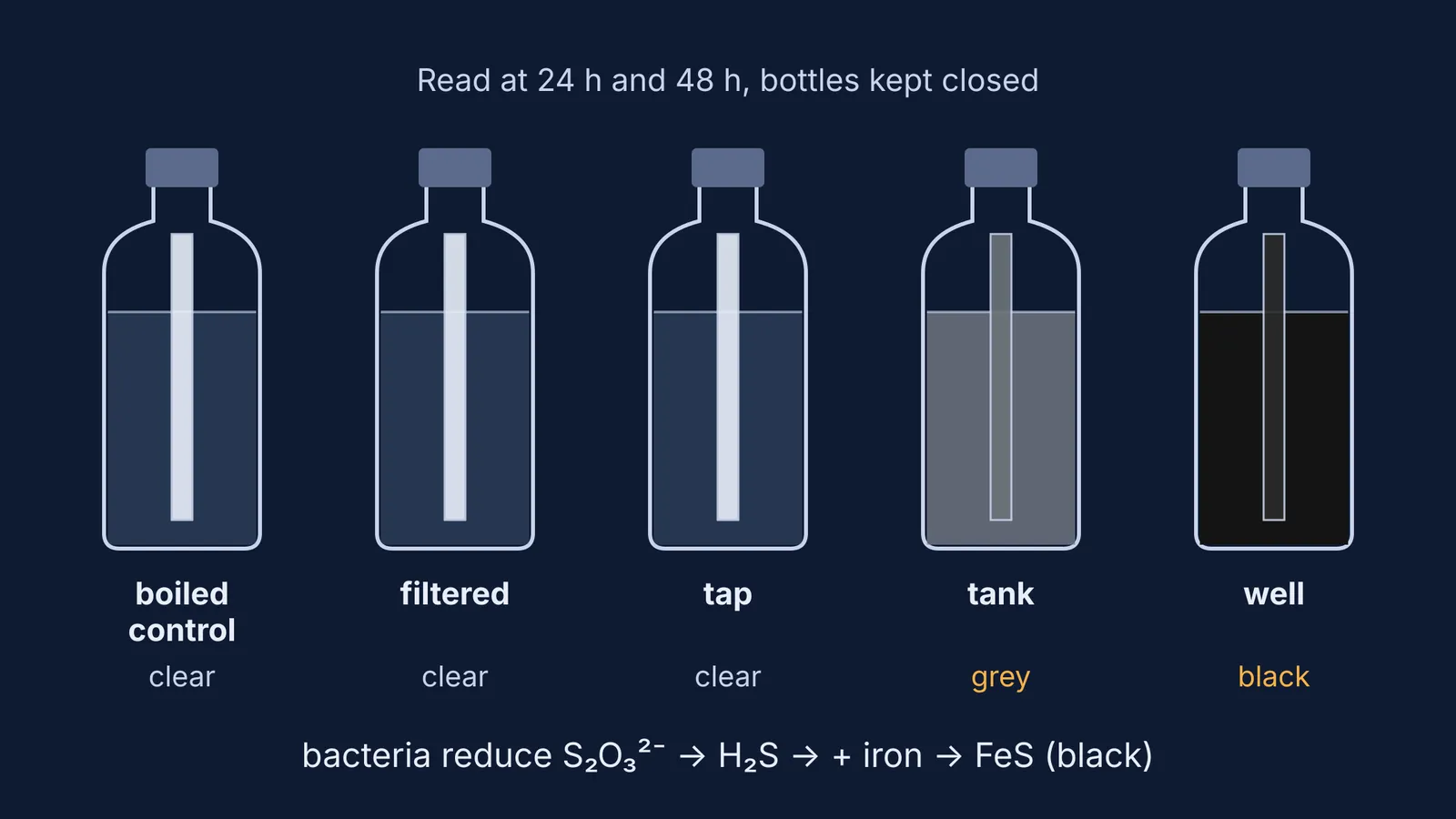
Bacteria reduce thiosulphate. Some gut bacteria, such as Citrobacter and Salmonella, and the anaerobe Clostridium perfringens, have enzymes that use thiosulphate as an electron acceptor. The half-equation, with electrons coming from the food in the medium, is: S₂O₃²⁻ + 2H⁺ + 2e⁻ → H₂S + SO₃²⁻.
H₂S meets iron. The iron from ferric ammonium citrate ends up as black iron sulphide. Written simply: Fe²⁺ + H₂S → FeS↓ + 2H⁺.
Check the balance. In the first equation, the two sulphur atoms and three oxygen atoms appear on both sides, the two hydrogens are balanced, and the charge is −2 + 2 − 2 = −2 on the left and −2 on the right. In the second, the charge is +2 on both sides.
This is the same idea as the lead acetate paper you use in salt analysis, where H₂S blackens the paper by forming PbS. The sodium nitroprusside and lead acetate tests for sulphide explain that side. The difference is that here a living organism makes the H₂S, so time and temperature matter.
How do you run the test as a school project?
Use sterile bottles with the strip already inside, either from a kit or prepared by your teacher.
Collect each sample straight into its bottle up to the mark, without touching the inside of the cap or bottle. Close it at once.
Always include a control: water that has been boiled and cooled, sampled the same way. If the control turns black, your bottles or handling were contaminated and the whole run is invalid.
Keep the bottles somewhere warm, about 30–37 °C if possible, or at a warm room temperature, away from sunlight.
Read them at 24 hours and at 48 hours, without opening them. Note the colour: no change, grey, or black.
Worked example: reading five bottles
A student tests five samples. The readings are illustrative, not real data.
Boiled control: no change at 24 h, no change at 48 h.
Filtered water (home purifier): no change at 24 h, no change at 48 h.
Tap water: no change at 24 h, no change at 48 h.
Overhead tank: no change at 24 h, grey at 48 h.
Open well: black at 24 h, black at 48 h.
Work through it step by step.
Is the run valid? The control stayed clear, so the bottles and medium were not contaminated. The other results can be trusted as far as the test goes.
Well water. Black within 24 hours is a clear positive. Faster blackening generally means more bacteria, and a field study in Bangladesh by Gupta and colleagues in the Journal of Applied Microbiology found the test caught 94% of samples with heavy E. coli contamination (1000 to 9999 colony-forming units per 100 mL).
Tank water. Grey at 48 hours is a weak positive. Treat it as "possibly contaminated" and retest. The same study found false positives rose as tests were read later, which is why it recommended reading at 24 hours.
Tap and filtered water. Clear at both readings. That is reassuring but not proof of safety. The Bangladesh study found the test missed most samples with low contamination (under 100 colony-forming units per 100 mL).
Write the conclusion carefully. For example: "The well sample showed strong evidence of faecal contamination. The tank sample was borderline and should be retested. The other samples showed no H₂S-producing bacteria in this test."
Why can the test give a wrong answer?
False positives. Some bacteria that are not from faeces also make H₂S. Water from deep wells and tubewells can carry sulphur-reducing soil bacteria, as Gupta and colleagues point out. Reading too late adds false positives too.
False negatives. Low levels of contamination may not turn the strip in time. A single sample is also a snapshot: water quality can change from day to day.
No number. The basic test gives yes or no, not a count of bacteria per 100 mL.
So a black bottle means "do not drink this water untreated, and ask the local water or health authority for a proper laboratory test". It is a screening tool, not a final verdict. For what boiling does and does not remove, see does boiling water kill all germs. If you want to add pH, hardness and TDS to your project, the water quality testing project guide covers those.
How do you handle and dispose of the bottles safely?
Treat every positive bottle as if it holds disease-causing bacteria. Never open it to smell or sample it, and never grow anything outside the sealed bottle.
Wash your hands after collecting samples and after handling the bottles.
For disposal, your teacher should add household bleach to each positive bottle, close it, and leave it for some hours before it is emptied and discarded. Wear gloves and goggles for this step.
If balancing reduction half-equations like this one trips you up, the Fermi Problem Library has a step-by-step solver that explains the reasoning for redox problems.
Quick checklist
The test detects H₂S-producing bacteria, an indicator of faecal pollution.
Thiosulphate is reduced to H₂S by bacteria; H₂S and iron give black FeS.
Always run a boiled-water control; a black control means the run is invalid.
Read at 24 h; later readings add false positives.
Clear does not mean safe; black means "send for a lab test".
Never open positive bottles; disinfect with bleach before disposal.


