

On this page
A parasite with a complicated life cycle has more places where it can break. Guinea worm is a clear example. It has to move from a person into pond water, into a tiny crustacean, and back into a person. India worked out where that chain was weakest and cut it there, using wells, filters, a chemical and plain explanation.
What is the guinea worm life cycle?
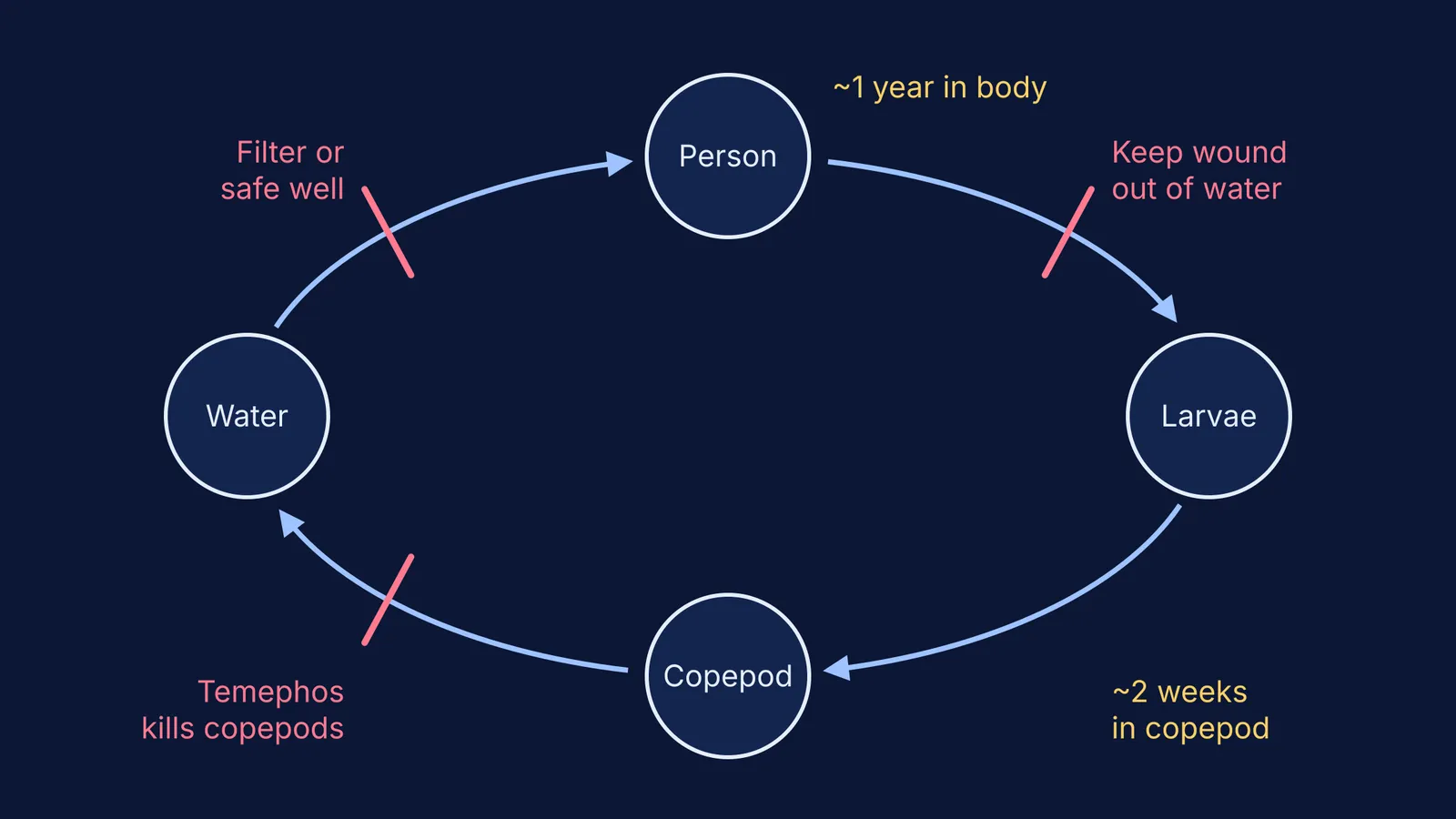
Guinea worm disease (dracunculiasis) is caused by the roundworm *Dracunculus medinensis*, which people catch by drinking water containing infected copepods, tiny crustaceans often called water fleas, according to the WHO fact sheet. Here is the loop, step by step, from the CDC's parasite life cycle page:
A person drinks unfiltered water from a pond or other still water that contains infected copepods.
The copepods die and release the larvae. The larvae bore through the stomach and intestinal wall.
The worms grow up and mate. The males die. The females travel under the skin towards the surface.
About a year after infection, the female makes a painful blister on the skin. The WHO says about 90% of these blisters appear on the lower leg.
When the wound touches water, the worm releases larvae. The CDC says a single worm releases hundreds of thousands of them.
Copepods eat the larvae. After about two weeks and two moults inside the copepod, the larvae can infect a person again.
According to the WHO, the female worm emerges 10 to 14 months after infection and is 60 to 100 cm long. People often put the painful wound in water for relief, and that is how the next round of larvae gets into the pond.
How did India eradicate guinea worm?
India began its Guinea Worm Eradication Programme in 1983-84. According to the National Centre for Disease Control (NCDC), the country had 39,792 cases in 12,840 villages across 89 districts of seven states in 1984. Rajasthan had 38% of them and Madhya Pradesh 29%. Each measure the NCDC lists targets one step of the cycle:
Step 1, drinking: traditional step wells were converted into safer draw wells.
Step 1, drinking: in areas where the disease was common, water was strained through fine mesh with 100-micrometre holes to remove Cyclops, the copepod that carries the larvae.
Step 6, copepods: the chemical temephos was added to unsafe water sources eight times a year to kill copepods.
Step 5, the wound: health education explained how the worm spreads and how to stop it.
The NCDC records the last case in July 1996, in Jodhpur district, Rajasthan. In February 2000, the International Commission for the Certification of Dracunculiasis Eradication recommended that India be certified free of transmission (WHO Weekly Epidemiological Record). According to The Carter Center, India was the second country to eliminate the disease after the international campaign began in 1986.
Why does knowing the life cycle lead to control?
India's methods were simple: a well rebuilt, a piece of mesh, a chemical, a conversation. Each one worked only because someone knew which stage it would hit. A filter does nothing against a disease spread by mosquitoes. Against guinea worm it is enough, because the parasite only enters through the mouth, inside a copepod.
The rest of the world has used the same tools. The WHO estimates there were about 3.5 million cases in 20 countries in the mid-1980s. In 2024, 13 human cases were reported, 7 in Chad and 6 in South Sudan. Smallpox was beaten with vaccination instead, and you can read how smallpox was eradicated with ring vaccination to compare the two strategies.
How can you use this to study any parasite?
Use this four-question "break the loop" method on any life cycle in your biology syllabus:
Hosts: Which organisms does it pass through, and in what order?
Outside stage: Where does it spend time outside a host (water, soil, a vector)?
Entry point: How exactly does it get into people (mouth, skin, a bite)?
Cheapest barrier: Which step can be blocked most easily, and with what?
Worked example, guinea worm: hosts are a person and a copepod. The outside stage is larvae in still water. The entry point is the mouth. The cheapest barrier is a cloth filter or a protected well.
Now try it on the liver fluke and its two hosts and on the worms in ascariasis and filariasis. You will notice that when the entry point changes, the best barrier changes with it. If you get stuck on a term like "intermediate host" or "vector", look it up in the Fermi Concept Library, which covers every concept in biology with its own lesson, and then come back to the four questions.
Choose one life cycle from your textbook tonight, answer the four questions on a single page, and circle the cheapest barrier.


