

On this page
Ascariasis, filariasis, and ringworm are three common human infections that frequently appear in biology syllabuses and medical entrance exams. Unlike inherited conditions—such as Mendelian disorders: sickle-cell anaemia, thalassemia and PKU—these infectious diseases are acquired directly from the environment. While they might sound similar when listed together, their biological causes, modes of transmission, and the organs they target are completely different.
What causes ascariasis, filariasis and ringworm?
To understand these diseases, we must look at their causative agents. Two are caused by parasitic worms (helminths), while one is actually a fungus.
Ascariasis: This infection is caused by *Ascaris lumbricoides*, a large parasitic roundworm (nematode). According to the CDC, ascariasis affects an estimated 772 to 892 million people globally.
Filariasis: Lymphatic filariasis, commonly known as elephantiasis, is caused by thread-like filarial nematodes. The vast majority of cases are caused by *Wuchereria bancrofti*, with *Brugia malayi* and *Brugia timori* causing the rest. The World Health Organization (WHO) reports that over 657 million people remain threatened by lymphatic filariasis worldwide.
Ringworm: Despite its name, ringworm (tinea) is caused by a group of fungi called dermatophytes, not a worm. The most common genera responsible are *Trichophyton*, *Microsporum*, and *Epidermophyton*.
How do ascariasis, filariasis and ringworm spread?
The route a pathogen takes to enter the human body determines how a disease is spread and how it can be prevented.
Ascariasis (Contaminated soil): The infection spreads through the fecal-oral route. *Ascaris* eggs are passed in the feces of an infected person. If these feces contaminate soil or water, the eggs can be accidentally ingested when a person eats unwashed vegetables, drinks contaminated water, or puts unwashed hands in their mouth.
Filariasis (Mosquito vectors): Unlike ascariasis, filariasis requires an insect vector. The microscopic larvae (microfilariae) are transmitted to humans through the bites of infected mosquitoes, including species of *Culex*, *Anopheles*, and *Aedes*. This vector-based life cycle is a common evolutionary strategy, similar to the one studied in Alphonse Laveran and the parasite that causes malaria or Carlos Chagas: a new parasite, its insect carrier and its disease.
Ringworm (Direct contact): This fungal infection is highly contagious and spreads through direct skin-to-skin contact with an infected person or animal. It can also spread indirectly if you share contaminated objects like towels, combs, or locker room floors.
Which body parts are affected?
Once inside the body, these pathogens migrate to very specific tissues to survive and reproduce.
Ascariasis affects the intestine: After the eggs are swallowed, they hatch in the small intestine. The larvae undergo a complex migration through the bloodstream and lungs before returning to the small intestine to mature into adult worms. Heavy infections can lead to abdominal pain and intestinal blockages.
Filariasis affects the lymphatic system: The adult filarial worms nest in the lymphatic vessels and nodes. Over time, this damages the lymphatic system and disrupts fluid drainage, leading to severe, chronic swelling of tissues (lymphoedema), commonly seen in the legs (elephantiasis) or genitals (hydrocele).
Ringworm affects the skin: Dermatophyte fungi require keratin to grow, so they exclusively target the outer, keratinized layers of the skin, scalp, and nails. This results in the characteristic itchy, red, ring-shaped rashes on the body.
How can you remember the differences for revision?
When preparing for exams or reviewing human health, keeping these key differences straight is essential. If you need a structured way to review the lifecycles of these pathogens, the Fermi Concept Library holds a lesson for every concept in biology, placing each organism in its proper context.
To test your recall, you can use Fermi's AI tutor. Instead of just printing an answer, Fermi's AI tutor works out what you already know and builds a plan for the session, checking your understanding of transmission routes and vectors as it goes.
Here is a quick summary framework to remember the trio:
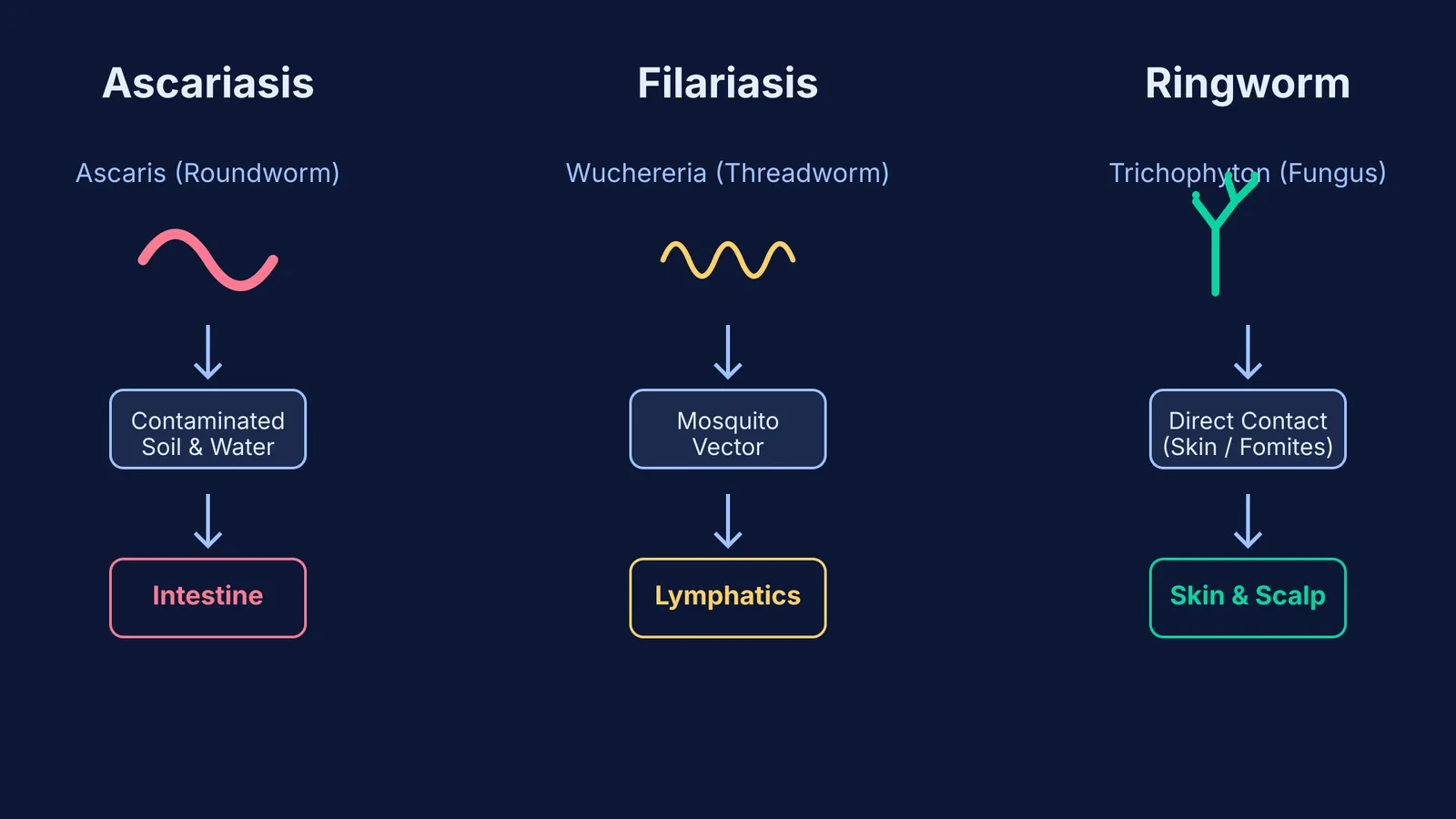
Ascariasis: *Ascaris lumbricoides* (Roundworm) → Fecal-oral route (Soil) → Small intestine.
Filariasis: *Wuchereria bancrofti* (Filarial worm) → Mosquito bite (Vector) → Lymphatic vessels.
Ringworm: *Trichophyton* / *Microsporum* (Fungus) → Direct contact (Skin/Fomites) → Skin, scalp, and nails.
By isolating the organism, the route, and the target organ, you can easily distinguish between these common human diseases.


