On this page
Smallpox is the only infectious disease ever eradicated, according to the World Health Organization. WHO says it was fatal in up to 30% of cases, that WHO launched an intensified plan to eradicate it in 1967, and that the last known natural case was in Somalia in 1977. The 33rd World Health Assembly declared the world free of smallpox on 8 May 1980, according to the CDC.
The turning point was a change of aim: from vaccinating as many people as possible to finding every case and closing a ring of immune people around it.
How was smallpox eradicated?
In a 2013 retrospective, D. A. Henderson named two features as critical: a surveillance-containment strategy, and a heat-stable vaccine that protected with a single inoculation.
WHO's 1966 plan had two parts: mass vaccination to reach 80% immunity, and surveillance, with a quick local vaccination drive around reported cases. Early on, William Foege and local staff working in eastern Nigeria found that smallpox was much less contagious than many believed, and that limited containment could stop reported outbreaks quickly (Henderson, 2013).
What is ring vaccination?
In surveillance-containment, workers isolated each patient and vaccinated the affected community and "rings" of contacts around them, starting with the closest (American Journal of Public Health). Because the smallpox virus is found only in humans (CDC Museum), a patient surrounded by immune people has no one left to infect, and the chain of transmission ends.
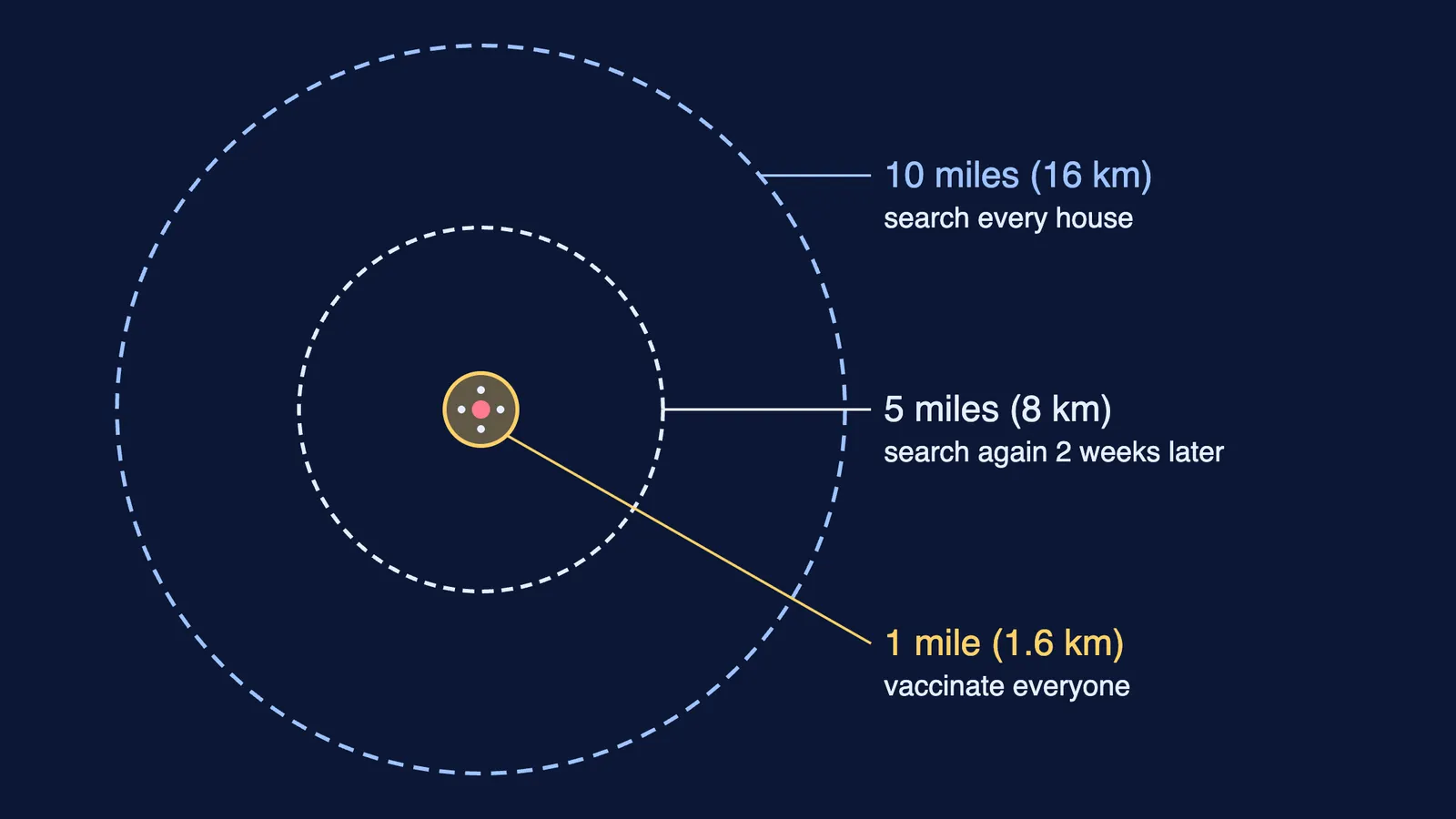
India's Operation Smallpox Zero rules from January 1975, recorded in WHO's official history Smallpox and its Eradication, set out the rings:
Infected house: two pairs of watchguard-vaccinators on 12-hour shifts, logging everyone in and out.
1 mile (1.6 km): vaccinate everyone, 4,000 to 5,000 people in rural areas and 80,000 in cities.
5 miles (8 km): a second house-to-house search two weeks later, to catch cases incubating during the first.
10 miles (16 km): a house-to-house search, usually 300 to 600 villages.
How did the bifurcated needle help?
A bifurcated needle splits at the tip into two prongs. The vaccinator dips it in vaccine, a drop collects between the prongs, and the needle pricks the skin's outer layers several times in a circular pattern (CDC Museum). Henderson wrote that it let vaccinators with little training succeed nearly 100% of the time, using a quarter as much vaccine. The CDC Museum says more than 7 million bifurcated needles were used in India alone.
How did India end smallpox in 1975?
India reported 188,003 smallpox cases in 1974, according to a table in the American Journal of Public Health history. The WHO history in Smallpox and its Eradication records that by the end of December 1974, smallpox remained in only 285 of India's more than 575,000 villages. Operation Smallpox Zero followed: vaccination in each infected village had to be essentially complete within two, at most three, days. The reward for reporting a case rose from 50 to 100 rupees, and in April 1975, 115,000 health workers searched house to house across the whole country in a single week.
The last case was Saiban Bibi, a 30-year-old homeless woman from Bangladesh living on the railway platform at Karimganj, Assam, who had caught smallpox from a patient in Sylhet District. She went to the Karimganj Civil Hospital on 26 May 1975. Between 22 and 26 May, 4,535 tickets had been sold at that station to 68 towns, so teams vaccinated around the station and then the whole town, posted four watchguards at her isolation ward and set up three border checkpoints. No further cases were found (WHO history). India was certified smallpox-free on 23 April 1977 (AJPH history).
How much did one containment operation cost?
The WHO history estimates a typical 1975 containment operation at Rs 24,562 (US$2,730). Work through its watchguard line yourself:
Two infected houses need 8 watchguards.
8 workers x 42 days = 336 worker-days.
336 x Rs 5 per day = Rs 1,680, under 7% of the total.
Petrol for the jeeps used in supervision, search and follow-up came to Rs 9,450, about 38% of the total and the largest single cost, more than all the temporary staff put together (Rs 9,100).
Why could smallpox be wiped out?
Smallpox passed five tests. Run them on any disease in your syllabus: each one it fails shows why eradication would be harder.
Humans only: the virus is found only in people (CDC Museum), so no animal can bring it back.
Easy to see: the rash begins on the face and hands (WHO), so search workers with a picture card could spot it.
Slow spread: it was less contagious than feared (Henderson, 2013), so a ring could close in time.
One dose: a single inoculation protected (Henderson, 2013).
Tough vaccine: freeze-dried, it withstood 100°F (about 38°C) for more than a month (Henderson, 2013).
Test 4 rests on immune memory, explained in why the secondary immune response is faster; the Fermi Concept Library has a lesson for every biology concept along the way. For earlier history, read how Tomás Romay brought smallpox vaccination to Cuba.