On this page
Children in Classes 3 to 5 learn to label a plant quickly: root, stem, leaf, flower, fruit, seed. What sticks less well is what each part does. Below: one job per part, a kitchen puzzle, and a celery activity that shows water climbing a stem.
What are the parts of a plant and their functions?
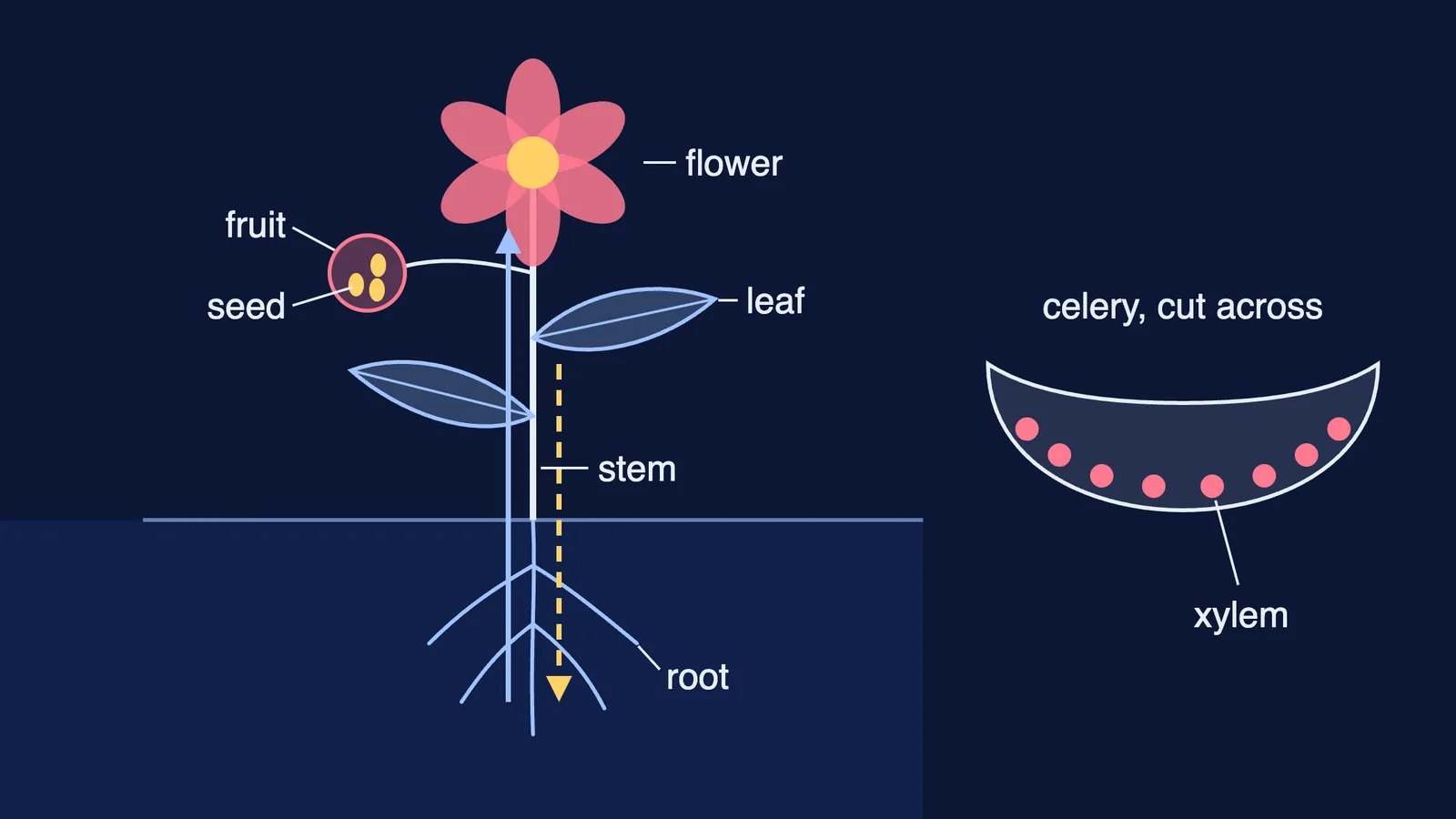
A plant has a root system, usually underground, and a shoot system above ground that takes in light for photosynthesis (OpenStax Biology 2e, an open textbook). One job per part, in words a Class 3 child can say back:
Root: holds the plant in the soil and drinks water and minerals. The root system anchors the plant while absorbing water and minerals from the soil (OpenStax, the plant body).
Stem: holds the plant up and carries water and food. A stem's main function is to support the plant, holding leaves, flowers and buds, and some stems also store food (OpenStax, stems).
Leaf: the plant's kitchen. Leaves are the main sites for photosynthesis, the process by which plants make their food (OpenStax, leaves).
Flower: makes seeds. After pollination and fertilisation, the fertilised ovule forms the seed and the ovary becomes the fruit (OpenStax, pollination and fertilisation).
Fruit: a box for seeds. Botanically, a fruit is a ripened ovary, and its job is seed dispersal: carrying seeds away from the parent plant (same source). It is also a covering that keeps the seeds protected while they develop (SDSU Extension).
Seed: a baby plant with a packed lunch. The seedling lives on food stored in the seed until its first leaves begin photosynthesis (OpenStax).
If your child wants to watch a seed wake up, our two-week seed germination plan for kids follows on neatly from this list.
Is a potato a root or a stem?
This question catches children, and many adults. A potato grows underground, so it looks like a root, but it is a stem. The stems of some plants, such as the potato, grow underground, and the part of the potato we eat is a tuber with buds, the "eyes" (OpenStax, stems). Ginger is an underground stem too: a rhizome, with new shoots growing from its buds (same source).
A simple rule for children: if it has buds or eyes that can sprout, it is probably a stem. An old, sprouting potato makes the point.
How does water travel from the root to the leaf?
Inside the stem are thin tubes. Xylem carries water and nutrients from the roots to the rest of the plant, and phloem carries the food made in the leaves to other parts (OpenStax, the plant body). Leaves have tiny openings called stomata (OpenStax, leaves), which let the plant take in carbon dioxide and release oxygen and water vapour (OpenStax, stems).
The University of York's school activity calls this pull of water from the ground up to the leaves, where it evaporates, transpiration, and says it is essential for moving water to all parts of plants (University of York, Celery Rocks!). To catch that water vapour leaving a leaf, try the polythene bag transpiration activity.
How do you do the celery-in-ink experiment?
The method follows the University of York's celery activity, which uses kitchen food colouring in place of ink. Pick a dark colour.
Take a short piece of celery with its leaves still on. Cut a fresh slice off the bottom.
Put a few centimetres of water in a clear glass and stir in plenty of food colouring.
Stand the celery in the coloured water. Ask your child: "Where do you think the colour will go?" Write the guess down.
Leave it for a day or so.
Look at the leaves. Then, with an adult holding the knife, cut across the stalk and look at the cut end.
Ask: "Where is the colour? Why only there?"
The York activity also suggests comparing three celery sticks: one with no leaves, one with leaves, and one with leaves and a hairdryer blowing on them. Water leaving the leaves speeds the colour up the stalk.
What should a Class 3 to 5 child be able to explain?
A five-minute dinner-table check. Your child should be able to:
name the six parts on any plant in your house or garden;
give one job for each, in their own words;
say why a potato is a stem, not a root;
explain where the colour went in the celery, and what the coloured dots are;
say which part makes the plant's food, and which part carries it.
If an older sibling wants the next layer, the Fermi Concept Library has each biology concept with its own lesson and its place in the map. Next, try the tap root vs fibrous root guide and pull up a weed and a grass plant to compare their roots.