On this page
Your teacher ties a polythene bag over a branch, leaves the plant in the sun, and a few hours later the inside of the bag is covered in water droplets. This classic transpiration activity comes back in practical files, vivas and board answers. Here is how to set it up, what to look for and how to explain it.
What is the polythene bag experiment for transpiration?
The version most schools use is Activity 25 in the NCERT science laboratory manual for Classes 6 to 8. Its aim is to "study that leaves release water vapour during the process of transpiration". You need a healthy, well-watered potted plant growing in the sun, dry polythene bags, and thread or rubber bands.
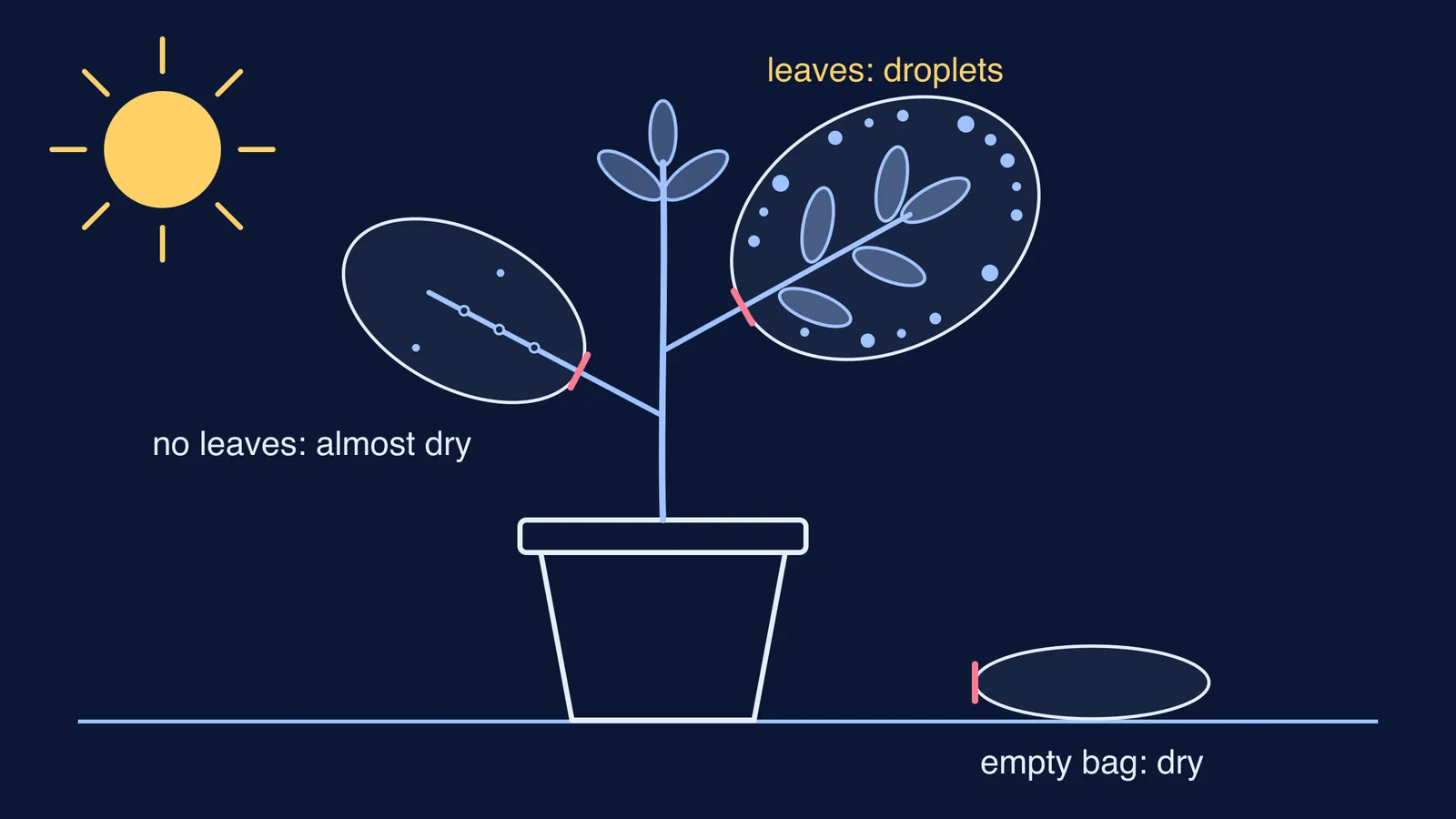
Pick two branches, each with 10-12 leaves.
Remove all the leaves from one branch and keep the leaves on the other.
Cover both branches with polythene bags and tie the mouths tightly.
Tie up an empty polythene bag and keep it in the sun beside the plant.
Look at the inner surface of each bag after a few hours.
The NCERT Class 10 chapter Life Processes has a shorter version, Activity 5.8. One pot holds a plant and the other a stick of the same height; the soil in both is covered with a plastic sheet so moisture cannot escape by evaporation, and both sets are covered and kept in bright sunlight for half an hour.
What should you observe in each bag?
The lab manual records three results:
Bag on the leafy branch: many water droplets on the inside.
Bag on the leafless branch: a negligible number of droplets.
Empty bag: no droplets at all.
Record them in that order, with the time you tied the bags and the weather.
Why do water droplets form inside the bag?
Explain it as a chain, one step per sentence:
Roots take up water from the soil, and the xylem carries it up to the leaves.
Water evaporates from the leaf cells and leaves the leaf as vapour through tiny pores called stomata.
The vapour is trapped in the closed bag and condenses on its inner surface as droplets.
NCERT's Class 10 textbook gives the definition in one line: the loss of water in the form of vapour from the aerial parts of the plant is known as transpiration (NCERT Class 10, Life Processes). The same chapter says transpiration helps the absorption and upward movement of water and dissolved minerals from roots to leaves, and also helps in temperature regulation. During the day, when the stomata are open, the transpiration pull is the main force moving water up the xylem.
Why did my bag stay dry?
Usually it is one of these:
The plant was indoors or in shade. The lab manual's note for teachers says to choose plants growing in the sun, not indoor or shaded ones.
The soil was dry, so the plant had little water to lose.
The bag was not tied tightly, so vapour escaped.
You checked too early. Give it a few hours in sunlight.
The day was cold or humid. The US Geological Survey explains that transpiration rises as temperature rises and falls as the humidity of the surrounding air rises; sunlight, wind and the type of plant matter too.
To test the stomata directly, try the manual's extension: pick two leafy branches, coat the leaves of one with a layer of oil, and bag both. The bag over the oiled leaves shows no droplets, because the oil clogs the stomatal openings.
How do you write it up for a practical file or viva?
A model observation and conclusion you can adapt:
Many water droplets appeared inside the bag on the leafy branch, very few in the bag on the leafless branch and none in the empty bag. The leaves released water vapour through their stomata. The vapour could not escape the closed bag, so it condensed on the inner surface as droplets. This loss of water as vapour from the aerial parts of a plant is called transpiration.
Viva questions drawn from the lab manual's own question list, with short answers:
Name the pores through which plants transpire. Stomata.
Why does the vapour appear as droplets? It is trapped in the bag and condenses on its inner surface.
Which transpires faster, a plant in the sun or one in shade? The plant in the sun, because light and warmth raise the rate.
If the links between stomata, xylem and the transpiration pull still feel loose, the Fermi Concept Library gives every biology concept its own lesson and shows its place in the map. When you practise exam-style questions, the Fermi Problem Library has worked problems with a step-by-step solver that explains the reasoning rather than printing an answer.
Before your viva, say the chain out loud once: roots, xylem, leaf cells, stomata, vapour, droplet.