

On this page
How does a taproot differ from a fibrous root system?
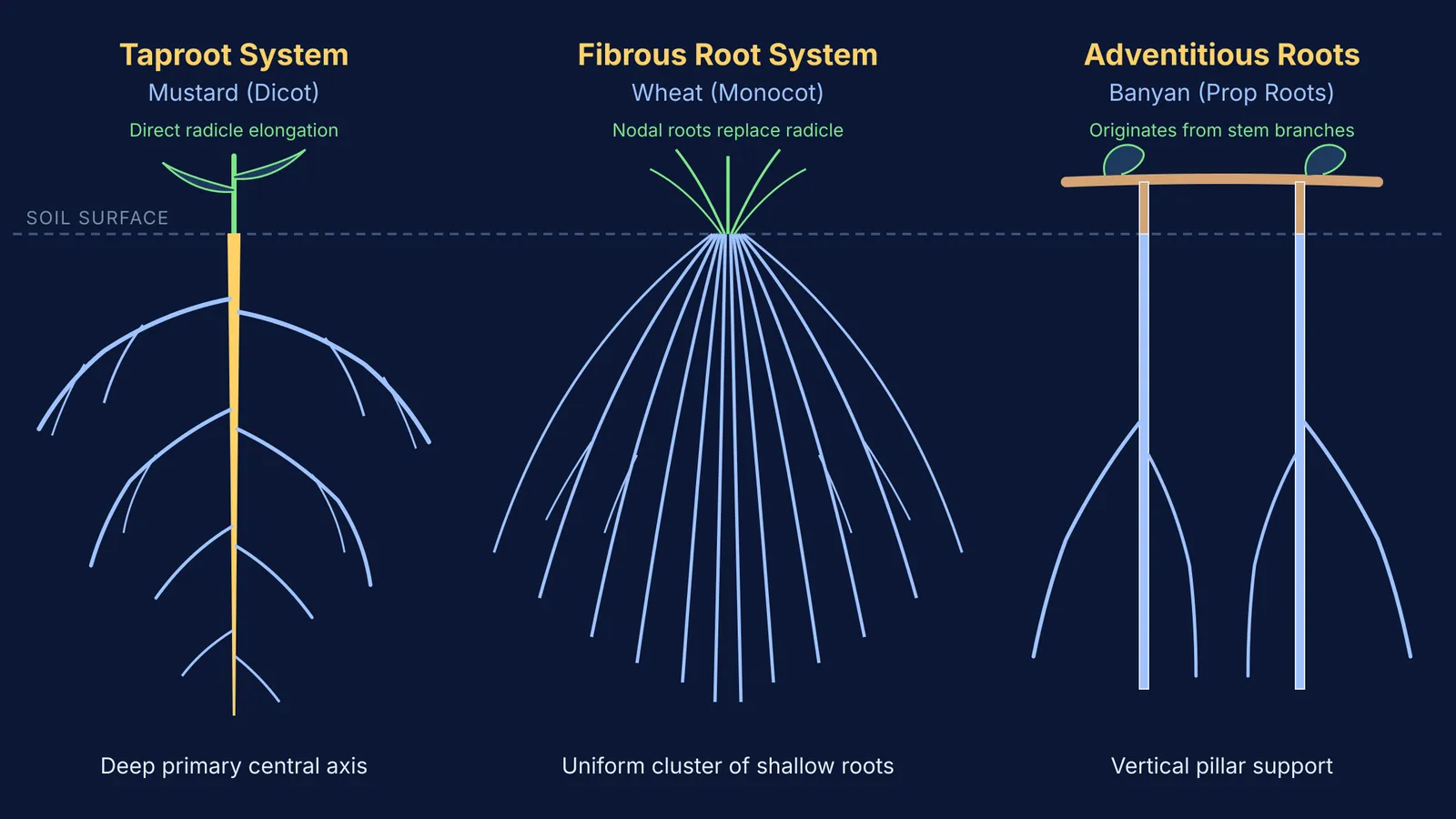
When a seed germinates, its embryonic radicle elongates directly into the soil to establish the primary root. In most dicotyledonous plants, such as mustard (*Brassica campestris*), this primary root persists and branches into secondary and tertiary roots in an acropetal sequence. As described in Chapter 5 of the NCERT Biology Class 11 textbook, the primary root and its lateral branches form the taproot system, which penetrates deep into the earth.
In monocotyledonous plants such as wheat (*Triticum aestivum*), the radicle's primary root is short-lived. Instead of deepening, it is replaced by a cluster of slender, uniform roots arising from the base of the stem. These form the fibrous root system, creating an extensive surface mat rather than a central anchor. This divergence mirrors monocot and dicot seed anatomy, where cotyledon count aligns with root architecture. To trace these developmental pathways across botany, the Fermi Concept Library covers every concept in physics, chemistry, biology, mathematics and computing, each with its own lesson and its place in the map.
Why do monocots replace their primary root with fibrous roots?
Monocot stems lack a vascular cambium and cannot produce secondary growth to thicken a single primary root into a heavy wooden pillar. Instead, as the plant tillers, it generates dozens of equal roots from the stem base.
The quantitative scale of this fibrous network was measured in a landmark study by botanist Howard J. Dittmer in 1937. In a single winter rye plant grown for 16 weeks, Dittmer documented 13.8 million roots spanning 623 kilometres in length. With its 14.3 billion root hairs, the total subterranean surface area reached roughly 639 square metres—over 130 times the surface area of the above-ground shoot. This dense network excels at capturing topsoil moisture and preventing soil erosion.
What makes adventitious roots structurally unique?
Any root that arises from plant parts other than the radicle is an adventitious root. While monocot fibrous roots are technically adventitious because they sprout from the stem base, botanists use the term for specialized aerial and nodal structures.
As outlined in the NCERT Biology Class 11 curriculum, key adventitious adaptations include:
Prop roots: Heavy pillar roots that hang from horizontal tree limbs in banyans (*Ficus benghalensis*) to provide vertical support.
Stilt roots: Angled brace roots emerging from the basal stem nodes of maize and sugarcane to prevent wind lodging.
Foliar roots: Reproductive rootlets emerging from leaf margins in *Bryophyllum*.
While typical lateral roots arise internally through pericycle and lateral root initiation, adventitious roots can form exogenously from stem or leaf tissues. In wetland halophytes, roots even grow upward against gravity, forming pneumatophores in mangrove vegetation to secure oxygen.
How do root biomechanics and soil foraging shape plant survival?
These architectures balance anchorage against resource capture. Biomechanist A. Roland Ennos in 200033042-7) showed that taproots act like structural piles, resisting overturning wind loads through rigidity and compressive support against leeward soil. Fibrous root systems function like guy ropes, distributing tension across a wide perimeter.
Foraging needs mirror this mechanical divide. Plant physiologist Jonathan P. Lynch in 2013 showed that steep, deep root architectures excel at capturing mobile nitrate and water that leach deep into the subsoil, whereas shallow foraging systems concentrate density in the topsoil to acquire immobile nutrients like phosphate.
When solving tricky morphology problems, the Fermi Problem Library offers worked problems with a step-by-step solver that explains the reasoning rather than printing an answer.
A 4-step framework for diagnosing root specimens in exams
Use this diagnostic sequence to classify root specimens accurately in NEET-UG and board exam questions:
Check origin point: If the root continues directly from the embryonic radicle, it is a primary taproot; if it emerges from stem nodes or leaves, it is adventitious.
Inspect axis hierarchy: A dominant, tapering central axis indicates a taproot system; a cluster of equal, slender roots indicates a fibrous system.
Check leaf venation: Dicot reticulate venation pairs with taproots; monocot parallel venation pairs with fibrous roots.
Distinguish form from modification: Carrots and radishes are taproots modified for storage; sweet potatoes are modified adventitious roots.
Reviewing these diagnostic contrasts systematically ensures you never lose marks on subtle root modifications or morphological exceptions.


