

On this page
Most diagrams in textbooks show a plant root as a set of completely static rings, looking much like a target on a dartboard. But this simple picture can be misleading. In reality, the root must continuously grow outwards to anchor the plant securely in the soil and reach new sources of water and dissolved minerals. Furthermore, it must eventually grow thicker to physically support a larger, heavier stem above ground. Both of these vital dynamic processes start in a single layer of cells known as the pericycle.
Where is the pericycle located?
The pericycle is a cylinder of tissue located just inside the endodermis, forming the outermost layer of the vascular cylinder, or stele (Wikipedia). It is usually made of thin-walled parenchyma cells, though it can contain thicker sclerenchyma cells for additional structural support.
Despite being a mature tissue, the pericycle is remarkably active. Much like the primary growth zones covered in meristems: apical, intercalary and lateral, it keeps the ability to divide long after the cells have left the root tip.
How does the pericycle form lateral roots?
A plant expands its root system by sending out lateral, or branch, roots. These do not grow from the outer skin (the epidermis) but from deep inside the main root.
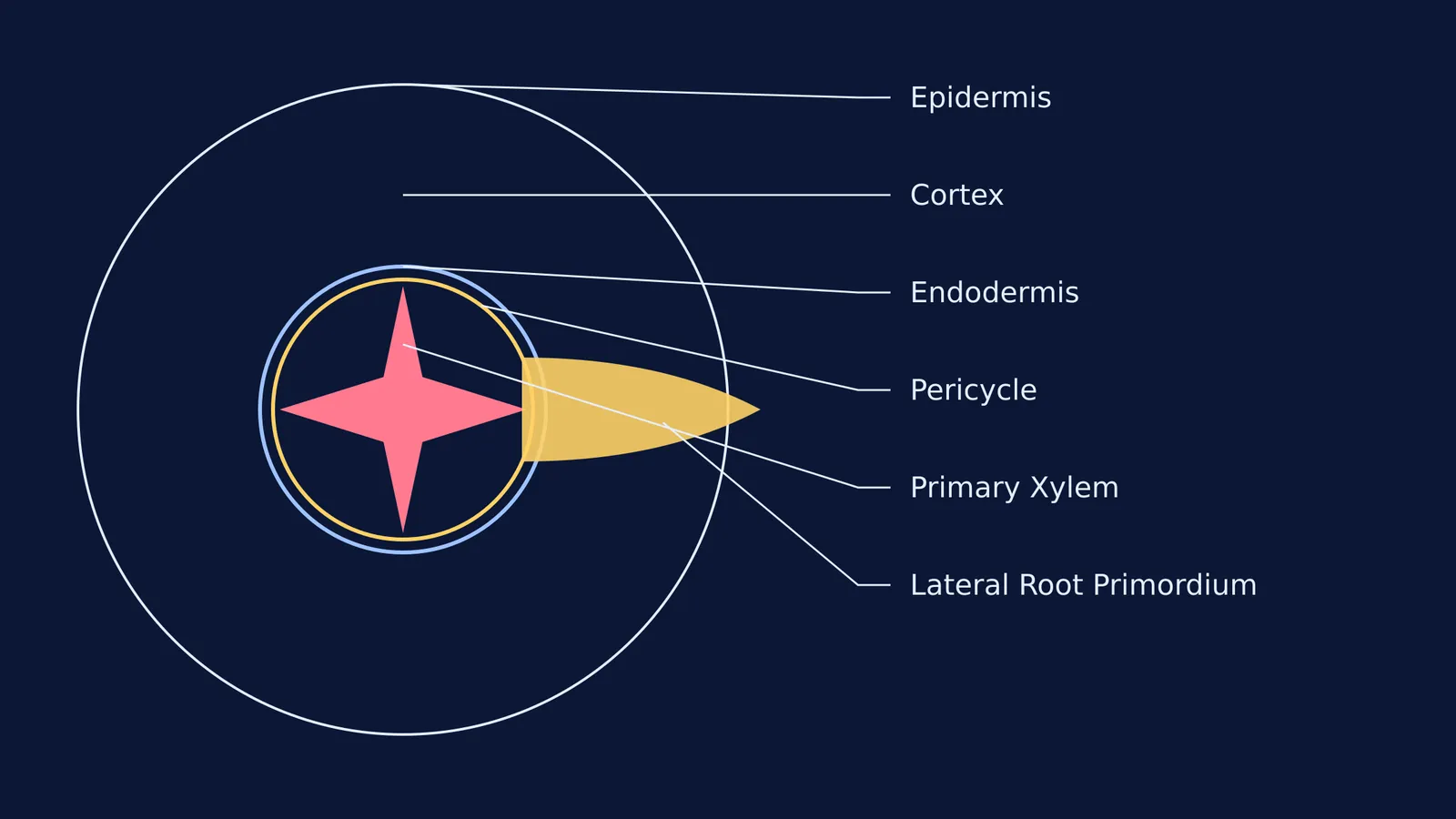
In most dicots, lateral roots originate exclusively from the pericycle cells that sit directly opposite the primary xylem poles (NCBI). When triggered by plant hormones like auxin, a small group of 3 to 8 pericycle cells begins to divide rapidly.
This localized burst of cell division—a contrast to the steady rates seen when comparing arithmetic vs geometric growth in plants—forms a dome-shaped lateral root primordium. As it grows, it pushes its way through the endodermis, the cortex, and finally the epidermis to emerge into the soil. Because it starts from the inner vascular cylinder, the new lateral root is immediately connected to the plant's main water and food transport systems.
If you are studying plant anatomy, picturing these 3D structures from 2D textbook sections can be difficult. The Fermi Concept Library has every concept in physics, chemistry, biology, mathematics and computing, each with its own lesson and its place in the map.
What is the pericycle's role in secondary growth?
While monocot roots generally stay the same thickness, dicot roots and gymnosperms undergo secondary growth to become thicker and woody. The pericycle is essential for this transition, playing two distinct roles:
Forming the vascular cambium: The vascular cambium—the tissue responsible for adding new xylem and phloem—forms a continuous ring in the root. Part of this ring develops from the tissue between the primary xylem and phloem. However, to close the circle, the pericycle cells located above the protoxylem poles become meristematic and divide to form the rest of the cambial ring.
Forming the cork cambium: As the root continuously thickens from this new vascular tissue being produced, the outer layers of the root (the epidermis and the cortex) stretch out and eventually rupture under the pressure. Before these protective outer tissues are lost completely to the surrounding soil, the pericycle steps in again to save the plant. Its cells divide once more to form the cork cambium, also known as the phellogen.
The cork cambium produces a layer of protective cork on the outside, creating the bark that shields the older root from physical damage and infection.
Understanding how tissues differentiate and "re-awaken" is key to mastering botany. If you get stuck memorising these pathways, the Fermi Problem Library has worked problems with a step-by-step solver that explains the reasoning rather than printing an answer.


