

On this page
Green's theorem ties line integrals back to the double integrals you already know. Once it clicks, an integral round four edges of a square becomes one short double integral, and the area of an ellipse falls out in two lines.
What is Green's theorem?
OpenStax Calculus Volume 3 describes Green's theorem as "an extension of the Fundamental Theorem of Calculus to two dimensions." In symbols, for a piecewise smooth, simple closed curve C oriented counterclockwise round a region D, with P and Q having continuous partial derivatives on an open region containing D:
∮_C (P dx + Q dy) = ∬_D (∂Q/∂x − ∂P/∂y) dA
The same OpenStax section defines the direction: C is positively oriented if, as you walk along it, the region D is always on your left. It also asks that D be simply connected, and notes that the theorem as stated so far "cannot handle regions with holes."
The quantity ∂Q/∂x − ∂P/∂y measures how much the field swirls at each point. Chop D into tiny squares and add up the swirl round each one: every inside edge is walked twice, in opposite directions, so it cancels. Only the outer boundary survives.
The result is named after George Green (1793–1841). The MacTutor biography records that his Essay on electricity and magnetism was published in March 1828, and that he "studied mathematics on the top floor of the mill, entirely on his own."
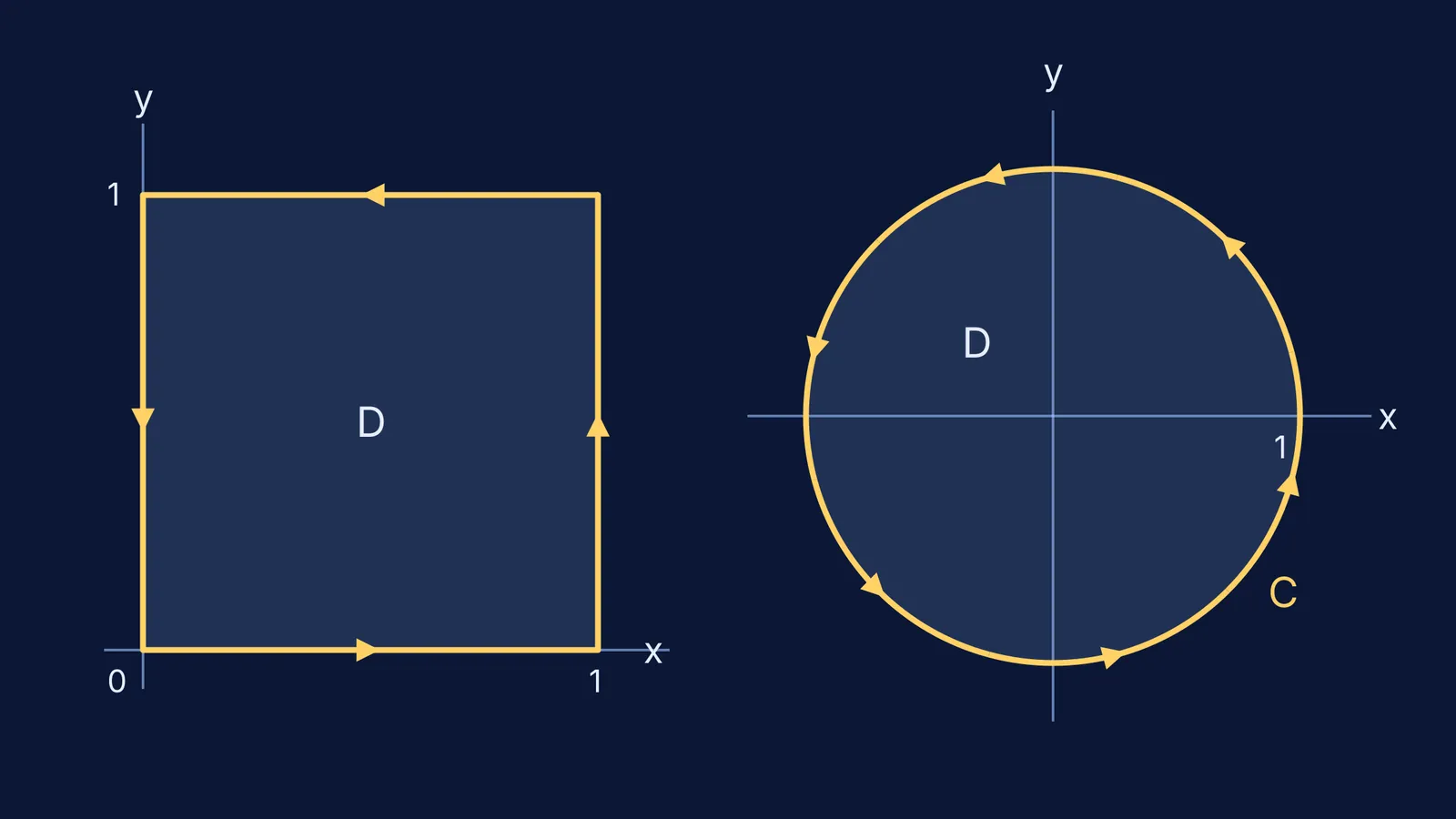
How do you check Green's theorem on the unit square?
Take P = xy and Q = x², and let C be the boundary of the square from (0, 0) to (1, 1), walked counterclockwise.
The double integral: ∂Q/∂x − ∂P/∂y = 2x − x = x, so ∬_D x dA = ∫₀¹∫₀¹ x dx dy = ½.
The line integral, one edge at a time:
Bottom, y = 0, x from 0 to 1: dy = 0 and P = 0, so this edge gives 0.
Right, x = 1, y from 0 to 1: dx = 0 and Q = 1, so this edge gives ∫₀¹ dy = 1.
Top, y = 1, x from 1 to 0: dy = 0 and P = x, so this edge gives ∫₁⁰ x dx = −½.
Left, x = 0, y from 1 to 0: dx = 0 and Q = 0, so this edge gives 0.
The total is 1 − ½ = ½, matching the double integral. Look at the top edge: x runs from 1 down to 0 because you walk right to left. Writing ∫₀¹ there is an easy slip to make, and it gives 3/2 instead.
For the right-hand side, see our guide to double integrals for area and volume.
How do you check it on the unit circle?
Now take P = −y and Q = x on the unit circle, x = cos t, y = sin t, with t from 0 to 2π (counterclockwise).
Line integral: −y dx + x dy = (sin²t + cos²t) dt = dt, so the integral is 2π.
Double integral: ∂Q/∂x − ∂P/∂y = 1 − (−1) = 2, and 2 times the area π is 2π.
Both sides agree. The line integral is the work this rotation field does on a particle taken once round; see work done by a vector force along a path for the physics reading.
How does Green's theorem give the area of a region?
Choose P and Q so that ∂Q/∂x − ∂P/∂y = 1; then the double integral is just the area. OpenStax uses the symmetric choice P = −y/2, Q = x/2, which gives:
Area of D = ½∮_C (x dy − y dx)
Try it on the ellipse x = a cos t, y = b sin t. Then x dy − y dx = ab(cos²t + sin²t) dt = ab dt, so the area is ½ × ab × 2π = πab. The trick works for any simple closed curve you can parametrise, which is why it pairs well with the area under a parametric curve such as the cycloid.
What are the common orientation pitfalls?
Check these before you trust an answer:
Direction: OpenStax states that the clockwise orientation of a disk's boundary is a negative orientation. Going clockwise flips the sign of the line integral.
Closed curve: C must return to its start. For an open path, close it with a segment, apply the theorem, then subtract that segment's line integral.
Holes: for a ring-shaped region, walk the outer boundary counterclockwise and the inner one clockwise, so the region stays on your left on both.
Bad points inside: P = −y/(x² + y²), Q = x/(x² + y²) gives ∂Q/∂x − ∂P/∂y = 0 at every point except the origin, yet its integral round the unit circle is 2π. The field is undefined at (0, 0), so Green's theorem does not apply to that disk.
If a step in a problem like this stalls you, the Fermi Problem Library has worked problems with a step-by-step solver that explains the reasoning rather than printing an answer. For the ideas underneath, the Fermi Concept Library gives each concept in mathematics its own lesson and its place in the map.
Your next step: redo the unit-square check with P = y² and Q = xy. Both sides should come to −½.


