On this page
In Class 11 you learn W = F·d: a constant force times a straight displacement. JEE problems break both: the force varies and the path curves. The fix is to cut the path into tiny steps, find the work on each step, and add them up.
How do you find work done by a variable force along a curved path?
The work done by a force along a path from A to B is W = ∫F·dr, taken along that path (OpenStax University Physics Volume 1, section 7.1). In the xy-plane, dr = dx i + dy j, so the dot product splits into two familiar pieces.
The same integral is often written ∫(P dx + Q dy), where P and Q are the x- and y-components of the force (OpenStax Calculus Volume 3, section 6.2). That one line is the whole method:
Write the force as F = Fx i + Fy j.
Write F·dr = Fx dx + Fy dy.
Use the path's equation to put everything in one variable: replace y with a function of x, and dy with (dy/dx) dx.
Set the limits from the start and end points, in that same variable.
Integrate.
Only the part of the force along the step does work, which is what the dot product picks out. If dot products still feel shaky, our post on finding λ so that two vectors are perpendicular shows a·b at work.
How do you write dx and dy along a parabola?
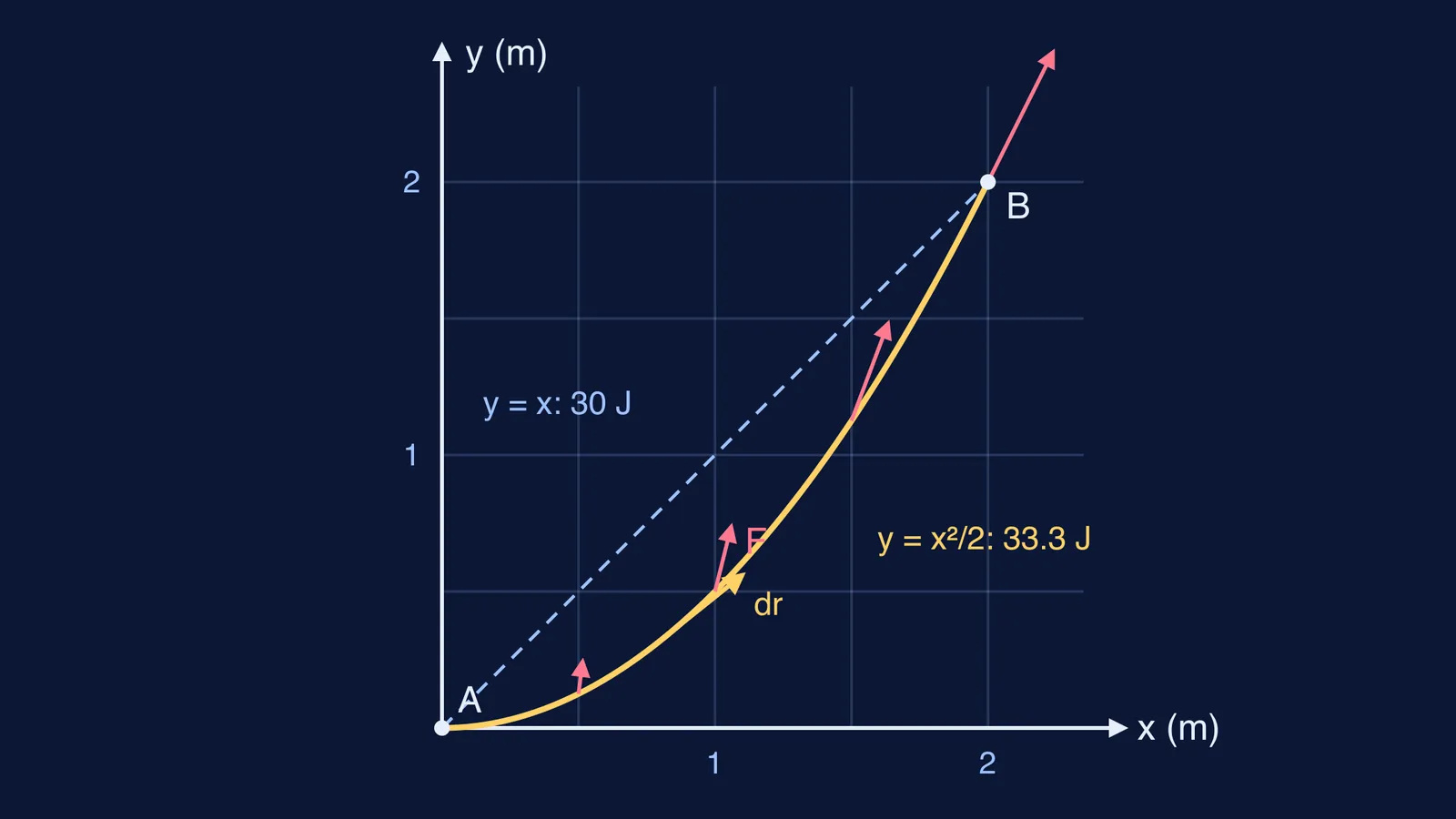
Take the example OpenStax works in section 7.1 (Example 7.4): a force F = (5 N/m)y i + (10 N/m)x j acts on an object moving along the parabola y = (0.5 m⁻¹)x² from A (0, 0) to B (2 m, 2 m). Below, x and y are in metres and force in newtons.
Components: Fx = 5y and Fy = 10x.
Dot product: F·dr = 5y dx + 10x dy.
Path: y = x²/2, so dy = x dx. Substituting both gives 5(x²/2) dx + 10x(x dx) = 2.5x² dx + 10x² dx = 12.5x² dx.
Limits: x runs from 0 to 2.
Integrate: W = ∫₀² 12.5x² dx = 12.5 × 8/3 ≈ 33.3 J, the answer OpenStax gives.
Does the work done depend on the path?
For some forces, yes. Here is our own extension of the OpenStax example: move the same object from A to B along the straight line y = x instead. Then dy = dx, F·dr = 5x dx + 10x dx = 15x dx, and W = ∫₀² 15x dx = 30 J. Same end points, different work.
That can happen because this force is not conservative. A conservative field is independent of path, and a conservative field F = ⟨P, Q⟩ must satisfy ∂P/∂y = ∂Q/∂x, the cross-partial property (OpenStax Calculus Volume 3, section 6.3). Here P = 5y and Q = 10x, so ∂P/∂y = 5 while ∂Q/∂x = 10. They differ, so there is no potential-energy shortcut; you must follow the path.
Gravity near Earth's surface and the spring force are conservative: their work depends only on the start and end positions (OpenStax University Physics, section 7.1). That is why the work done stretching a spring from x₁ to x₂ needs only the two extensions.
What mistakes cost marks in these problems?
Mixing variables: leaving a y inside an integral over x.
Forgetting dy: substituting y = x²/2 but leaving dy untouched. Writing dy = x dx is half the job.
Wrong limits: if you switch to y, the limits become the y-values of A and B.
Direction: going from B to A flips the sign of the work.
Treating the force as constant: W = F·d needs a constant force. If the force varies along the path, integrate.
The same idea of adding up the work on small pieces solves the leaking bucket lifted from a well, where the force changes with height.
Where can you practise line integrals for work?
If your method is right but the algebra slips, worked examples with every step explained help most. The Fermi Problem Library has worked problems with a step-by-step solver that explains the reasoning rather than printing an answer. If the dot product or the cross-partial test is the gap, the Fermi Concept Library gives every concept in physics and mathematics its own lesson.
Try one yourself with the force from OpenStax Example 7.4, now along y = x³/4 from (0, 0) to (2, 2). Write dy = (3x²/4) dx, collect the terms, and you should get 8.75x³ dx and a work of 35 J, a third answer for the same two end points.