On this page
A spring that is already stretched pulls back before you add a single millimetre. That one fact separates ½k(x₂² − x₁²) from ½k(x₂ − x₁)², and it is why the second form can lose marks in Class 11 tests and JEE Main. Here is the reason, a worked example and a check you can run in the exam hall.
Why is the work ½k(x₂² − x₁²) and not ½k(x₂ − x₁)²?
By Hooke's law the spring force is F = −kx, where x is the extension from the natural length. The force changes as you pull, so work is an integral, not force times distance.
The work done by the spring force between two positions is W = −½k(x₂² − x₁²), as Equation 7.5 of OpenStax University Physics, Volume 1 shows. If you pull slowly, so the block gains no kinetic energy, your work is the same size with the opposite sign: +½k(x₂² − x₁²).
The same result appears as energy: the change in elastic potential energy between two positions is ΔU = ½k(x₂² − x₁²), with U = ½kx² when the zero is set at the unstretched length, according to OpenStax section 8.1. Work between two extensions is just the difference of two stored energies, each measured from the natural length.
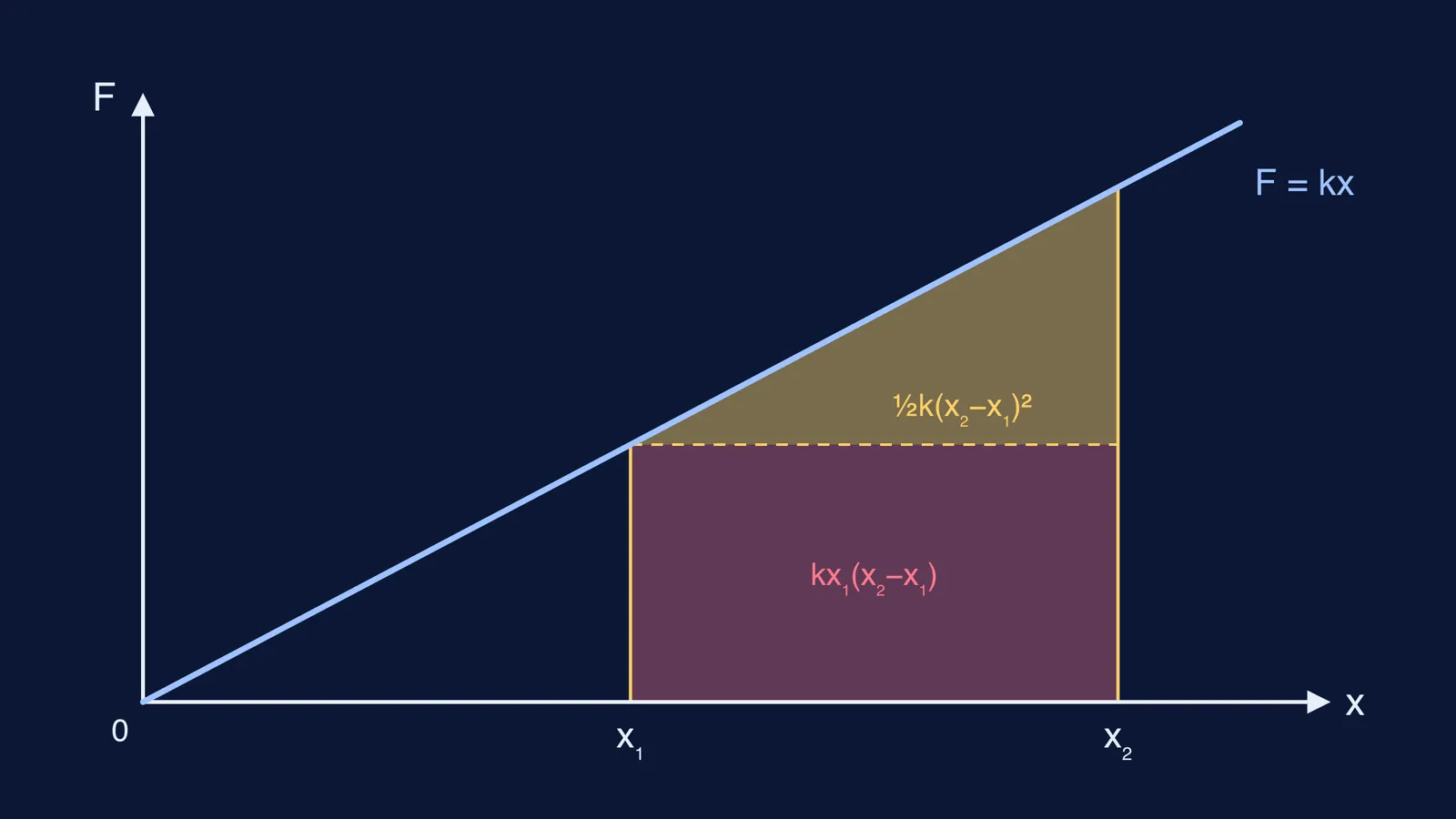
On a graph of F = kx against x, the work from x₁ to x₂ is the area under the line, a trapezium with two pieces:
a triangle on top, of area ½k(x₂ − x₁)², the only part the wrong formula counts
a rectangle underneath, of area kx₁(x₂ − x₁), the work done against the force the spring already had at x₁
Add them and you get ½k(x₂² − x₁²). The wrong formula throws away the rectangle. For more on areas like this, see our guide to work from force-displacement graphs.
Worked example: what does the second stretch cost?
This example is from OpenStax University Physics, Example 7.5. It takes 0.54 J of work to stretch a spring 6 cm from its natural length. How much more work stretches it from 6 cm to 12 cm?
Find k from the first stretch: 0.54 = ½k(0.06)², so k = 300 N/m (3 N/cm).
Use the right formula: W = ½ × 300 × (0.12² − 0.06²) = 150 × (0.0144 − 0.0036) = 1.62 J.
Compare the wrong formula: ½ × 300 × (0.12 − 0.06)² = 0.54 J.
The wrong formula says the second 6 cm costs what the first did. It cannot: the spring pulls back with 18 N at the start of the second stretch and 36 N at its end, while the first stretch began at 0 N. The correct answer, 1.62 J, is three times the work of the first stretch.
Why does ½k(x₂ − x₁)² feel right?
Three habits lead students there.
Reading x as "how far I moved it". In U = ½kx², x is the extension from natural length, not the distance moved in this step.
Algebra autopilot. x₂² − x₁² factorises as (x₂ − x₁)(x₂ + x₁), which is larger than (x₂ − x₁)² whenever x₂ > x₁ > 0.
The first problem you solved. Many textbook problems start from a slack spring, where x₁ = 0 and both forms agree. The habit sticks, then fails mid-stretch.
Our list of work-energy mistakes that quietly cost marks covers the sign errors that often travel with this one.
How do you check a spring work answer in the exam?
Run these four checks before you move on.
Measure both positions from the natural length. If the question gives "stretched a further 4 cm", write x₁ and x₂ as total extensions first.
Square, then subtract. Write ½k(x₂² − x₁²) on the page before putting numbers in.
Sense-check the size. Stretching an already stretched spring by the same amount must cost more than the first stretch did.
Watch compression. Squares ignore sign. Going from 2 cm compressed to 3 cm stretched with k = 300 N/m gives ½ × 300 × (0.03² − 0.02²) = 0.075 J, using the OpenStax formula above. The wrong form, ½ × 300 × (0.05)², gives 0.375 J, five times too much.
When a block hits or is launched by a spring, the same rule sits inside the energy equation; see our explainer on spring-block energy, compression and maximum speed.
When you cannot see which step slipped, the Fermi Problem Library has worked problems with a step-by-step solver that explains the reasoning rather than printing an answer. If the idea of potential energy itself feels shaky, the Fermi Concept Library gives each concept in physics its own lesson.
Try it now: a spring with k = 200 N/m is stretched from 5 cm to 10 cm. Write the answer both ways and see which one passes the four checks.