

On this page
Every find-λ question on perpendicular vectors comes down to one line of algebra. Here is the method, three worked examples and the parallel case, so you never mix the two up in a JEE Main or board paper.
Why does a·b = 0 mean the vectors are perpendicular?
For a = a1 i + a2 j + a3 k and b = b1 i + b2 j + b3 k, the dot product is a1b1 + a2b2 + a3b3, and two nonzero vectors are orthogonal if and only if their dot product is zero (OpenStax Calculus Volume 3, section 2.3).
The reason is the angle form, a·b = |a||b|cos θ: when θ = 90°, cos θ = 0, so the whole product is zero. Our explainer on finding the angle between two vectors covers the angle form.
How do you find λ so vectors are perpendicular?
Write both vectors in i, j, k form, putting a 0 in for any missing component.
Multiply matching components: i with i, j with j, k with k.
Add the three products and set the sum equal to zero.
Solve for λ. The equation may be linear or quadratic.
Put each value of λ back in and check the dot product really is 0.
Example 1, λ in one vector: take a = 2i + λj + 6k and b = i − 2j + 3k. Then a·b = (2)(1) + (λ)(−2) + (6)(3) = 20 − 2λ, so λ = 10. Check: 2 − 20 + 18 = 0.
Example 2, λ in both vectors: take a = λi + 3j + k and b = λi − 2j − 3k. Then a·b = λ² − 6 − 3 = λ² − 9, so λ = 3 or λ = −3. Both work, so write both.
Sometimes the quadratic has no real roots. With a = λi + 2j + k and b = λi − λj + 3k, you get λ² − 2λ + 3 = 0, whose discriminant is 4 − 12 = −8. No real λ makes this pair perpendicular, and saying so is the correct answer.
Example 3, a + λb perpendicular to c: take a = 2i + 2j + 3k, b = −i + 2j + k and c = 3i + j + 0k. The dot product distributes, so (a + λb)·c = a·c + λ(b·c). Here a·c = 6 + 2 + 0 = 8 and b·c = −3 + 2 + 0 = −1, so 8 − λ = 0 and λ = 8. Check: a + 8b = −6i + 18j + 11k, and its dot product with c is −18 + 18 + 0 = 0.
How is the parallel case different?
Parallel vectors have the same or opposite directions (OpenStax, Vectors in the Plane), so one is a scalar multiple of the other: a = kb. In components, that becomes a ratio test: a1/b1 = a2/b2 = a3/b3.
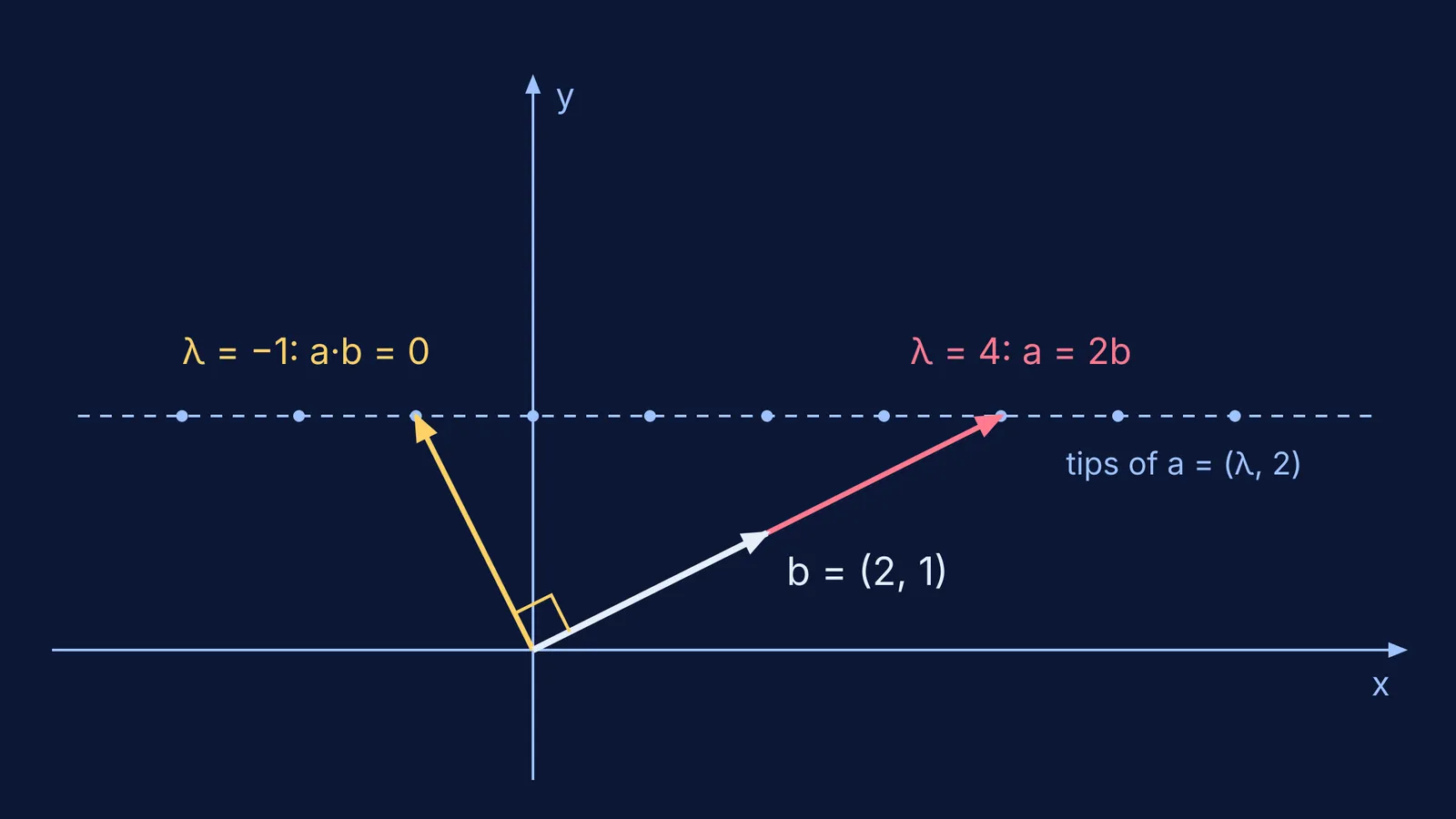
Use the pair from Example 1: a = 2i + λj + 6k and b = i − 2j + 3k. The ratios are 2/1 = λ/(−2) = 6/3. The known ratios both equal 2, so λ/(−2) = 2 and λ = −4. Then a = 2i − 4j + 6k = 2b.
So λ = 10 makes this pair perpendicular and λ = −4 makes it parallel. The diagram at the top shows the same idea in two dimensions.
Perpendicular: one equation, a sum of products set equal to zero.
Parallel: a chain of equal ratios that must all agree. If the known ratios disagree (say 2/1 and 1/3), no λ works.
Never divide by a zero component of b; for a parallel pair, the matching component of a must also be zero.
You can also check a parallel answer with the cross product: two vectors are collinear exactly when a × b = 0, a result set as an exercise in OpenStax section 2.4. Our post on why the cross product of parallel vectors is zero explains why.
What mistakes cost marks on these questions?
Using the wrong condition. Underline perpendicular or parallel first.
Sign slips with negative components. Bracket each product, as in (λ)(−2).
Dropping one root of a quadratic in λ.
Cancelling a vector from both sides of a dot-product equation. See the dot product cancellation trap.
Skipping the substitution check.
If you keep landing on the wrong λ, the Fermi Problem Library has worked problems with a step-by-step solver that explains the reasoning rather than printing an answer. If the dot product itself feels shaky, the Fermi Concept Library gives each mathematics concept its own lesson and its place in the map.
Next step: try the self-test on three pairs tonight, and write the check line every time.


