

On this page
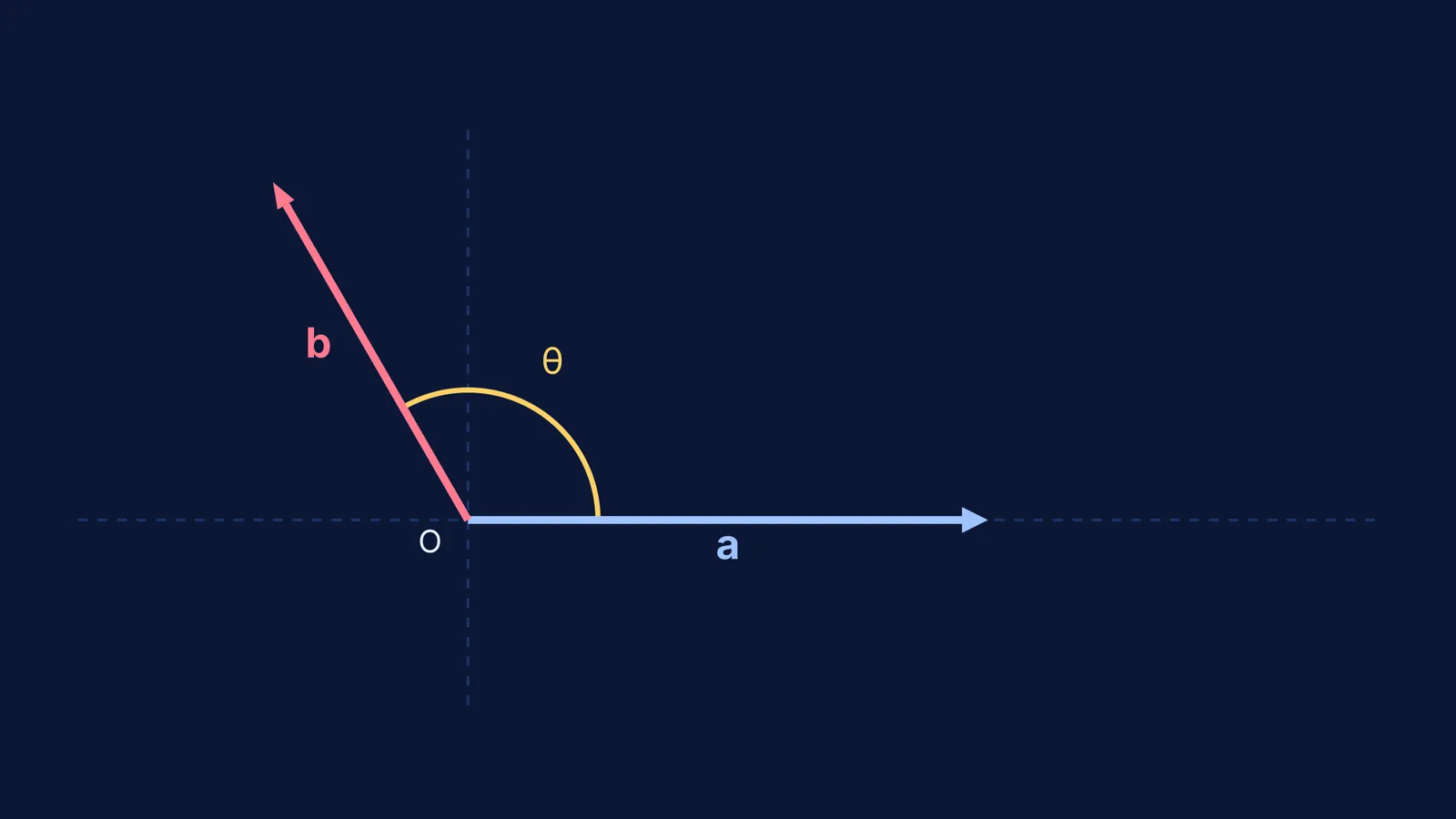
The angle θ between two nonzero vectors determines how much they point in the same direction. We find this angle using the dot product (or scalar product), a mathematical operation which takes two vectors and returns a single number. Geometrically, the dot product measures how much one vector projects onto another. If you imagine shining a light directly over one vector, the dot product captures the length of its shadow cast upon the second vector, scaled by that second vector's length.
According to OpenStax Calculus Volume 3, the dot product of two nonzero vectors is defined as the product of their magnitudes multiplied by the cosine of the angle between them. From this geometric definition, we can rearrange the equation to get the central formula for finding the angle:
cos θ = (a · b) / (|a| |b|)
Once you calculate cos θ using the raw vector components, you can find the exact angle by taking the inverse cosine (arccos).
How do you find the angle between two vectors using the dot product?
To find the angle between vector a and vector b, follow these three steps:
Calculate the dot product (a · b) by multiplying their matching components (the x, y, and z values) and adding the results together.
Find the magnitude (length) of each vector, |a| and |b|, using the square root of the sum of their squared components.
Divide the dot product by the product of the magnitudes to get cos θ, then use your calculator's inverse cosine function to find θ.
Here is a worked example for the vectors a = 2i + j - k and b = i + 2j + 2k.
First, find the dot product: a · b = (2 × 1) + (1 × 2) + (-1 × 2) a · b = 2 + 2 - 2 = 2
Next, find the individual magnitudes: |a| = √(2² + 1² + (-1)²) = √(4 + 1 + 1) = √6 |b| = √(1² + 2² + 2²) = √(1 + 4 + 4) = √9 = 3
Now, substitute these three numbers into the formula: cos θ = 2 / (3√6) θ = cos⁻¹(2 / (3√6))
If you are stuck on setting up the vector components or visualising the angle in three dimensions, the Fermi Concept Library contains interactive lessons that map out these geometry ideas step by step.
How can you tell if the angle between two vectors is acute or obtuse?
You do not always need to calculate the exact inverse cosine to understand the relationship between two vectors. The sign of the dot product alone tells you whether the angle is acute, right, or obtuse. Because the vector magnitudes |a| and |b| are always positive lengths, the sign of cos θ strictly matches the sign of the dot product.
Acute angle (θ < 90°): The dot product is positive (a · b > 0). The vectors point broadly in the same direction.
Obtuse angle (90° < θ ≤ 180°): The dot product is negative (a · b < 0). The vectors point away from each other.
Right angle (θ = 90°): The dot product is exactly zero (a · b = 0).
Two nonzero vectors are orthogonal (perpendicular) if and only if their dot product is zero (OpenStax). This is a powerful property used constantly in physics and engineering, such as when calculating the torque about a point with vectors.
What happens when vectors are parallel or anti-parallel?
When two vectors point in exactly the same direction, the angle between them is 0°. The cosine of 0° is exactly 1. This means the dot product reaches its maximum possible positive value, and the equation simplifies directly to a · b = |a| |b|. You can instantly spot parallel vectors if their dot product equals the product of their lengths.
Conversely, if the vectors point in exact opposite directions (anti-parallel), the angle is 180°. The cosine of 180° is -1. The dot product hits its maximum negative value, giving a · b = -(|a| |b|). This extreme condition is frequently used in physical mechanics problems where two forces act in total opposition, pulling directly against each other.
How do you find an unknown for perpendicular vectors?
Examiners often test your understanding of orthogonal vectors by giving you two perpendicular vectors with an unknown algebraic component (often written as λ or k) and asking you to find it.
Since you know the vectors are perpendicular, you can confidently state that their dot product must be exactly zero.
Worked example: Find the value of λ if the vectors a = 3i - λj + 2k and b = 4i + 2j - k are given as being perpendicular.
Set the dot product to zero: a · b = 0
Multiply the matching components: (3 × 4) + (-λ × 2) + (2 × -1) = 0
Simplify the resulting equation: 12 - 2λ - 2 = 0
Solve for λ: 10 - 2λ = 0, which means 2λ = 10, so λ = 5.
This zero-dot-product condition is the fastest way to verify perpendicularity, much like how comparing position vectors offers a quick collinear points test. If you hit a roadblock while working through similar vector problems, Fermi's AI tutor can write out the components on a virtual board and hold the line of reasoning until you spot the correct algebraic step yourself.


