

On this page
In standard arithmetic, if 3x = 3y, you can easily cancel the 3 to find that x = y. When studying vector algebra for JEE or Class 12 maths, it is tempting to apply this same logic to the dot product. If a · b = a · c, it seems obvious that b must equal c.
But this is false.
Vector algebra has hidden traps where standard arithmetic rules fail. The cancellation law does not apply to the dot product or the cross product individually.
Why doesn't a · b = a · c mean b = c?
If you subtract a · c from both sides of the equation, you get a · b − a · c = 0. Using the distributive property of vectors, this factors out to a · (b − c) = 0.
According to NCERT Vector Algebra, the dot product of two non-zero vectors is zero only when they are perpendicular to each other. Therefore, this equation only tells us that vector a is perpendicular (orthogonal) to the difference vector (b − c).
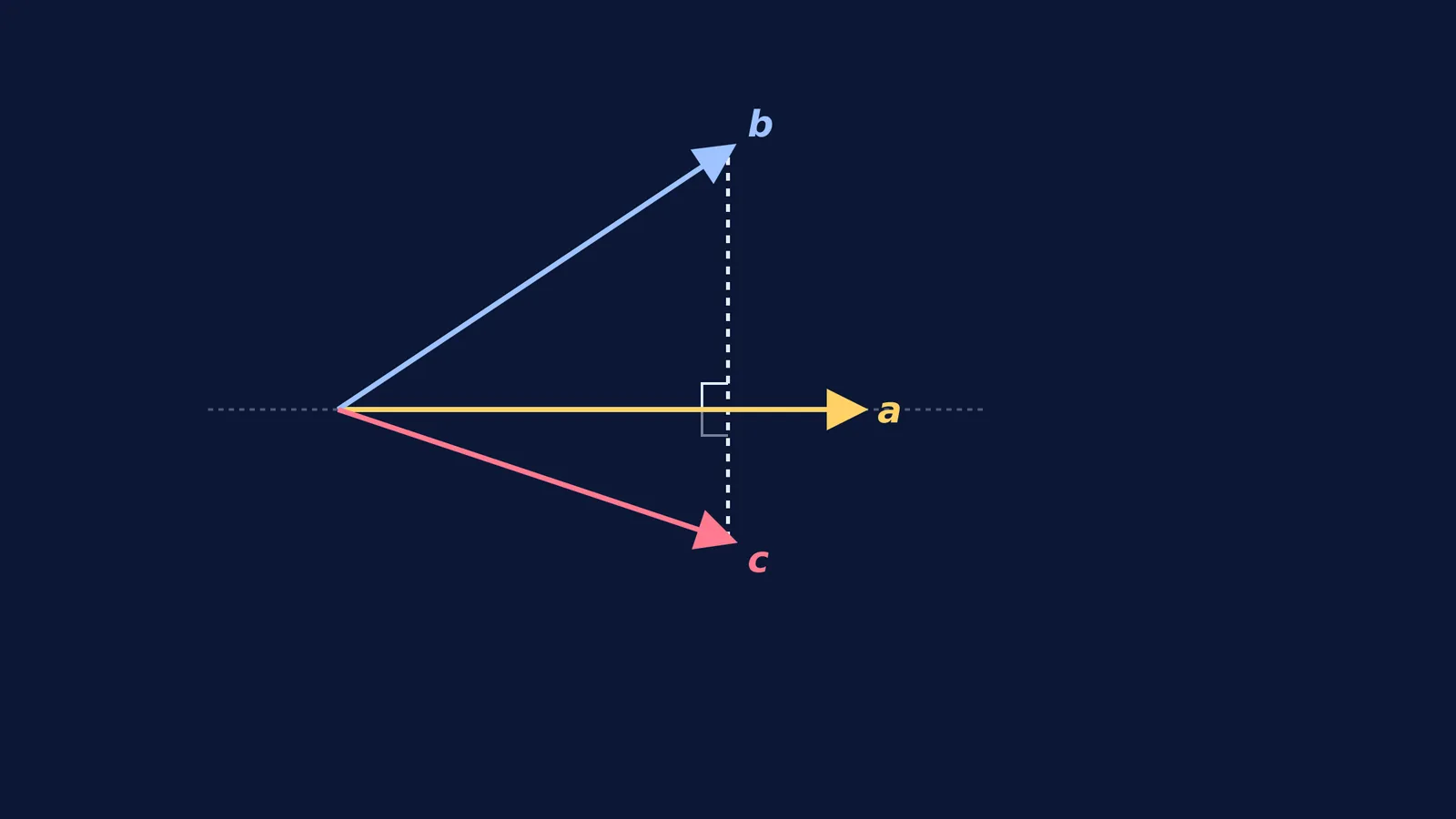
Any two vectors b and c that share the same projection along a will satisfy this equation. As long as the line connecting the tips of b and c meets a at a 90° angle, their dot products with a will be identical. Our diagram above shows exactly this: b and c are clearly different vectors, but because their difference is perpendicular to a, their dot products are equal.
A numerical example of the dot product trap
To see this in action, let us test some simple coordinates in 2D space. Imagine vector a lies exactly along the x-axis, so a = (4, 0).
Now let us define two other vectors:
b = (3, 2)
c = (3, -1)
To find the dot product a · b, we multiply their matching components and add them: (4 × 3) + (0 × 2) = 12. To find the dot product a · c, we follow the exact same steps: (4 × 3) + (0 × -1) = 12.
Both dot products equal 12, so a · b = a · c. However, b and c are completely different vectors. If you subtract them, you get b − c = (0, 3). This resulting vector points straight up the y-axis, making it perfectly perpendicular to our original vector a. Because it is perpendicular, the dot product of a and (b − c) is zero, which is the exact mathematical reason why the two initial dot products matched.
Does the cross product a × b = a × c mean b = c?
The cross product has a very similar cancellation trap. If you are given a × b = a × c, you still cannot cancel a to conclude that b = c.
Rearranging the equation gives a × (b − c) = 0.
The cross product of two non-zero vectors is zero when they are parallel to each other. So, this equation only proves that vector a is parallel to the difference vector (b − c). Once again, b and c do not have to be equal; they just need to form a difference vector that points in the same or opposite direction as a.
This mathematical behavior is why it is crucial to handle vector operations carefully in physics problems, whether you are dealing with collinear points with vectors in maths or finding torque about a point with vectors in mechanics.
When can you conclude that b = c?
You can only cancel a vector if you know both equations are true at the exact same time. If you are given that for a non-zero vector a:
a · b = a · c
a × b = a × c
If both hold true, then (b − c) must be perpendicular to a (from the dot product equation) and parallel to a simultaneously (from the cross product equation). A vector cannot be both perpendicular and parallel to a non-zero vector unless it is the zero vector itself.
Therefore, b − c = 0, which finally proves that b = c.
When preparing for competitive exams, always check for these hidden properties. If you ever hit a wall with vector properties, the Fermi Concept Library has every concept in physics, chemistry, biology, mathematics and computing, each with its own lesson and its place in the map. Or if you get stuck applying them to a tricky vector problem, the Fermi Problem Library has worked problems with a step-by-step solver that explains the reasoning rather than printing an answer.


