

On this page
This is our second set of eight original Gravitation questions for NEET-UG Physics, and it follows set 1 of our Gravitation NEET practice questions. This set covers what set 1 skipped: field and potential together, a group of masses, angular momentum, a high satellite's period, escape with speed to spare and an orbit around a heavier star. We wrote each one ourselves rather than adapting NCERT or past papers.
What does this set cover from the NEET syllabus?
Physics Unit 6 of the NMC's updated syllabus for NEET (UG)-2026 is Gravitation. Besides the universal law and g, it names Kepler's law, potential energy and potential, escape velocity, and a satellite's orbital velocity, period and energy. All eight questions fit that list and Chapter 7 of NCERT Class 11 Physics (Reprint 2026-27).
Take g = 9.8 m/s², R = 6400 km for Earth and G = 6.67 × 10⁻¹¹ N m² kg⁻². Treat planets as uniform spheres.
How should you use this set?
Cover the answers. Allow one minute per easy question, two per hard.
Before any formula, write which idea solves the question.
Mark r, the distance from the centre, before you use any formula.
Read every trap, even for questions you got right.
New to the chapter? Read our Gravitation for NEET preparation guide. If a step below loses you, the Fermi Problem Library has worked problems with a step-by-step solver that explains the reasoning rather than printing an answer.
Easy: field, potential and escape
Q1 (easy). At a point above a planet of radius 3000 km, the gravitational potential is −1.2 × 10⁷ J/kg and the gravitational field is 3.0 N/kg. How high above the surface is the point?
(A) 1000 km (B) 2000 km (C) 4000 km (D) 7000 km
Answer: (A). V = −GM/r and the field is GM/r², so r = |V| ÷ field = 4.0 × 10⁶ m = 4000 km from the centre, and the height is 1000 km.
Trap: (C) is r, the distance from the centre, not the height above the surface.
Q2 (easy). The gravitational potential at Earth's surface is −6.27 × 10⁷ J/kg. What is it at a height of R/4?
(A) −4.01 × 10⁷ J/kg (B) −4.70 × 10⁷ J/kg (C) −5.02 × 10⁷ J/kg (D) −7.84 × 10⁷ J/kg
Answer: (C). V = −GM/r, so V falls as 1/r. At r = 1.25R, V = −6.27 × 10⁷/1.25 ≈ −5.02 × 10⁷ J/kg.
Trap: (A) divides by 1.25², the rule for g. Potential goes as 1/r, field as 1/r².
Q3 (easy). From Earth's surface, ball P is launched straight up and ball Q, ten times heavier, at 30° above the horizontal. What is the ratio of the least launch speeds that let each escape Earth, P to Q?
(A) 1 (B) 1/2 (C) √10 (D) 2
Answer: (A). Escape needs ½mv² ≥ GMm/R, so v = √(2GM/R). Mass cancels and energy ignores direction, so both need the same speed.
Trap: (B) counts only the upward part of the velocity, but energy is a scalar.
Medium: systems, angular momentum and periods
Q4 (medium). Small spheres of 2 kg, 3 kg and 4 kg lie on a straight line in that order, with 0.5 m between neighbours. How much work is needed to move the 4 kg sphere very far away while the other two are held fixed?
(A) 1.60 × 10⁻⁹ J (B) 2.13 × 10⁻⁹ J (C) 2.93 × 10⁻⁹ J (D) 4.27 × 10⁻⁹ J
Answer: (B). Only the pairs that include the 4 kg sphere change: 3 kg at 0.5 m and 2 kg at 1.0 m. W = G(4 × 3/0.5 + 4 × 2/1.0) = 6.67 × 10⁻¹¹ × 32 ≈ 2.13 × 10⁻⁹ J.
Trap: (C) adds all three pairs, but the 2 kg to 3 kg distance never changes. See our gravitational potential energy problems for more systems of masses.
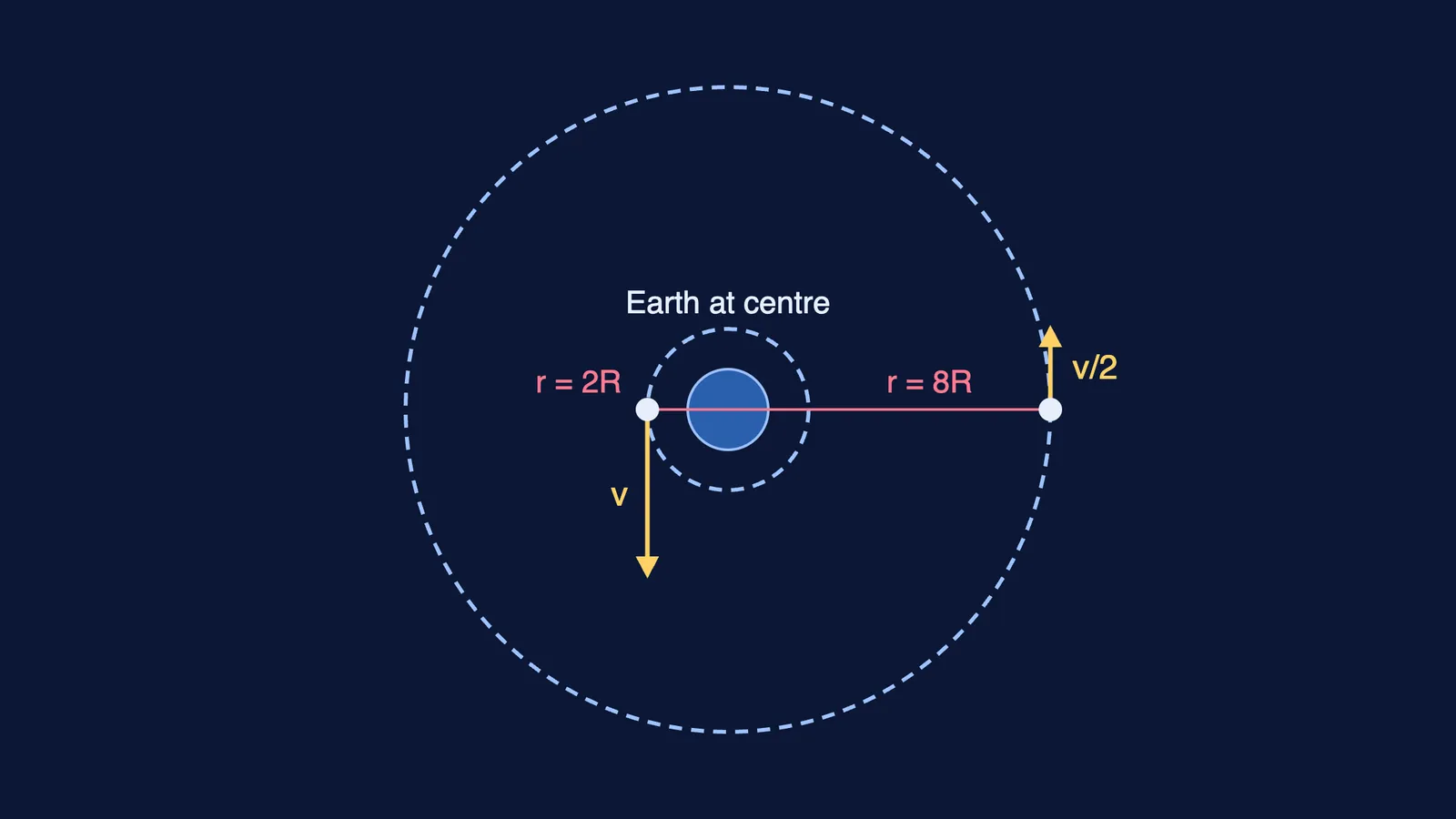
Q5 (medium). Two satellites of equal mass circle Earth at heights R and 7R. What is the ratio of their angular momenta about Earth's centre, outer to inner?
(A) 1/2 (B) 2 (C) 4 (D) 8
Answer: (B). L = mvr and v = √(GM/r), so L = m√(GMr). The radii are 8R and 2R, so the ratio is √4 = 2.
Trap: (A) is the ratio of speeds. The outer satellite is slower, but its larger radius wins.
Q6 (medium). A satellite circles Earth at a height of 8R above the surface. What is its period?
(A) 12.7 h (B) 25.4 h (C) 31.9 h (D) 38.1 h
Answer: (D). From GM/r² = (2π/T)²r, T = 2π√(r³/GM) with GM = gR². With r = 9R, T = 2π × 27 × √(R/g) ≈ 1.37 × 10⁵ s ≈ 38.1 h.
Trap: (C) puts r = 8R, the height, in place of the distance from the centre.
Hard: speed to spare and a heavier star
Q7 (hard). A probe is fired from Earth's surface at 15.0 km/s. Ignoring air and every other body, how fast is it moving when it is very far from Earth?
(A) 3.80 km/s (B) 7.08 km/s (C) 9.98 km/s (D) 12.7 km/s
Answer: (C). Escape speed is √(2gR) = 11.2 km/s. Energy conservation gives ½v∞² = ½v² − GM/R, so v∞² = v² − vₑ² = 225 − 125.4 = 99.6 and v∞ ≈ 9.98 km/s.
Trap: (A) subtracts the speeds, 15.0 − 11.2. Energy subtracts squared speeds.
Q8 (hard). Planet P circles star X. Planet Q circles star Y, which has 8 times the mass of X. Both orbits are circular, and Q moves twice as fast as P. What is the ratio of their periods, Q to P?
(A) 1/8 (B) 1/2 (C) 1 (D) 2√2
Answer: (C). For a circular orbit GM/r² = v²/r, so r = GM/v². Q's radius is 8/2² = 2 times P's. Then T = 2πr/v gives 2 ÷ 2 = 1: the periods are equal.
Trap: (A) assumes the same star, where T ∝ 1/v³.
Redo Q4 and Q7 in two days without the solutions.


