

On this page
This second set of eight original Gravitation questions for JEE Main Physics follows Gravitation JEE Main practice questions, set 1 and tests what set 1 left out. There are six single-correct MCQs and two numerical-value questions (Q4 and Q6), none from NCERT or a past paper.
Which Gravitation topics does set 2 cover?
Unit 6 of NTA's Syllabus for JEE (Main) - 2027 covers the universal law, g with altitude and depth, Kepler's law, potential, escape velocity and satellites. Set 2 adds g below the surface, field from a potential, a satellite's energy, Kepler's third law for two satellites and for an ellipse, escape from two masses, g with height, and an orbit changed by a burn.
All questions stay inside that unit and Chapter 7 of the NCERT Class 11 Physics textbook, Reprint 2026-27. Use g = 9.8 m/s² and R = 6400 km, as that chapter does. Ignore rotation and air.
How should you use this set?
Cover the answers. Allow two minutes each, three for Q7 and Q8.
Name the tool first: force, energy or period.
In numerical questions, carry units to the end and round once.
If a solution skips a step, the Fermi Problem Library has worked problems with a step-by-step solver that explains the reasoning rather than printing an answer. New to the chapter? Read how to prepare Gravitation for JEE Main first.
Easy: depth, potential and satellite energy
Q1 (easy). At what depth below Earth's surface is g 1% less than at the surface?
(A) 32 km (B) 64 km (C) 128 km (D) 640 km
Answer: (B). Below the surface g = g₀(1 − d/R). A 1% drop needs d/R = 0.01, so d = 0.01 × 6400 = 64 km.
Trap: (A) uses the height rule g₀(1 − 2h/R), which gives a 1% drop at 32 km above the surface, not below it.
Q2 (easy). In a region, the gravitational potential is V = (3x² + 4y) J/kg, with x and y in metres. What is the size of the gravitational force on a 2 kg mass at (1 m, 2 m)?
(A) 7.2 N (B) 14.4 N (C) 20 N (D) 22 N
Answer: (B). The field is minus the slope of V: Eₓ = −6x = −6 N/kg and E_y = −4 N/kg at that point. Its size is √(36 + 16) = 7.21 N/kg, so the force is 2 × 7.21 ≈ 14.4 N.
Trap: (D) multiplies the potential there, 11 J/kg, by the mass. Force comes from how V changes, not from V.
Q3 (easy). A satellite in a circular orbit has kinetic energy 5.0 × 10⁹ J. What is its total mechanical energy?
(A) +5.0 × 10⁹ J (B) −5.0 × 10⁹ J (C) −1.0 × 10¹⁰ J (D) −2.5 × 10⁹ J
Answer: (B). In a circular orbit, KE = GMm/2r and PE = −GMm/r, so the total is −GMm/2r, the negative of the KE.
Trap: (C) is the potential energy, −2 × KE, not the total.
Medium: periods, transfers and escape
Q4 (medium, numerical). Two satellites circle a planet in the same plane and direction. The inner one has a period of 104 min; the outer one's orbit radius is 9 times larger. How many minutes pass between their closest approaches?
Answer: 108. Kepler's third law, T² ∝ r³, gives the outer period 104 × 9^(3/2) = 2808 min. The inner satellite gains one full lap on the outer: 1/t = 1/104 − 1/2808, so t = 108 min.
Trap: 2704, the difference of the two periods. Subtract angular speeds, not periods.
Q5 (medium). Two identical fixed spheres, each of mass M, have centres 2d apart. A small body sits on the perpendicular bisector of the line joining them, √3d from its midpoint. What is the least speed it needs to escape to infinity?
(A) √(GM/d) (B) √(2GM/d) (C) 2√(GM/d) (D) √(4GM/√3d)
Answer: (B). The body is √(d² + 3d²) = 2d from each centre, so the potential there is −2GM/2d = −GM/d. Escape needs v²/2 = GM/d, so v = √(2GM/d).
Trap: (C) adds the escape speeds from each sphere, √(GM/d) each. Energies add; speeds do not.
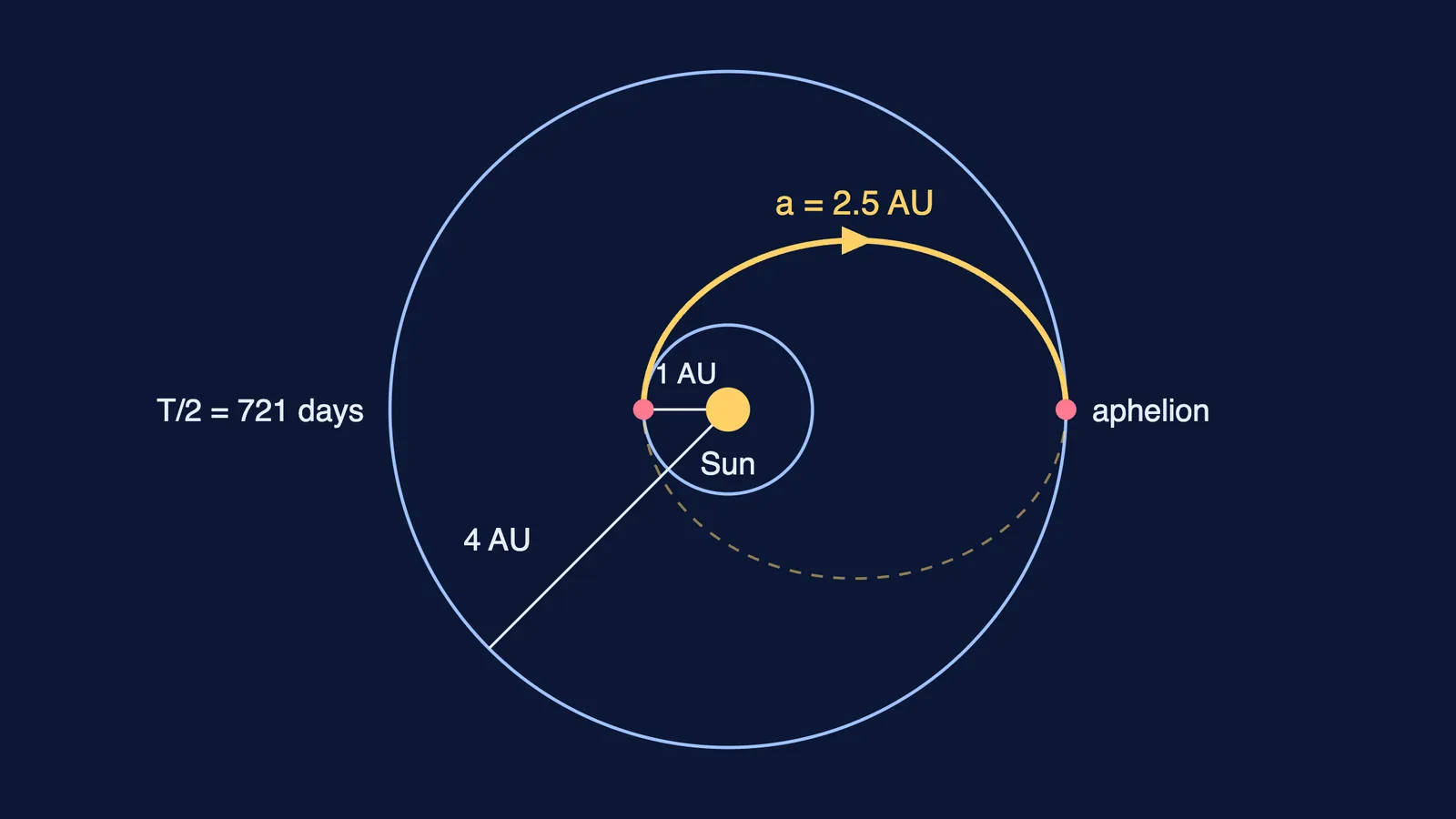
Q6 (medium, numerical). A short burn moves a probe from a 1.0 AU circle around the Sun onto an ellipse with the Sun at one focus, closest point 1.0 AU and farthest point 4.0 AU. A circular orbit at 1.0 AU takes 365 days. How many days does the probe take to reach 4.0 AU, to the nearest day?
Answer: 721. The ellipse's semi-major axis is (1.0 + 4.0)/2 = 2.5 AU. Kepler's third law holds for ellipses with the semi-major axis a in place of r: T = 365 × 2.5^(3/2) ≈ 1443 days. The trip is half an orbit, about 721 days.
Trap: 1460, which uses 4.0 AU as the semi-major axis.
Hard: g with height and changing orbits
Q7 (hard). A pendulum clock keeps correct time at sea level. It is carried up a mountain and now loses 15 s per day. About how high is it?
(A) 0.56 km (B) 1.11 km (C) 2.22 km (D) 66.7 km
Answer: (B). T = 2π√(L/g) and, at height h, g = g₀R²/(R + h)², so T grows by the factor (R + h)/R. Losing 15 s in 86,400 s means h/R ≈ 15/86,400, so h ≈ 6400 × 1.74 × 10⁻⁴ ≈ 1.11 km.
Trap: (C) uses the depth rule g₀(1 − d/R). That answers a mine, not a mountain.
Q8 (hard). A satellite circles a planet at radius r. A brief rocket burn against its motion cuts its kinetic energy to two-thirds of its value, without changing its direction, and it misses the planet. What is its closest distance to the planet's centre afterwards?
(A) r/3 (B) r/2 (C) 2r/3 (D) 3r/2
Answer: (B). After the burn v² = (2/3)GM/r, and the burn point becomes the farthest point. At the closest point r′, angular momentum gives rv = r′v′, and energy gives v²/2 − GM/r = v′²/2 − GM/r′. With x = r/r′ this becomes x² − 3x + 2 = 0, so x = 2 (x = 1 is the burn point) and r′ = r/2.
Trap: (D) uses v² = GM/r as if the new path were a circle. Losing energy brings it closer.
For more orbit practice, work through our satellite problems in Gravitation.


