

On this page
Your phone finds its position from radio signals sent by satellites about 20,200 km up. By the time those signals reach you, they are so weak that they sit below the random electrical noise in the receiver itself. That sounds impossible: how can you hear a whisper that is quieter than the hiss of your own radio? The answer uses three ideas from your syllabus, the inverse-square law, thermal noise and a clever use of a known pattern, and you can work out every step with a calculator.
How GPS turns timing into distance is covered in how GPS on a phone finds your location. This post is only about signal strength: how weak the signal is, and how the receiver still picks it out.
How weak is a GPS signal when it reaches the ground?
GPS satellites fly in medium Earth orbit at about 20,200 km, according to the US government's GPS space segment page. The civil signal (called C/A) is broadcast at 1575.42 MHz.
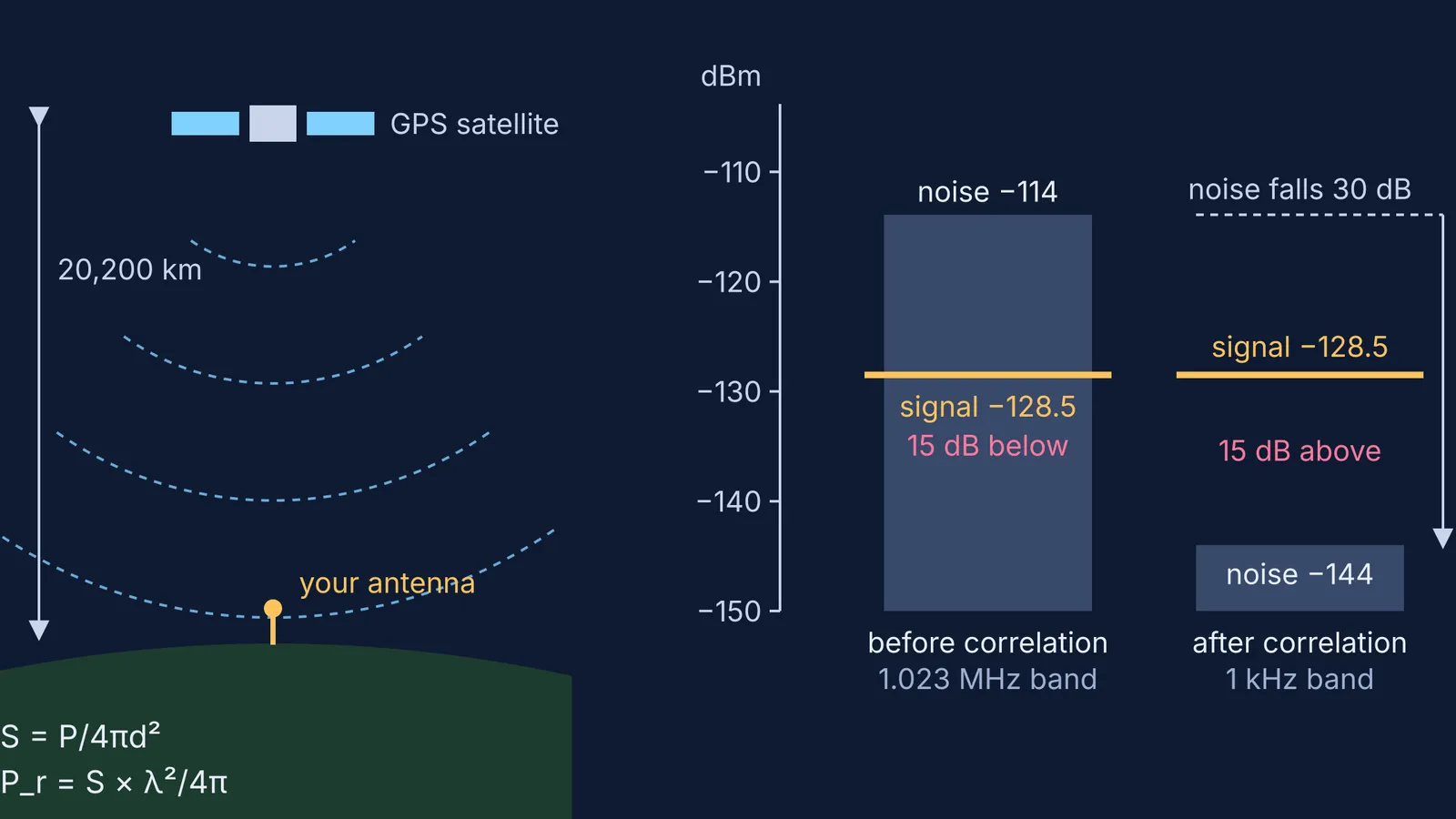
The official answer to "how weak" is in the GPS interface specification, IS-GPS-200, revision N (2022). Its table of minimum received signal strength gives −158.5 dBW for the C/A signal on L1, measured at the output of a 3 dBi linearly polarised antenna near the ground, for a satellite more than 5° above the horizon.
Convert that to watts: 10^(−158.5/10) W = 1.4 × 10⁻¹⁶ W. In dBm (decibels relative to one milliwatt) it is −158.5 + 30 = −128.5 dBm.
Why is the signal so weak after 20,200 km?
A transmitter's power spreads out over a growing sphere, so the power per square metre falls as 1/d². This is the inverse-square law, and it is the heart of the link sum in the Friis transmission equation.
Worked example 1: the received power
Data. Satellite power, counted as if it were radiated equally in all directions: P = 500 W. This is a round illustrative value; the specification sets the received level, not this number. Distance d = 20,200 km = 2.02 × 10⁷ m (satellite overhead). Frequency f = 1575.42 MHz.
Flux at the ground. S = P/4πd² = 500 ÷ (4π × (2.02 × 10⁷)²) = 9.8 × 10⁻¹⁴ W/m².
Wavelength. λ = c/f = 3.00 × 10⁸ ÷ 1.575 × 10⁹ = 0.190 m, about 19 cm.
Area a simple antenna collects from. A simple (isotropic) antenna behaves as if it caught all the power falling on an area λ²/4π = 0.190² ÷ 4π = 2.9 × 10⁻³ m², about 29 cm².
Received power. P_r = S × A = 9.8 × 10⁻¹⁴ × 2.9 × 10⁻³ = 2.8 × 10⁻¹⁶ W, which is −125.5 dBm.
Low satellite. At 5° elevation the slant distance is about 25,200 km, so P_r drops by (20,200/25,200)², to about 1.8 × 10⁻¹⁶ W (−127.5 dBm).
These are within a few dB of the specified minimum of −128.5 dBm. Real satellite antennas point their power at the Earth, and real receivers have gains and losses, so the sum only gets the size right.
What is the noise that the GPS signal sits under?
Every resistor and every receiver at temperature T has random thermal noise. Its power in a bandwidth B is N = kTB, where k = 1.38 × 10⁻²³ J/K. This is derived in Johnson noise and Boltzmann's constant.
The C/A code is sent at 1.023 million chips per second (chips are the code's on and off steps; the rate is in IS-GPS-200), so the signal is spread over roughly 1 MHz. We take 1.023 MHz as the receiver's bandwidth; the main lobe of the spectrum is actually 2.046 MHz wide, so this is an approximation.
Worked example 2: signal against noise
Noise per hertz. kT at 290 K = 1.38 × 10⁻²³ × 290 = 4.0 × 10⁻²¹ W/Hz, which is −204 dBW/Hz.
Noise in the band. N = kTB = 4.0 × 10⁻²¹ × 1.023 × 10⁶ = 4.1 × 10⁻¹⁵ W, which is −113.9 dBm.
Compare. Signal −128.5 dBm minus noise −113.9 dBm = −14.6 dB. The signal is about 15 dB below the noise, about 29 times weaker.
Units check. J/K × K × 1/s = J/s = W. Correct.
Real receivers add a few dB of their own noise on top of kTB, which makes things a little worse.
How does a receiver find a signal below the noise?
Each GPS satellite repeats its own known code, 1,023 chips long, once every millisecond (IS-GPS-200 calls it a Gold code of 1 millisecond in length). The receiver makes its own copy of the code and slides it along the incoming signal until the two line up. When they match, it multiplies and adds up over a full millisecond.
Noise does not match the code, so its contributions add up randomly and largely cancel. The signal matches every chip, so its contributions add up in step. In frequency terms, the correlation squeezes the signal from a band about 1 MHz wide into one about 1 kHz wide (one over the 1 ms code period). The noise that matters is then only the noise in 1 kHz.
Worked example 3: the processing gain
Noise in 1 kHz. N = kTB = 4.0 × 10⁻²¹ × 1,000 = 4.0 × 10⁻¹⁸ W, which is −144.0 dBm.
Gain. 10 log₁₀(1.023 × 10⁶ / 10³) = 10 log₁₀ 1,023 = 30.1 dB. This is called the processing gain.
New comparison. −128.5 − (−144.0) = +15.5 dB. The signal is now about 15 dB, roughly 35 times, above the noise.
So "below the noise" is true only before correlation. After it, the signal stands well clear. Receivers go further by adding up many milliseconds, which is how phones can still lock on indoors, more slowly.
Different satellites use different codes, so their signals share one frequency and the receiver separates them by code. India's NavIC system uses its own frequencies and codes, so its numbers differ from the GPS ones here.
Where does this show up in JEE and NEET physics?
You will not be asked about GPS codes, but the pieces are core: intensity from a point source (I = P/4πr²), power and energy in electromagnetic waves, decibel arithmetic, and kT as the scale of thermal energy. A question that mixes them is a good test of units. If you want to practise multi-step sums like these, the Fermi Problem Library has a step-by-step solver that explains the reasoning.
Quick checklist
Specified minimum C/A signal on the ground: −158.5 dBW = −128.5 dBm = 1.4 × 10⁻¹⁶ W.
Flux falls as P/4πd²; a simple antenna collects from an area λ²/4π.
Thermal noise N = kTB; kT at 290 K is about −204 dBW/Hz.
In a 1 MHz band the noise is about −114 dBm, so the signal is about 15 dB below it.
Correlating with the known 1,023-chip code narrows the band to about 1 kHz: a 30 dB gain.
Power ratios use 10 log₁₀; dBm = dBW + 30.


