

On this page
The golden ratio is not decoration in a regular pentagon; the angles force it. Spot two similar triangles inside the shape and φ drops out of one line of algebra; the same picture gives cos 36° exactly.
What is the golden ratio, exactly?
Euclid defined the idea as cutting a line so that "as the whole line is to the greater segment, so is the greater to the less", which he called extreme and mean ratio (Euclid, Elements Book VI, Definition 3, D. E. Joyce's edition).
The golden ratio is φ = (1 + √5)/2 = 1.6180339887…, the positive root of φ² − φ − 1 = 0 (Wolfram MathWorld, Golden Ratio).
The useful form to remember is φ = 1 + 1/φ: a number one more than its own reciprocal.
Why is the golden ratio in a regular pentagon?
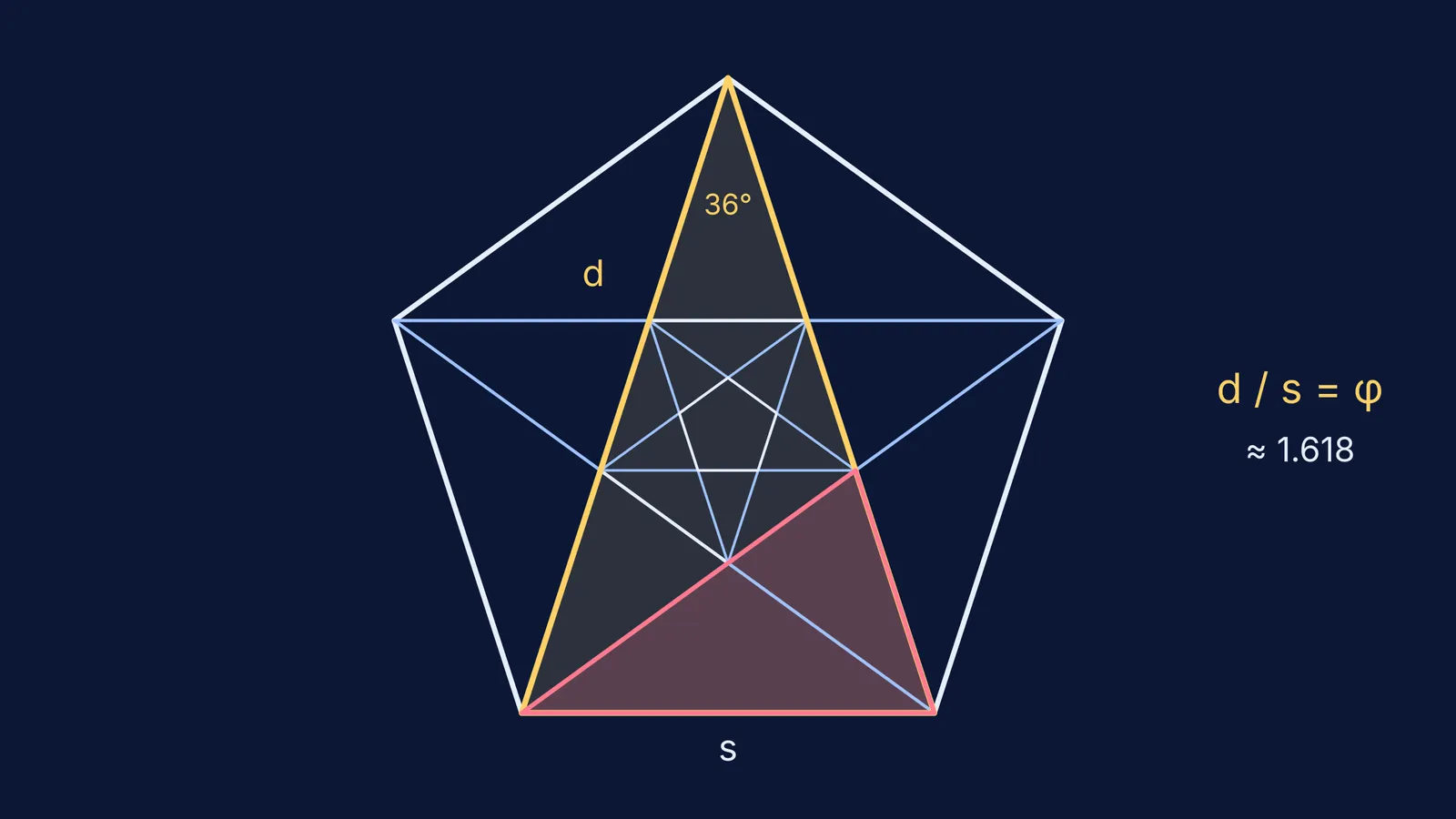
Euclid proved that two diagonals of a regular pentagon that meet inside it cut each other in extreme and mean ratio, and that the longer piece equals the side (Elements Book XIII, Proposition 8). In modern terms, the diagonal d and side s satisfy d/s = φ (Wolfram MathWorld, Regular Pentagon).
The proof needs only angles and similar triangles.
A pentagon's interior angles add up to (5 − 2) × 180° = 540°, so each angle of a regular pentagon is 540° ÷ 5 = 108°.
Label the pentagon ABCDE with side s. Triangle ABC is isosceles with apex angle 108°, so its base angles are 36°: every diagonal makes 36° with the side next to it.
At vertex A, diagonals AC and AD split the 108° into three angles of 36°.
Triangle ACD has diagonals as legs, a side CD as base, a 36° apex at A and 72° base angles: the 36-72-72 triangle.
Let diagonal BD cross AC at P. In triangle DPC, angle PCD = 72° and angle PDC = 36° (step 2), so angle DPC = 72°. So DP = DC = s, and triangle DPC has the same angles as ACD: they are similar.
In triangle APD, angle PAD = 36° and angle PDA = 36°, so AP = DP = s. That leaves PC = AC − AP = d − s.
Similarity gives AC/CD = DP/PC, which is d/s = s/(d − s).
Put x = d/s; step 7 becomes x = 1/(x − 1), which is x² − x − 1 = 0. The positive root is (1 + √5)/2, so d/s = φ. If similarity feels shaky, revise the AA, SSS and SAS similarity criteria first.
What is the golden triangle?
A golden triangle is an isosceles triangle whose equal side divided by its base is φ, and whose apex angle is 36° (Wolfram MathWorld, Golden Triangle). Euclid built exactly this shape, an isosceles triangle with each base angle double the apex angle, as the step before inscribing a regular pentagon in a circle (Elements Book IV, Proposition 10).
Triangle ACD is one. In step 5, DP bisects its 72° base angle at D and cuts off a smaller golden triangle, DPC, scaled down by φ.
Why is cos 36° equal to φ/2?
Apply the sine rule to triangle ACD: side AD = d faces the 72° angle at C and CD = s faces 36°, so d/sin 72° = s/sin 36°.
That gives d/s = sin 72° ÷ sin 36° = (2 sin 36° cos 36°) ÷ sin 36° = 2 cos 36°. Since d/s = φ, cos 36° = φ/2 = (1 + √5)/4 ≈ 0.809.
For cos 72°, drop the altitude from A to CD; it halves the base, so cos 72° = (s/2)/d = 1/(2φ) = (√5 − 1)/4. Wolfram MathWorld lists both exact values (Regular Pentagon) and writes φ = 2 cos(π/5) (Golden Ratio). Our post on deriving sin 30°, 45° and 60° from two triangles reads exact values from a triangle the same way.
How do pentagrams nest inside pentagons?
Draw all five diagonals and you get a pentagram; its five crossing points make a smaller regular pentagon that points the other way. Each tip of the pentagram is a golden triangle, and a tip's side divided by the inner pentagon's side is φ (Wolfram MathWorld, Pentagram).
Check the chain with s = 1. Two other diagonals cut each diagonal into tip, middle, tip.
The diagonal is φ ≈ 1.618.
From step 6, tip + middle = 1, so a tip is φ − 1 ≈ 0.618.
The middle, 0.382, is the inner pentagon's side.
In order, 1.618, 1, 0.618, 0.382: each is φ times the next.
So the inner pentagon is the outer one shrunk by φ² ≈ 2.618 and turned upside down.
If steps 2 to 6 lose you, the Fermi Problem Library has worked problems with a step-by-step solver that explains the reasoning rather than printing an answer. The Fermi Concept Library gives similar triangles and the sine rule each their own lesson. To see what φ = 1 + 1/φ becomes when you keep substituting it into itself, read the golden ratio as a continued fraction.


