

On this page
It is easy to forget whether sin 60° is √3/2 or 1/2 halfway through a board paper, and memorising harder is not the fix. Two small triangles hold every value of sin, cos and tan at 30°, 45° and 60°, and you can redraw them in the margin. It is the method the NCERT Class 10 textbook uses in section 8.3 of Chapter 8, Introduction to Trigonometry.
Why do two triangles give exact values?
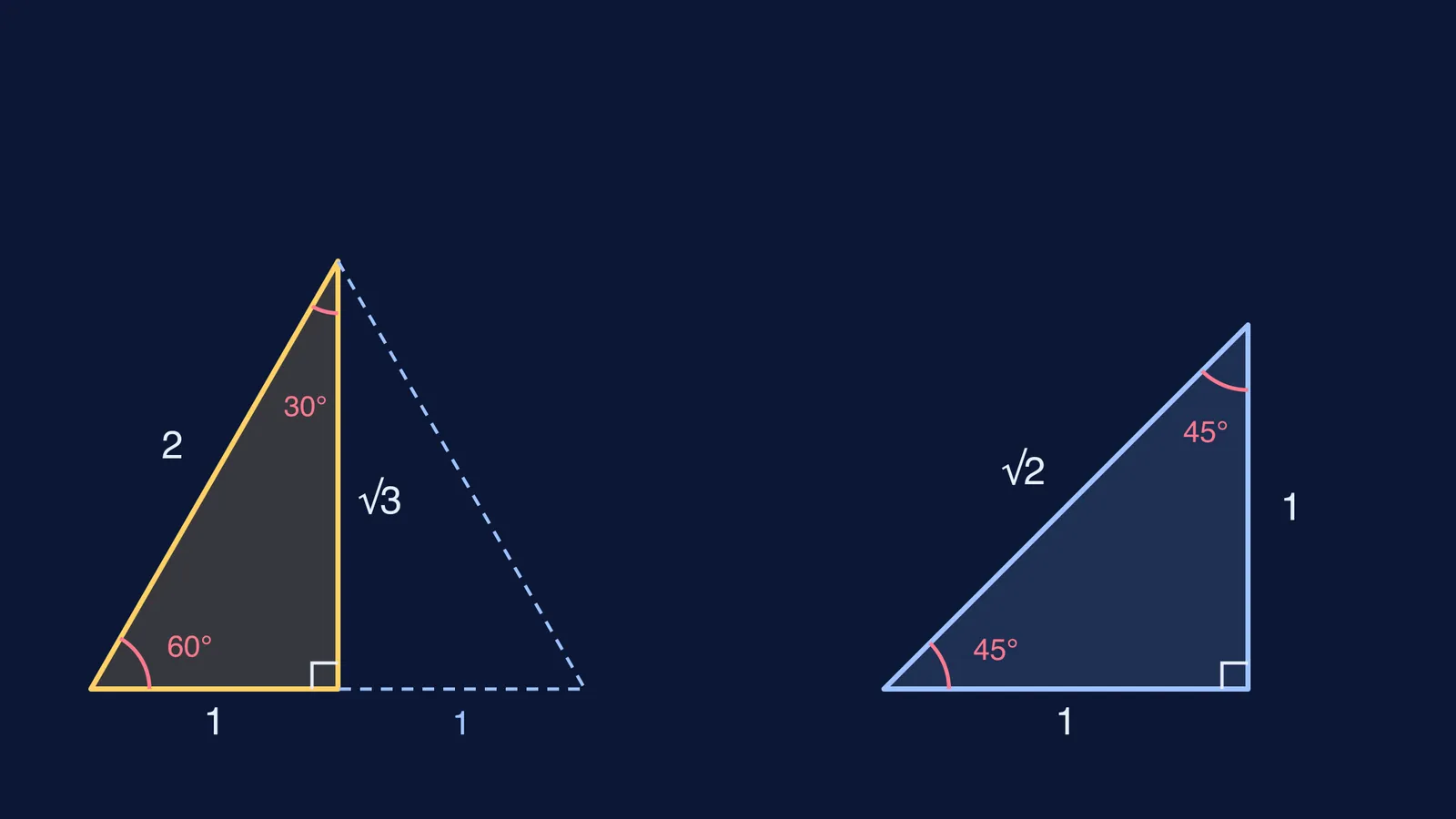
A trig ratio depends only on the angle, not on how big the triangle is, because all right triangles with the same angles are similar. (We explain this in why trigonometric ratios don't depend on triangle size.) So you are free to choose side lengths that make the arithmetic easy. In the two triangles below, geometry gives you the angles for free, and Pythagoras gives the missing side as an exact surd, not a decimal.
How do you derive sin 45°, cos 45° and tan 45°?
Draw triangle ABC, right-angled at B, with angle A = 45°. The angles add to 180°, so angle C = 45° too.
Equal angles face equal sides, so AB = BC = a.
By Pythagoras, AC² = a² + a² = 2a², so AC = a√2.
Read off the ratios: sin 45° = a/(a√2) = 1/√2, cos 45° = 1/√2, and tan 45° = a/a = 1.
NCERT's derivation uses these same side lengths (NCERT Class 10 Mathematics, Chapter 8, p. 122). √2/2 is the same number as 1/√2, just rationalised.
How do you derive sin 30° and sin 60°?
Draw an equilateral triangle ABC with each side 2a. Every angle is 60°.
Drop the perpendicular AD from A to BC. Triangles ABD and ACD are congruent, so BD = DC = a and angle BAD = 30°.
Keep only triangle ABD: right-angled at D, with angle B = 60° and hypotenuse AB = 2a.
By Pythagoras, AD² = (2a)² − a² = 3a², so AD = a√3.
At the 30° angle (A), the opposite side is BD = a and the adjacent side is AD = a√3. So sin 30° = 1/2, cos 30° = √3/2 and tan 30° = 1/√3.
At the 60° angle (B), the roles swap: opposite is AD, adjacent is BD. So sin 60° = √3/2, cos 60° = 1/2 and tan 60° = √3.
The side is 2a so that the half is a and no fractions appear. NCERT makes the same choice and collects all the results in its Table 8.1 (NCERT Class 10 Mathematics, Chapter 8, pp. 122-125).
Remember just two sets of sides, 1, √3, 2 and 1, 1, √2, and you can rebuild all nine values.
How can you check a value before you use it?
Smallest angle, shortest side. The side a faces the 30° angle, so sin 30° must be the smaller sine, 1/2, not √3/2.
Sine rises, cosine falls. NCERT notes that as an angle grows from 0° to 90°, sin A increases from 0 to 1 and cos A decreases from 1 to 0 (NCERT Class 10 Mathematics, Chapter 8, p. 125). So 1/2 < 1/√2 < √3/2 must hold for sin 30°, sin 45° and sin 60°, and it does.
Squares add to 1. (1/2)² + (√3/2)² = 1/4 + 3/4 = 1. If your pair fails this, one value is wrong.
Tan against 1. Tan 45° = 1 because the legs are equal; tan 60° = √3 is more than 1 and tan 30° = 1/√3 is less.
Worked example: using the half-triangle on a real question
In triangle PQR, right-angled at Q, the hypotenuse PR = 10 cm and angle P = 60°. Find PQ and QR.
PQ is adjacent to P, so cos 60° = PQ/10. Since cos 60° = 1/2, PQ = 5 cm.
QR is opposite P, so sin 60° = QR/10. Since sin 60° = √3/2, QR = 5√3 cm.
Check with Pythagoras: 5² + (5√3)² = 25 + 75 = 100 = 10². Correct.
This is the half-equilateral triangle with a = 5: sides 5, 5√3 and 10. Once you spot the shape, you can often write the answer straight away.
Where to go next
With the compound-angle formulas, these values give you sin 15° and tan 75° without a table. If the ratios themselves still feel shaky, start with our introduction to Class 10 trigonometry.
If a definition is the gap, the Fermi Concept Library has a lesson for every concept in mathematics, with its place in the map. If you keep getting a step wrong, the Fermi Problem Library has worked problems with a step-by-step solver that explains the reasoning rather than printing an answer.
Tonight, draw both triangles from memory and fill in all nine values. Do it twice in a row and you no longer need the table.


