

On this page
You do not need a trig table for 15°, 75° or 105°. Each is a sum or difference of 30°, 45° and 60°, whose values you already know. The method is in section 3.4 of the NCERT Class 11 maths textbook, Chapter 3, Trigonometric Functions: split the angle, apply the formula, check with a decimal.
What are the sin(A ± B), cos(A ± B) and tan(A ± B) formulas?
NCERT proves these in section 3.4 of Chapter 3, starting from cos(x + y) on the unit circle, and OpenStax Precalculus lists the same six:
sin(A + B) = sin A cos B + cos A sin B
sin(A − B) = sin A cos B − cos A sin B
cos(A + B) = cos A cos B − sin A sin B
cos(A − B) = cos A cos B + sin A sin B
tan(A + B) = (tan A + tan B)/(1 − tan A tan B)
tan(A − B) = (tan A − tan B)/(1 + tan A tan B)
NCERT attaches a condition to tan(A + B): none of A, B and A + B may be an odd multiple of π/2, so that each tan exists.
You also need the standard values: sin 30° = 1/2, cos 30° = √3/2, tan 30° = 1/√3; sin 45° = cos 45° = 1/√2, tan 45° = 1; sin 60° = √3/2, cos 60° = 1/2, tan 60° = √3. If any of these feels shaky, the Fermi Concept Library gives each trigonometry concept its own lesson and its place in the map.
How do you find sin 15° without a table?
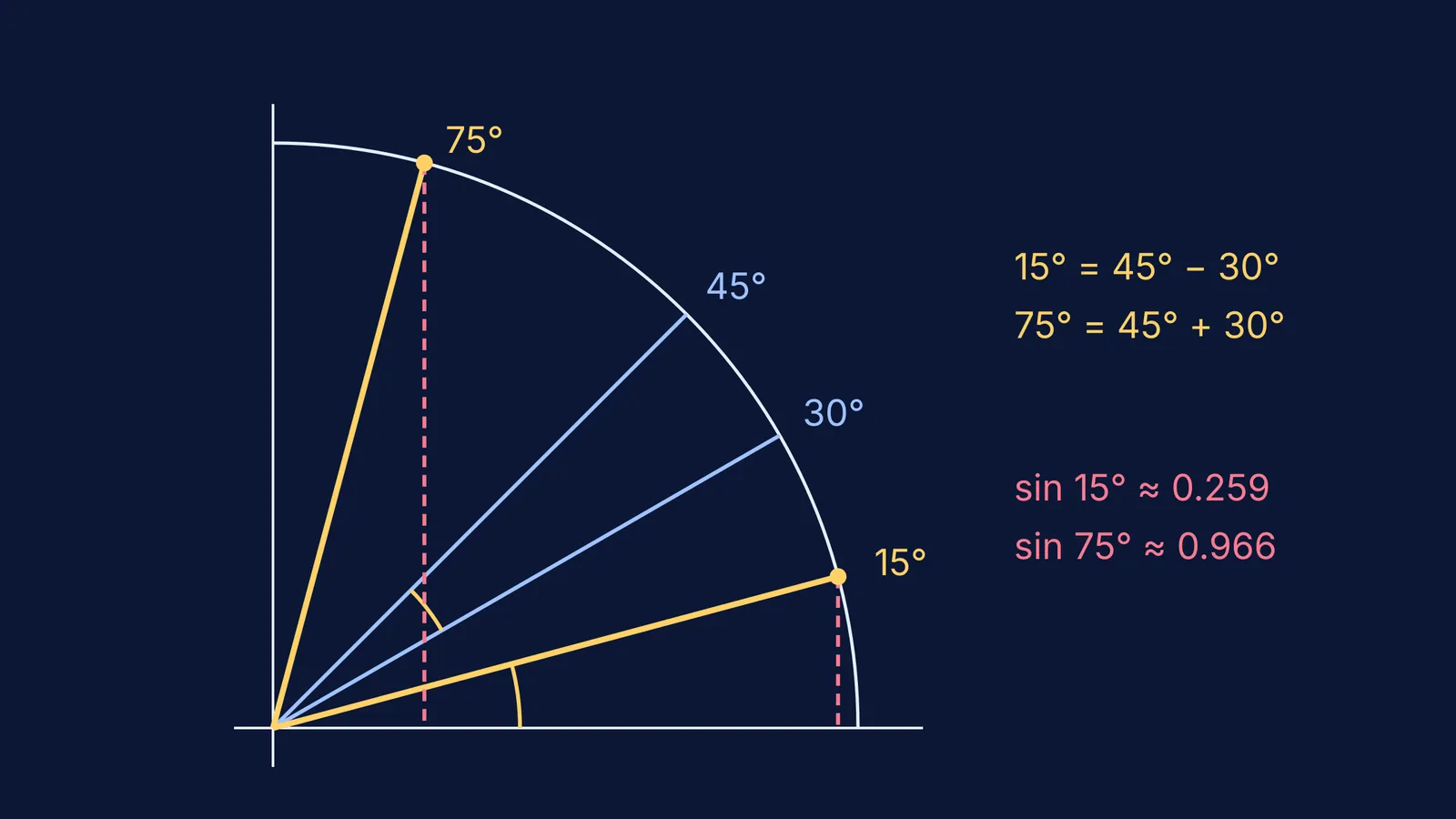
Split: 15° = 45° − 30°.
Apply sin(A − B): sin 15° = sin 45° cos 30° − cos 45° sin 30°.
Substitute: (1/√2)(√3/2) − (1/√2)(1/2) = (√3 − 1)/(2√2).
Tidy if your teacher prefers no root in the denominator: multiply top and bottom by √2 to get (√6 − √2)/4.
This is Example 11 in the NCERT chapter, which reaches the same (√3 − 1)/(2√2).
Check it: (1.732 − 1) ÷ 2.828 ≈ 0.259, just over half of sin 30° = 0.5, which fits.
The same split gives cos 15° = cos 45° cos 30° + sin 45° sin 30° = (√3 + 1)/(2√2), about 0.966. Because sin(90° − x) = cos x, that is also sin 75°. OpenStax works cos 75° from 45° + 30° and gets (√6 − √2)/4, the same number as sin 15°, as it must be.
How do you find tan 75° without a table?
Split: 75° = 45° + 30°.
Apply tan(A + B): (tan 45° + tan 30°)/(1 − tan 45° tan 30°) = (1 + 1/√3)/(1 − 1/√3).
Multiply top and bottom by √3: (√3 + 1)/(√3 − 1).
Rationalise by multiplying top and bottom by (√3 + 1): (4 + 2√3)/2 = 2 + √3.
Decimal check: 2 + 1.732 = 3.732. Tan 60° is about 1.73 and tan climbs steeply towards 90°, so this makes sense.
A second check uses the textbook. On the way to tan 13π/12, Example 12 in the NCERT chapter shows tan π/12 (that is, tan 15°) = 2 − √3. Since 75° = 90° − 15°, tan 75° should equal 1/tan 15°, and (2 + √3)(2 − √3) = 4 − 3 = 1. The two answers agree.
Which split should you use for other angles?
15°: 45° − 30°, or 60° − 45°
75°: 45° + 30°
105°: 60° + 45°
165°: 180° − 15°, then use your 15° result
For 105°: sin 105° = sin 60° cos 45° + cos 60° sin 45° = (√3 + 1)/(2√2), which equals sin 75°, as sin(180° − x) = sin x requires. If the quadrant step trips you up, our guide to allied angles in Class 11 trigonometry covers it.
How do you check the answer with a rough decimal?
Remember √2 ≈ 1.414 and √3 ≈ 1.732, then run this checklist:
Sign: is the angle in a quadrant where this function is positive?
Size: sin 15° must sit between sin 0° = 0 and sin 30° = 0.5.
Pair: sin² + cos² should give 1. For 15°, 0.259² + 0.966² ≈ 1.000.
Reciprocal: tan 75° × tan 15° should give 1.
A common slip is a minus in the middle of cos(45° − 30°). The decimal check catches it: 0.26 is far too small for cos 15°, which must be close to 1.
If you use the right formula but still land on the wrong answer, the Fermi Problem Library has worked problems with a step-by-step solver that explains the reasoning rather than printing an answer. For more practice, try our post on proving trigonometric identities, or see how to find sin 18° and cos 36°, which needs a different trick.
Next time you see 15°, 75° or 105°, split it into 30°, 45° and 60° before you reach for a table.


