On this page
Most Class 10 similarity questions come down to two skills: knowing exactly what each test needs, and naming the triangles in the right order.
What does each similarity criterion need?
The CBSE Mathematics syllabus for 2025-26 lists three similarity criteria in the Class 10 Triangles chapter, all to be stated without proof. The same document gives the Geometry unit 15 of the 80 marks in the Class 10 board paper. In plain words:
AA (also written AAA): two angles of one triangle equal two angles of the other. The third pair then matches on its own, because the angles of every triangle add up to 180°.
SSS: all three pairs of corresponding sides are in the same ratio. No angle check is needed; equal ratios force equal angles.
SAS: one pair of angles is equal, and the two sides that enclose that angle are in the same ratio. The angle must sit between the two sides you compare.
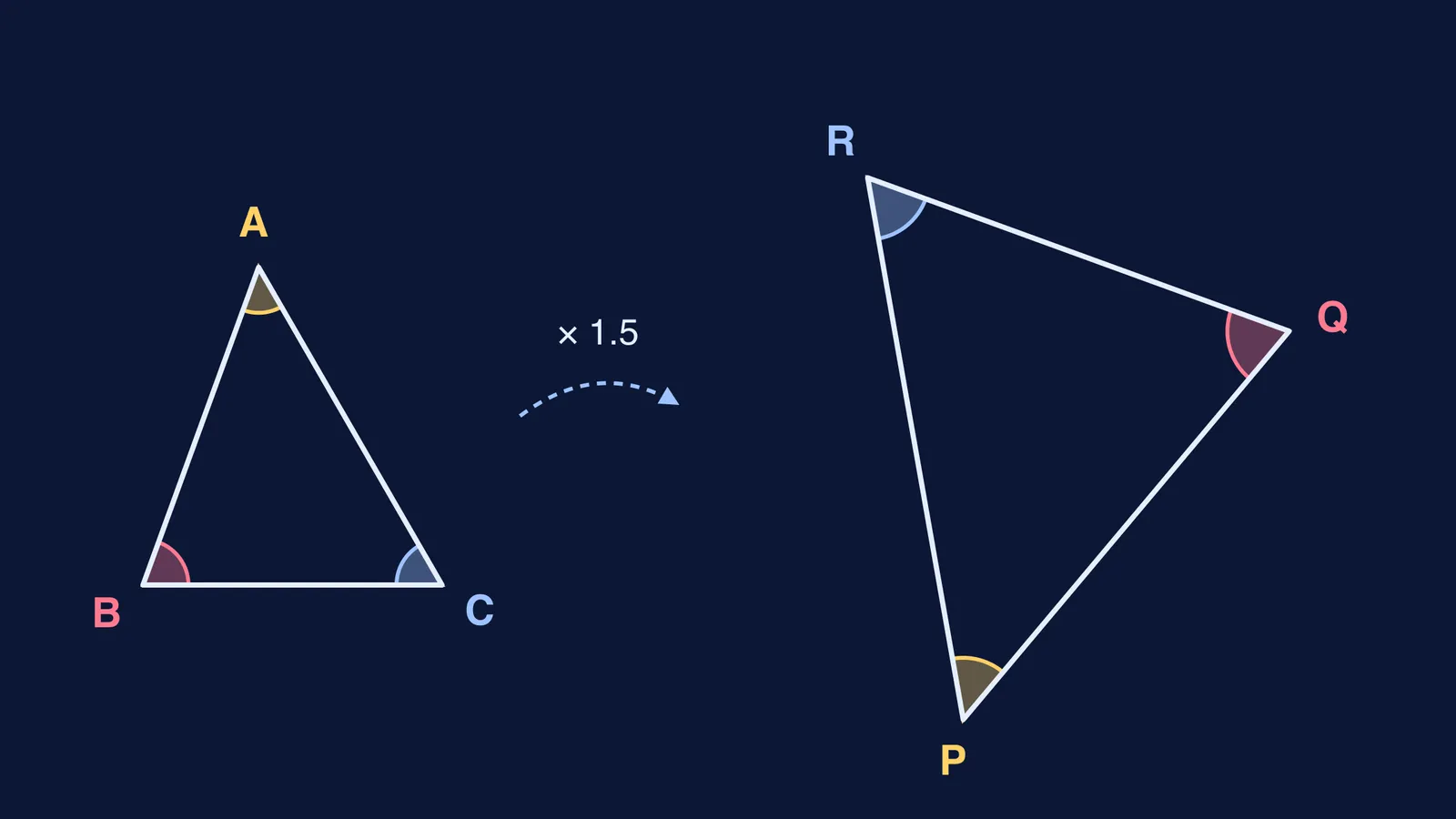
What none of them needs is equal lengths. Similar triangles have the same shape and possibly different sizes, and the common ratio of corresponding sides is called the scale factor. The Wikipedia article on similarity) states the same conditions.
How is similarity different from congruence?
Congruence asks for the same shape and the same size; similarity asks only for the same shape. The CBSE syllabus lists the Class 9 congruence rules as SAS, ASA, SSS and RHS, and expects Class 10 students to work out ways to differentiate between congruent and similar figures. Three differences catch students out:
Congruence SSS and SAS need equal sides. Similarity SSS and SAS need equal ratios of sides.
AAA is not a congruence test. A small and a large equilateral triangle have the same angles but different sides. For similarity, two angles are enough.
Congruent triangles are a special case of similar ones: two congruent shapes are similar with a scale factor of 1, as Wikipedia) puts it.
For the congruence side, see our explainers on what CPCT means and when you can use it and why RHS congruence works only for right triangles.
How do you match corresponding vertices?
Writing ΔABC ~ ΔPQR claims that A matches P, B matches Q and C matches R, in that order. Get the order wrong and every ratio after it is wrong. Match by the criterion you used:
After AA: vertices with equal angles go in the same position.
After SSS: sort each triangle's sides from shortest to longest, pair them, then pair the vertices opposite each pair of sides.
After SAS: the two equal-angle vertices pair first; then the shorter enclosing side pairs with the shorter one.
Worked example: SSS, where the obvious order is wrong
In ΔABC, AB = 4 cm, BC = 6 cm and CA = 5 cm. In ΔPQR, PQ = 9 cm, QR = 7.5 cm and RP = 6 cm. Are they similar, and how should you name them?
Sort the sides. ΔABC: AB = 4, CA = 5, BC = 6. ΔPQR: RP = 6, QR = 7.5, PQ = 9.
Check the ratios: 6/4 = 1.5, 7.5/5 = 1.5 and 9/6 = 1.5. All equal, so the triangles are similar by SSS with scale factor 1.5.
Pair the opposite vertices. Shortest sides AB and RP: C pairs with Q. Middle sides CA and QR: B pairs with P. Longest sides BC and PQ: A pairs with R.
Write the statement in that order: ΔABC ~ ΔRPQ.
Writing ΔABC ~ ΔPQR instead would claim AB/PQ = BC/QR, which is 4/9 against 6/7.5: not equal.
Worked example: AA hidden inside one figure
ΔABC has a right angle at B, and BD is drawn perpendicular to AC. ΔADB and ΔABC share ∠A, and ∠ADB = ∠ABC = 90°, so they are similar by AA. Matching equal angles gives A with A, D with B (the right angles) and B with C. The correct statement is ΔADB ~ ΔABC, which gives AD/AB = AB/AC, so AB² = AD × AC. The same angle-matching idea is how you find a pole's height from its shadow.
What should you check before writing a similarity statement?
Name the criterion, and confirm you have exactly what it needs: two angles, three ratios, or one angle plus the two sides that enclose it.
For SAS, check the angle lies between the two sides you compared.
Order the vertices with the matching rule above, then read each side pair back.
If a rule still feels slippery, the Fermi Concept Library gives every mathematics concept its own lesson. To see where a vertex order went wrong in your own working, the Fermi Problem Library has worked problems with a step-by-step solver that explains the reasoning rather than printing an answer.
Try the SSS example again tomorrow without looking, and check your statement against the read-back rule.